



This essay was published this morning in Inflection Points. You can read the essay on our site, here. The essay has already been covered in the ABC, the AFR and Politico Australia.
By Henry Sherrell & Lachlan Vess
Perhaps the most momentous political catch-cry in modern Australian politics is John Howard’s “we will decide who comes to this country, and the circumstances in which they come”. It is a straightforward expression of national sovereignty, and it has bipartisan instincts. Bob Hawke said much the same. In the 25 years since, it has become a truism of Australian politics that public legitimacy of immigration depends on control.
What is less remarked upon is the truth that underlies the reality of more than three in ten people living in Australia today being born overseas. We do not accept new migrants because we are kindhearted. We accept them because doing so has been good for the country. Australia is a bigger, stronger, richer, and more interesting place—precisely because of immigration.
Today, Australians are losing trust and affection for immigration. This happens in difficult economic times. But we are pouring fuel on that fire with a visa system that is increasingly undermining long-standing Australian economic and social values.
Howard’s rhetoric back in 2001 was accompanied by a structural change in Australia’s visa system, one where the government ceded control to vested interests who have increasingly crowded out the national interest. This structural change was accompanied by a regime of lax enforcement and temporary visas which today, per the 2023 Parkinson Review of the Migration System, “undermines our democratic resilience and social cohesion” by creating a class of “permanently temporary” workers, the existence of which undermines institutions like the minimum wage and citizenship.
To win back a public sceptical on migration, we must improve our nation’s visa system. Globally, immigration is the catalyst for this populist era. Without immigration, today’s populists would be impotent. To some, this reality has meant simply ignoring the topic, and attempting to elevate other issues in order to dominate the public debate. This approach is failing. Keeping our heads in the sand will only delay the inevitable backlash, and if anything will likely make that backlash worse.
A quiet, managerial response to one of the defining political issues of the era—a few tweaks and some sentimental rhetoric—will do little to win hearts and minds. The days of quiet bipartisanship are gone. Australia is not Europe, nor are we the United States. Our connection to immigration is different, it is deeper and stronger. We owe it to ourselves to get these policies right.
Little here is easy: the immigration system is complex and the trade-offs are sharp. The social, economic, and political risks of change are genuine but pale in comparison to the stakes for our society. When Australia gets immigration right, our nation becomes more productive, more vibrant, and more wealthy. But if widespread scepticism to immigration morphs into entrenched resentment, it will open up a social fracture impossible to bridge.
Instead of ignoring the problem—or worse, condescending to those who mention it—those of us who support immigration must express a confident alternative to the status quo, one that is based on our nation’s liberal values, and confronts the real problems within the migration system without reflexively reaching for nasty, brutal ways to treat people.
Public support for immigration is dwindling
An increasing number of Australians think too many people are coming to our shores, the highest share since the visa system was overhauled by the Howard government.
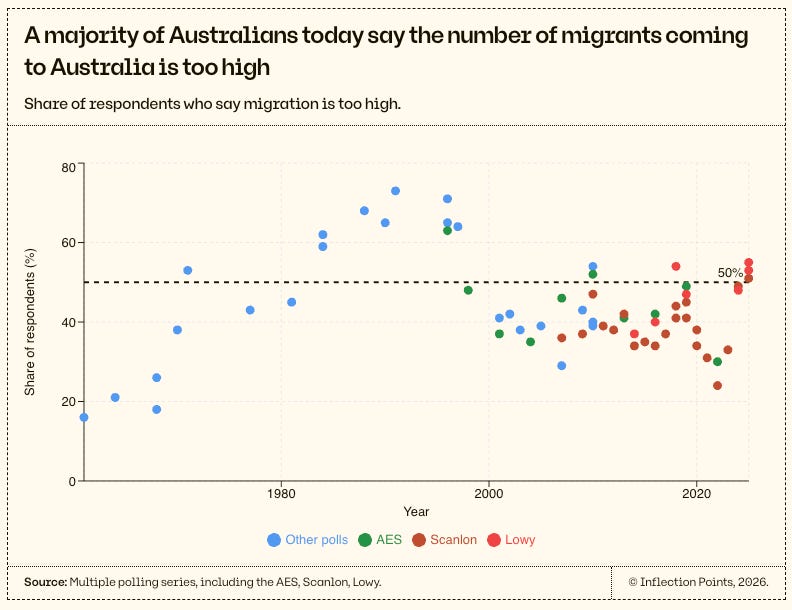
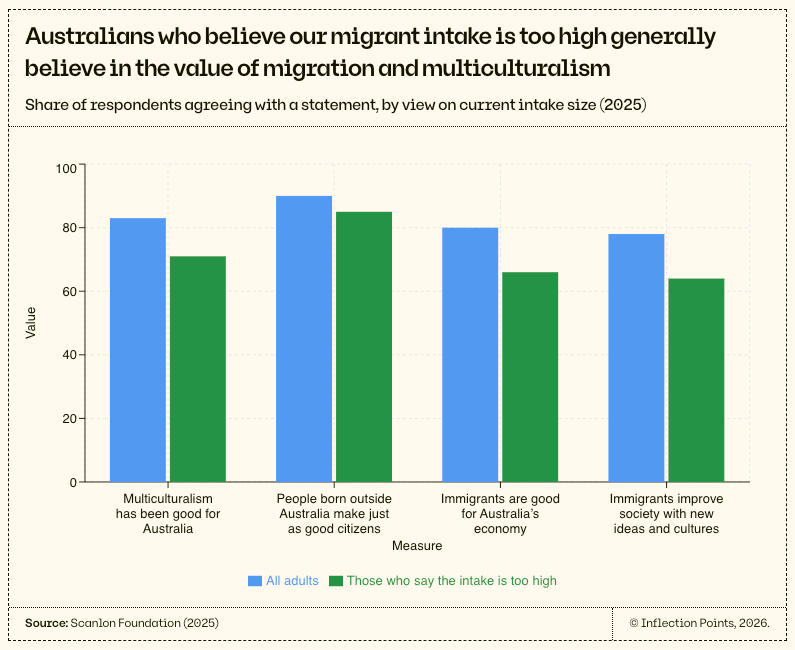
These people are not racist. A full 46% of overseas-born Australians say that immigration is too high. They are making a judgement about the pace of immigration and whether the system is working for them. We know this, because the very same people who say the rate of migration is too high also by and large believe multiculturalism has been good for Australia. Nine in ten Australians believe people born outside Australia make just as good citizens as those born here.
Of course, a small number of Australians hold discriminatory views. Just one in five support discriminating against others based on their ethnicity. This belief cuts against our country’s egalitarian aspiration and is rightly rejected by the bulk of Australians.
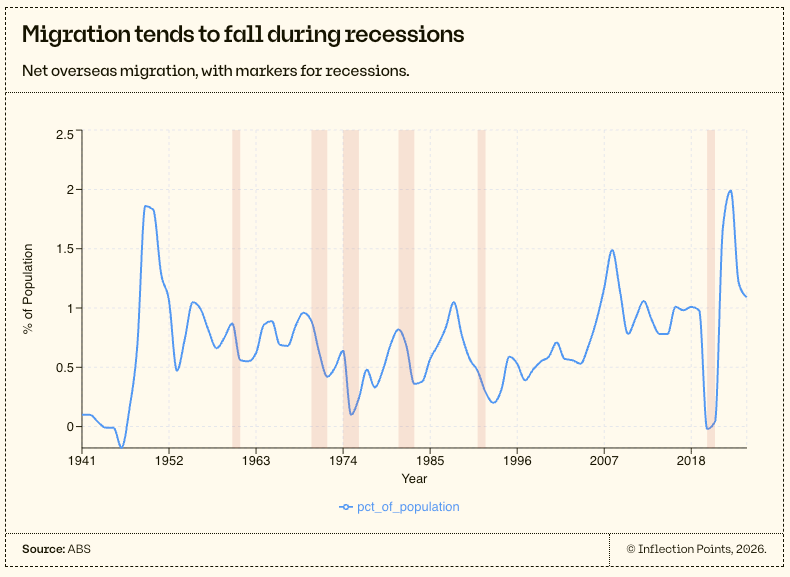
Rather than racism, then, it is predominantly material economic factors that shape public attitudes to immigration. In times of full employment and rising living standards, public attitudes tend to be more expansive and welcoming. The post-war era of mass migration to Australia occurred in a time of economic opportunity. In every recession since, the pace of immigration has fallen—sometimes through government intervention, and sometimes because migrants stopped coming. Since 2006, immigration has been above one per cent of the population multiple times, compared to twice in the fifty years prior to that. Large, uncontrolled spikes in growth sap public trust.
The public debate in Australia on immigration should be big and it should be open. That will mean stomaching—and often rejecting—some ugly sentiment on occasion. We should listen, engage constructively, speak where we must, and state plainly our values. But the debate must occur in earnest. The first step to solving a problem is admitting there is one. And that will require supporters of immigration not just to defend it in principle, but also to admit that our migration system has problems, and that there are genuine ways to improve it.
Immigration policy needs clear aims
The starting point is to broadly agree on a common goal for immigration policy: to make the lives of Australians better.
An open public debate can help us collectively decide how many people come to Australia and who they are. No matter the volume of modelling undertaken by Treasury, Home Affairs or think tanks, the nature of these choices will remain political. We should never delegate them to bureaucrats, independent experts, or third parties who seek to control the visa system. We need politicians.
The Albanese Government’s Migration Strategy, released in late 2023, outlined a set of objectives, including increasing living standards for Australians. But the Strategy left unanswered the questions of who an Australian is and how much immigration Australia should have. That was a mistake.
Immigration policy should benefit Australians first
We believe Australians are citizens and permanent residents. People who hold a temporary visa are not Australians, but the longer someone stays here, the more we owe them some consideration of their circumstances.1
The visa system should pick people deliberately, across all parts of the system, to benefit Australians. This principle has underpinned most migration policy throughout Australian history, if only implicitly. Many of those arriving in Australia in the wake of World War Two were chosen because they were young, single, and healthy. Older, destitute-looking refugees were screened out. Australia has never welcomed ‘huddled masses’ as a benevolent act. We have never said, as the Emma Lazarus poem at the base of the Statue of Liberty goes, ‘Give me your tired, your poor…’. Australia has welcomed displaced people throughout history insofar as it has served our interests.2
This central principle of prioritising Australians over non-Australians means increasing living standards of Australians. Immigration should improve our ability to build and produce, including healthcare and education, as well as housing construction and major public works.3 One of our nation’s most significant public works projects, the original Snowy Hydro, was built largely by migrants from more than 30 countries.
We should use the Budget to spread the gains of immigration across society. Australia has an immigration system that contributes more in government revenue than is spent on support. To sweeten this bargain further, in the most recent Budget, the Albanese Government increased visa fees, leading to an increase in government revenue in the billions. This should be celebrated as a downpayment on the aged pension and Medicare. But there is more work required to generate additional public benefit over and above private enrichment.
Immigration policy should balance costs and benefits
Even though Australia does reap a general benefit from the migrants we select, there remain specific costs for us to still contend with. The foremost of these is housing costs.
One practical consequence of higher migration is greater demand for housing. This should be uncontroversial. In a well-functioning market, housing supply responds to this demand, providing more housing and softening the impact on costs. But in the past half-decade of serious economic headwinds, supply responses have been their most lethargic while immigration has been its highest.
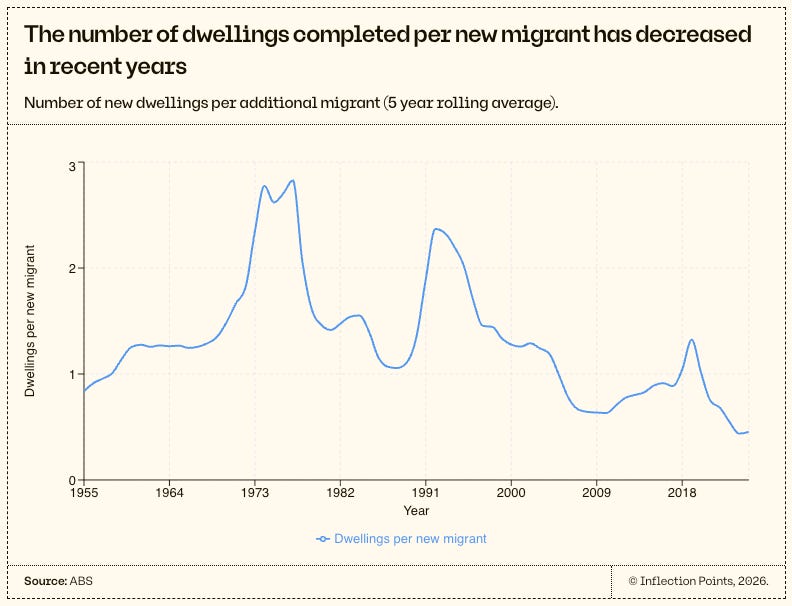
The current state of the housing market has meant that the cost of migration to those in the rental market or looking to buy a home is bigger than it would be in a more supply-elastic market. At the moment, this cost has become visible to many Australians in the form of higher rents and house prices. The benefits, meanwhile, are far less evident in the day-to-day. Estimates from the Australian housing literature indicate a 1% increase in adult population increases rents by nearly 3% over time.4 This is small compared to the broader run-up in housing costs, though it still adds up.
Improving housing supply should be the main game to deal with these effects. But even a well-functioning housing market will struggle to respond to sharp, unplanned spikes in population growth, which is why we must ensure the system is better-equipped to avoid unplanned spikes in the first place.
Immigration policy should keep growth below one percent
Australia’s abiding principle of self-interest has enabled us to be a high-immigration country throughout our history.
That said, our nation’s tolerance of migration is by no means without limit. We believe a one per cent rate of population growth per year due to immigration is the ceiling for Australian society, beyond which the costs grow quickly and political support wilts.5
There is no science to this figure; it is an estimate based on historical observations. It is a high figure compared to almost every other liberal democracy, and broadly comparable to the Australian post-war average, and well below the post-war peak.6
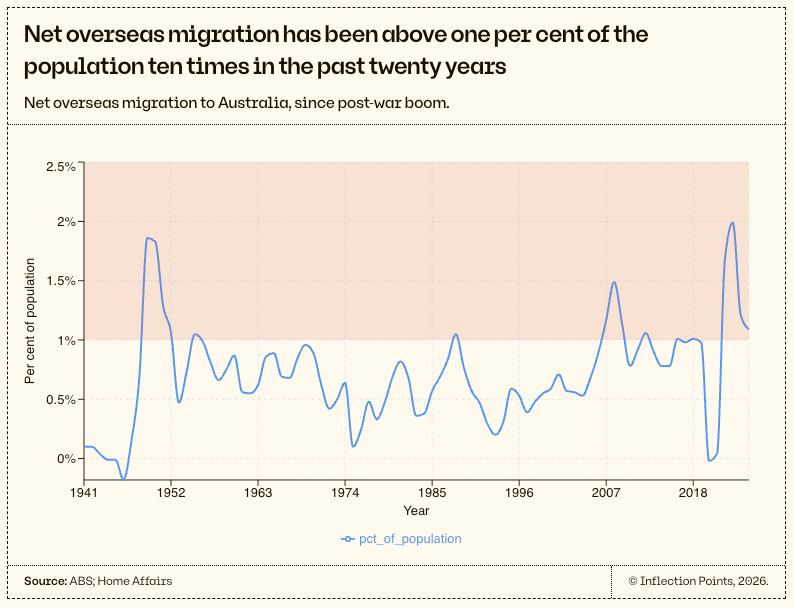
We are currently above this ceiling and must figure out how to get below. To do this, we must begin by understanding how our current visa policy actually impacts net overseas migration figures. We can get most of the way there with an approximation: permanent visa grants plus the change in the population of temporary visa holders.
It’s not a perfect match, and there is residual—but this is a useful way of thinking about controlling the controllables with our migration policy toolkit.7 This will prove an important framework for thinking about the tradeoffs that a one per cent ceiling will require us to make.
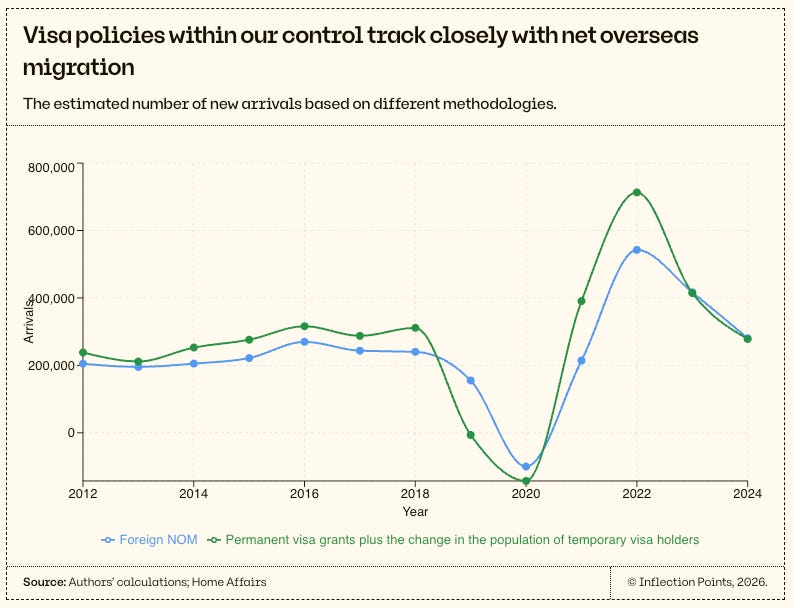
Reasonable people can disagree on the maximum rate of immigration and we would be better served if more people were willing to wade into this question. The Parkinson Review recommended a target with upper and lower bounds. We believe a one per cent upper bound is as good a starting place as any.
Further, when people are doing it tough, immigration should be reduced from this ceiling, depending on the severity and context.8 The Albanese Government’s Budget forecasts a rate of about 0.9 per cent in 2026-27, falling to 0.8 in 2027-28 onwards, which strikes us as about right. The important thing now is meeting those forecasts and working to create a system that precludes a jump above 1% again.
Targets can be a useful tool for policy making. They set expectations both within the public and within the machinery of government, helping to guide both expectations and decisions by requiring people to make explicit tradeoffs. An explicit targeted ceiling on migration would enable a multi-year planned approach to migration reform, providing a clear signal to those with a stake in the visa system—particularly state governments, employers, and Australian citizens who want to live with their partners and children.9 At the moment, the system works on a year-to-year basis, which prioritises short-term flexibility over an ability to plan and shape with certainty. Right now, Australians are demanding certainty, and we believe the system should give it to them.
Improving immigration enforcement to promote public confidence
Immigration enforcement is necessary, and often traumatic. Rules need to be followed. It doesn’t matter what the rules are if there are no consequences for those who break them. At the same time, if we ignore the context of people’s lives when enforcing the system, our values will buckle under the weight of public outrage.
Australia is the liberal world’s leading country for enforcing the rules of its visa system. Our geographic good fortune, combined with long-held policy positions and a willingness to spend money, has given us an enforcement regime with strong foundations.
Unlike many other liberal democracies, Australia has few illegal arrivals. Boats carrying people without visas are turned back, and a life in Australia is not an option for people who seek to arrive this way. People arriving by plane almost universally have a valid visa.
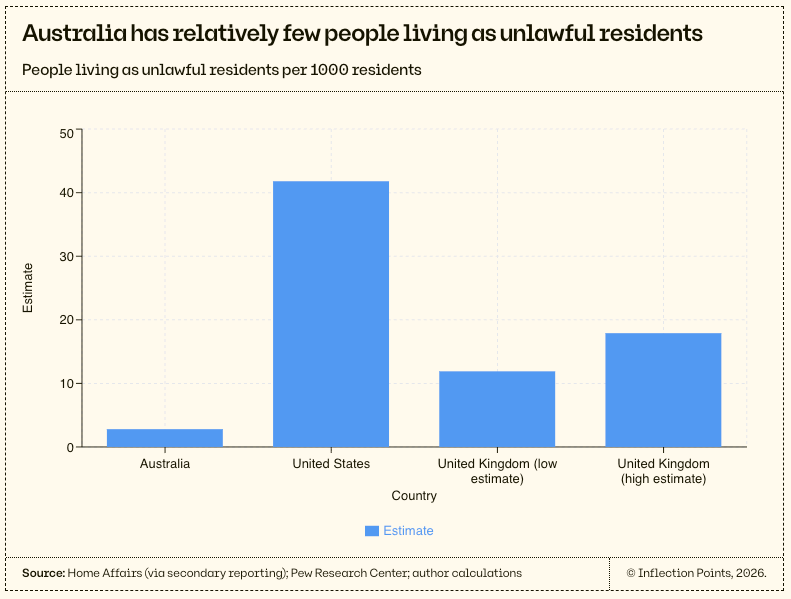
Australia has a tiny share of people living as unlawful residents, at less than 3 in 1,000 people. Compare this to about 40 in 1,000 people in the United States, or even the UK, where the rate is about four times as high as ours, and we are a clear outlier. As a share of the population, we have fewer unlawful residents today than we did in the 1980s.
Further, we have some of the strictest rules in the world concerning visa cancellation. Those sentenced to 12 months in jail automatically lose their visa, regardless of how long they have lived in Australia.10
All of this is eye-wateringly expensive. Border enforcement activities cost taxpayers $1.6 billion in 2025-26. Compliance and detention cost an additional $1.2 billion. This excludes offshore detention, another $970 million. And at the moment, there is no additional capacity in immigration detention, and the average period of stay is longer than 440 days. More than a third of people in immigration detention have been detained longer than one year.
Australian Border Force staffing should prioritise work that helps people leave. Obtaining travel documents, passports, and engagement with detained people requires time and resourcing. When people in prison have concluded their sentence and their visa has been cancelled, these people should head from ‘prison to plane’, instead of being detained in a detention centre for weeks, if not months, while paperwork holds up movement. This should be tracked and measured.
For the officials on the front line, this is hard yakka, intensive and risky work. Among the more difficult tasks facing migration officials is the separation of malice from inadvertent mistakes. It is clear that deliberate rulebreakers should be removed from Australia. Most Australians would agree we should detain and deport a convicted murderer if they are not an Australian citizen.11
But as we drift from the worst offenses, there is less consensus about what to do. Should a grandmother living in Australia illegally for decades be returned to her country of birth? Should Australian-born citizens be deprived of a parent who is a non-violent offender? These everyday situations reflect the difficult job of enforcing the rules.
We do not need a Border Force official on every corner. But we do need real, practical alternatives to chasing people on expired visas across empty paddocks. These are just a few.
Ask first, then force people to leave
To achieve a one per cent rate of net overseas migration, we need more people to leave Australia voluntarily when they have no pathway to stay. They will not choose to do this unless they have incentive to. It is a hard slog to get people to leave Australia against their will, not least because of how great a place it is to live.
Instead of forcing people to leave as the starting point, we should ask people to leave and give them better reasons to do so.
One barrier for people choosing to leave is that those who have overstayed their visa are often subject to ‘re-entry bans’ where they are unable to make another visa application to enter Australia. We should soften this approach for those who leave willingly, and allow them to make another visa application, so long as it’s done from outside Australia. This would not cost anything and is not a security risk because the person is outside the country. But it would make it substantially more attractive to choose to leave Australia in the first place.
Further, the Departing Australia Superannuation Payment, or DASP, which is a tax on super balances ranging from 35% to 65% payable by those departing permanently, should be waived for those who leave by choice upon visa expiry. The chance at a new visa application, as well as access to untaxed superannuation deposits, helps make leaving Australia a more attractive choice than remaining in the shadows.
Australia already operates a ‘Return and Reintegration Assistance Program’, which arranges voluntary exits for those in detention or with no pathway to residency. Yet the program is contracted out and focuses on ‘in-kind’ support, instead of cash incentives. We should get over this aversion to giving people money, and make the choice more appealing. A cash payment upon return to another country of $20,000 to $30,000 would be significantly more attractive compared to a program of in-kind assistance delivered via third parties contracted to the Department of Home Affairs.
Many Australians will think that it is unfair to spend taxpayer dollars helping non-citizens to leave Australia. But this funding is comparatively cheap compared to endless weeks spent in immigration detention.12 And it is more compassionate too.
Too often, ideas like these are ignored or even ridiculed for being too soft on those who do not comply with visa rules. Yet any policy designed to remove people from Australia needs a credible way of working in the real world. Our persistent disregard for better approaches to actually getting people to move out of Australia means the system flounders at capacity, moving slowly, and preventing immigration enforcement work from occurring.
Getting serious about forcing people to leave
Australia already prioritises deporting serious criminals. For other people who refuse to leave voluntarily, the Federal government should be willing to use new legislative tools in a selective manner.
Only a small number of countries refuse to accept non-voluntary returns of their own citizens, meaning these citizens in Australia are able to wait it out indefinitely. It is much more common for countries to drag their feet, refusing to issue travel documents in order to prevent people from leaving Australia, making the process of forcibly deporting someone a lengthy and costly process.
The Federal government should actively seek to ensure these countries work with us. In 2024, the Parliament passed the Migration Amendment (Removal and Other Measures) Bill. The Minister for Immigration can now designate a “removal concern” country. This allows the Australian government to prevent citizens from that country from applying for visas. This power has yet to be used by the Albanese Government. This instrument should be invoked in a targeted manner, aimed for example at government officials in the first instance, similar to how other targeted sanctions operate in the foreign policy context.13
Dealing with asylum applications
Australia is a country with longstanding commitments to the Refugee Convention, but is also seen by many as an international pariah. Written in the aftermath of World War Two and amended in the 1960s, the Convention is simultaneously a historical artefact from a different era and one of the deepest expressions of international liberal values.
The Convention prevents signatory states from returning people to their home if they have a well-founded fear of persecution, and provides a baseline set of rights to those people. Australia, through programs like offshore processing and boat turnbacks, has been at the forefront of pushing the bounds of contemporary asylum policy norms. We have walked away from central parts of the post-war framework, without working with others to find a new set of global processes suitable to the 21st century.
It should be a major priority for Australia to coordinate with other interested countries, both liberal democracies and strong regional actors, in our own national interest. Globally, we are approaching a tipping point, beyond which we will be left with few international norms on asylum. Reforming multilateral agreements is hard and uncertain work—and yet it grows more necessary with each passing year. Australia is well-placed to lead and agitate for a more appropriate set of rules for our era.14
Clearing the Administrative Review Tribunal backlog
The costs of muddling through with the status quo will grow over time. Australia’s asylum system is already under extreme pressure, which is spilling over to the rest of the visa system. Those who do not want to leave Australia can, as a last resort, apply for asylum regardless of their actual circumstances. This buys them more time in Australia, as an asylum application rejected by the Department of Home Affairs is then appealed to the Administrative Review Tribunal (ART) and increasingly to the Federal Court.
This is happening in ever-larger numbers. There are currently over 100,000 people who have been rejected for asylum but who remain in Australia.
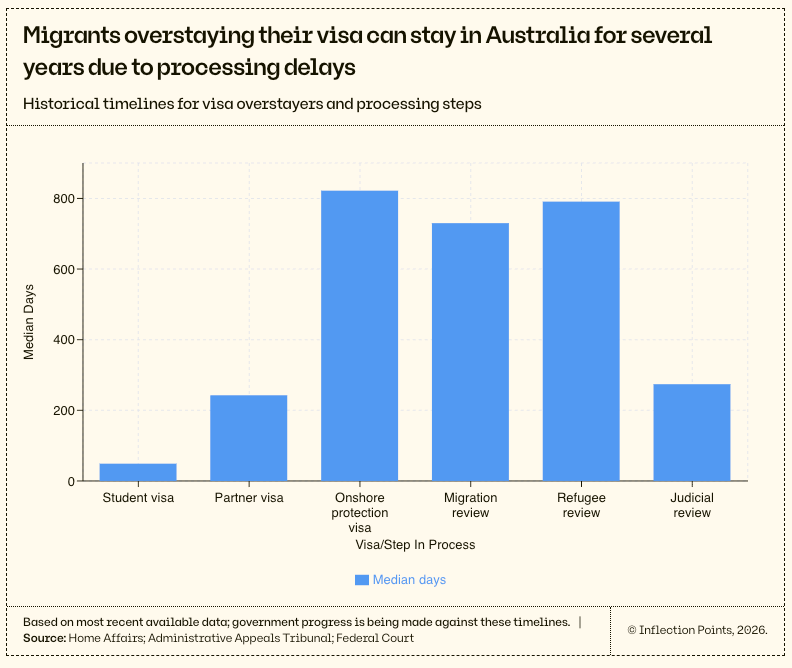
The Albanese Government has directed more funding in an attempt to speed up how these applications are decided and reviewed. Quicker decisions reduce the appeal of lodging bogus applications. Applications recently submitted are assessed first, preventing long waits for people looking for more time.This appears to be working, with the number of protection visa applications decreasing from 2,400 in March 2024 to about 1,800 in recent months.
In 2024-25, for the first time in several years, the number of decisions made by the bureaucracy outweighed the number of applications, pushing down the backlog. Unfortunately, under the current system this simply shunts applications into appeals faster.
Addressing this requires us to pursue several policy options at once. An active, hands-on approach should be introduced in order to work with people who have no pathway to remain in Australia, and convince them that they should leave. As above, incentives such as the DASP payment and the removal of barriers for future visa applications should be promoted.
Given the scale of the problem, there is a sound argument to better streamline and fast-track decisions. In many cases, this will mean removing oral hearings and deciding appeals on the papers—an approach recently introduced for student visa appeals at the Administrative Review Tribunal. The ART will need to assess applications in a ‘last in, first out’ manner, removing the incentive to appeal. Further triaging, with routing on the basis of complexity, will also help. Here, we should learn from the mistakes of the recently abolished Immigration Assessment Authority—which removed procedural safeguards while also increasing processing times by clogging up judicial review—and from the successes of jurisdictions such as Switzerland, which shrank average processing times from almost four years to under four months.
If progress cannot be made using these tools and management, more sweeping changes should be considered, such as limiting appeals and introducing new Federal Court powers to more easily remove baseless claims, without overwhelming the courts as the IAA did. But most importantly we should be loath to introduce forms of deterrence that won’t shift how people behave, such as removing the right to work while an appeal is being heard. This will simply push more people into the cash economy and toward being undocumented. Almost every country tries this approach and it never works. We should not be seduced by the false promises of seemingly simple solutions.
Employers should be punished for exploiting workers
Migrants get most of the attention when it comes to immigration enforcement. But far too many employers are benefitting from and getting away with the mistreatment and exploitation of migrant workers.
There are thousands of employers permitted to sponsor different categories of migrant workers. Many more employers hire people who don’t require sponsorship, like international students or backpackers. Yet in 2024-25, employers across Australia attracted fewer than 100 total sanctions from immigration authorities.
This lack of enforcement has created a business model in Australia: underpay workers on temporary visas, offer low prices to customers, squeeze your competitors, and steal market share while driving down standards. Rinse and repeat. Cleaners, fruit pickers, security guards, delivery drivers, restaurant staff, retail work, construction site labourers. Employers disproportionately hire people on temporary visas to do these jobs, many of whom will never speak up about mistreatment due to their visa status. It isn’t hard to imagine that this exploitation of migrant workers could perhaps be the major factor placing downward pressure on Australia’s local wages and work conditions.
The Migration Act criminalises employer mistreatment of migrant workers and outlines a host of obligations and regulations for employers. The Fair Work Act maintains a strong set of minimum standards. Most employers try to do the right thing but it’s very hard to compete against those who ignore the law.
In 2024, Parliament passed legislation for new powers to tackle exploitative treatment of migrants. For the first time, employers can be prohibited from hiring any worker on a temporary visa if they have previously been penalised by immigration authorities or in the Federal Court.
In over two years, this power has been used on just one occasion. A single Italian deli has been penalised despite hundreds of sponsorship sanctions occurring since July 2024 when the law commenced. This apathy towards enforcement is almost an invitation to exploit workers. Prohibiting already sanctioned exploitative employers would demonstrate the government doesn’t just want to increase the minimum wage, it wants to protect it.
Most worryingly, new criminal penalties have yet to be prosecuted. Bringing a criminal case is not straightforward. It requires significant legwork and careful preparation. However the Department of Home Affairs has one of the largest legal operations in the country, with hundreds of lawyers working in the legal division, overseeing many thousands of individual cases in the Federal Court at any one point in time.
More funding would help more enforcement. Recognising the fiscal crunch, the Department of Home Affairs should be able to keep any revenue raised from employer fines and penalties. This would create an incentive to enforce the law, target employers who do the wrong thing, and generate a self-reinforcing cycle where more enforcement activities would generate additional funding.
Improving migrant selection to make Australia wealthy
Clearer goals, more effective rules, and improved enforcement are just the first steps to a well-functioning and sustainable immigration system. They are necessary, but not sufficient.
In a system where migration growth is limited to 1 per cent—or any other binding growth rate—trade-offs become real. Each visa given to a migrant has a clear opportunity cost: the other potential migrant we could have selected. A regional visa for a chef to work in Ballarat means one less employer-sponsored visa for a civil engineer in Melbourne.
The stakes of this one visa decision is around $300,000 of fiscal benefit to Australian taxpayers. And across 205,000 permanent visas granted a year, these single decisions add up. Who we select and how is the crucial determiner of how much benefit Australians receive from migration.
There are too many people living on temporary visas
Today, there are too many people living in Australia on temporary visas. As at June 2026, there were almost 3 million people in Australia who held a temporary visa.
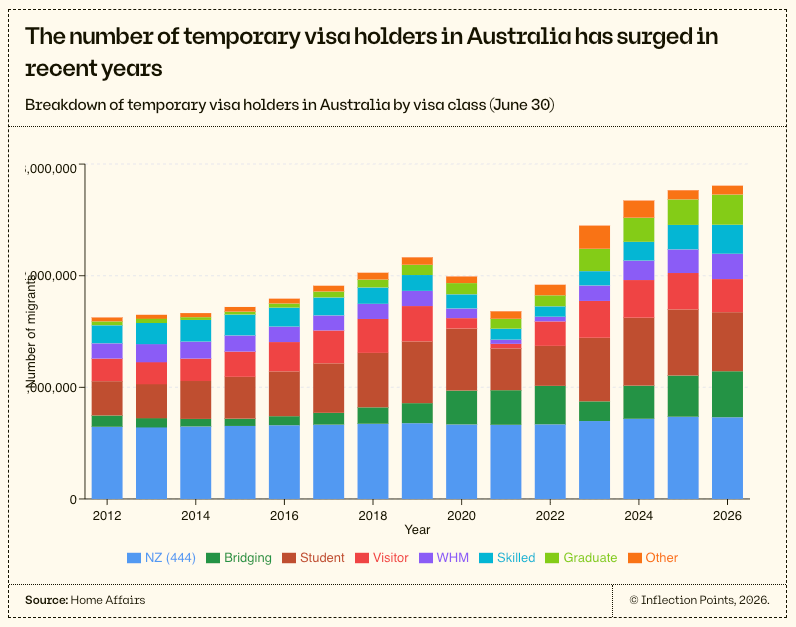
International students, temporary graduates, skilled workers, backpackers, and people in limbo now make up 1.7 million people in Australia compared to 830,000 ten years ago, an increase from 3.4 per cent of Australia’s population to about 6.1 per cent.15
This change has been particularly concentrated among younger age groups, with the potential for profound effects. We estimate that around 28% of all 25-29 year old females and 33% of similar aged males in Australia were on temporary visas in 2025.
This change has been particularly concentrated among younger age groups, with the potential for profound effects. We estimate that around 28% of all 25-29 year old females and 33% of similar aged males in Australia were on temporary visas in 2025.16 This temporariness and uncertainty makes it hard for migrants to make concrete life decisions.
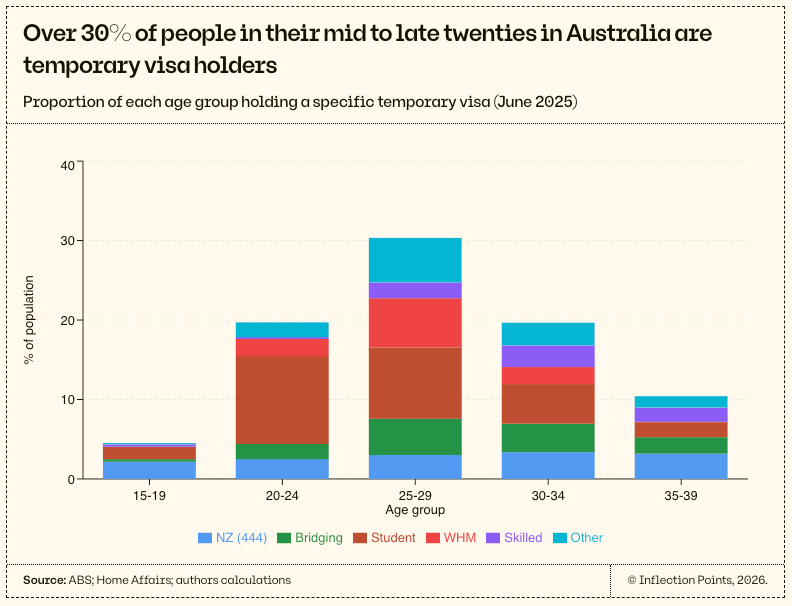
This is the “permanently temporary” cohort highlighted by the Parkinson Review, and it’s a larger cohort than most Australians would expect. This long-term temporariness is driven by a fundamental mismatch between the number of temporary migrants and the number of permanent visas available. We are becoming a less egalitarian country by one of the most important metrics. This comes with large economic and social costs both to migrants and to Australians.
The end of “permanently temporary”
The starting point should be an active decision made by the government as to how long is too long to spend on temporary visas. At the moment, many appear to agree people should not hold temporary visas for an indefinite period of time but few suggest specifics to prevent it happening.
We suggest eight years. This is a period of time long enough to undertake study and work in Australia, without being so long that people’s entire lives are shaped by their time here. Prior to the pandemic, around 80% of international students and 90% of temporary skilled migrants left Australia or transitioned to a permanent visa after 8 years.
Given the scope of this change, Parliament should define these rules in the Migration Act. It may be possible to use the Migration Regulations, creating a new application criteria that explicitly states how many years people can be in Australia.
This would provide a firm legal deadline for the transition from a temporary visa to a permanent visa, or to leave Australia. It would affirm that Australians value and prioritise long-term community over short-term extraction.
This major change to our nation’s visa system will demonstrate two things.
First, to Australians, it will show the government is not interested in an ever larger group of people living in Australia but not as Australians.
Second, to prospective migrants, it will show they have a defined period of time to live here on temporary visas. For some, this would result in heartbreak, as they may be forced to leave Australia after making the most of their time here. This not-insignificant cost to individuals is worth bearing for the sake of the system as a whole, to better recognise Australians’ preference for permanent residency.
We should select skilled migrants based on wages, not perceived ‘need’
The Australian migration system is considered ‘well-targeted’ by the standards of many of our peer nations. This relative success is driven by skilled visas, which are about two-thirds of permanent visas granted.17 Compared to Australians of the same age, skilled migrants typically earn more.
But this doesn’t mean we’re doing as well as we could be. Australia is an attractive destination for migrants and has an enforceable border. If we are serious about a one per cent ceiling for immigration, each visa issued has an opportunity cost, requiring us to prioritise migrants who improve Australians’ lives the most.
Our current approach to selecting skilled migrants is occupation-centric. The idea is that we identify skills we are short on, or that we think we will need more of in future, and then we match our migrant intake to that. This sounds sensible in theory—if we have a ‘need’ then we should fill it. But in practice this is not so straightforward.
For starters, it is very difficult to define ‘need’. Different sectors of the economy need different kinds of workers—from healthcare workers, to builders, to engineers. Predicting future needs is even harder, because they are highly influenced by trends in domestic education and global technology. The rise of AI may mean we need fewer programmers than we thought two years ago. Or we might need more. We simply don’t know.
The sum total of these many needs has resulted in lists of eligible occupations in the hundreds. And once on the list, a profession rarely comes off: accountants, for instance, have been on various skilled occupation lists for most of the last two decades. We are targeting poorly.
And then there is the biggest failure of our occupation-centric approach: only around 30-40 per cent of points-tested migrants are employed in their nominated occupation. Even if Australia accurately defines an occupation as in need and selects someone in this occupation, there is no guarantee they will actually work in that occupation. There is no guarantee a given ‘need’ will actually be met.
This system of ‘needs-based’ guesswork has failed. But there is an alternative: a wage-based system, where we enable the market, rather than vested interests and bureaucrats, to determine who the highest-value migrants are.
The amount an employer will pay for someone’s skills is the strongest predictor of their future income, and is a decent proxy for worker productivity. And higher incomes increase the ability to improve the lives of Australians through higher net fiscal contributions. It’s as good a measure of economic value as we have.
Employers are also best placed to pick people for jobs. While two civil engineers may look similar on paper to a bureaucrat, the engineering company is best-placed to discern which engineer has the actual skills the company is lacking.
Minimum wage floors are already used for employer-sponsored temporary skilled visas. But we should rely on them here even more, by removing the haphazard occupation lists and using a re-calibrated, higher, wage floor. It is currently set at around $79,500, similar to the average Australian worker’s earnings. We recommend the temporary skilled work visa should be set at $109,000, the average rate for full-time earnings, and indexed to average weekly earnings.18
Targeting higher wages has two additional potential benefits. There is a potential distributional benefit—with labour market effects felt mostly by the workers on the highest incomes—which in turn has a potential, though mild, deflationary benefit—lowering prices to access labour-intensive specialist workers like as doctors, dentists, barristers, vets, and the like.
Employers should use the temporary skilled visa as the main way to fill a job. With the higher wage threshold, the process should be allowed to operate quickly and efficiently. Permanent skilled visas should reflect similar settings, allowing workers who are sponsored by employers a straightforward transition from a temporary visa to a permanent visa. Occupation lists for these permanent visas could then also be removed.
A wage floor of $109,000 and eliminating occupation lists would have substantial effects on the skilled visa program. This is by design.
Some occupations and industries that rely on the skilled migration system will be cut-out under a higher wage floor. For example, the most common occupation sponsored by employers is chef, often nominated with a salary at the current minimum threshold. We’d expect much fewer sponsored chefs under our proposal. But the fact these chefs are paid less suggests that Australians are not getting the most value out of these visa spots.
We believe that many more high-wage jobs would be sponsored if it was introduced with a suite of deregulatory changes that make it more straightforward to sponsor workers. Formal obligations should be stripped back and fees waived.
A high wage floor also provides a strong proxy for better-behaved employers, meaning that sponsorship would come with less risk of exploitation. At the moment, visa rules have a lowest-common-denominator approach, regulating as if every employer has a high potential of exploiting or mistreating their workers.19
Employers wear large costs and uncertainty from this, preventing many from sponsoring migrants into high-wage jobs. We should make it easier for well-behaved, high-paying firms to bring in the workers they genuinely need.
A more compelling concern with a higher wage floor may be that it precludes essential services workers, particularly in industries where the government has a role in suppressing wage growth, such as nursing.
However, as is the case with many occupations, nurse wages in Australia range substantially. The minimum annual base salary is about $70,000 for a first year registered nurse. However the award rate is not the market rate. Jobs and Skills Australia suggests the annual median earnings of a Registered Nurse is about $114,000, meaning employers will still be able to sponsor experienced nurses.20
Others may raise concerns about low-wage jobs in industries viewed as critical, like aged care and child care. This is where Australia should hold the line. A strong lesson from migration policy across the world is these low-wage jobs are very difficult to match up to employer sponsored visa pathways. Australia’s migration system already plays a role in these sectors outside of skilled visa streams. Spouses of skilled migrants, partners of Australian residents, and refugees all play a disproportionate role in these jobs. And critically, these people are not tied to single employers, allowing them a degree of mobility, and a safety net that makes them less likely to be exploited.
Australia needs to hold the line and promote a visa system that is primarily about higher wage jobs, and leave employers and jobs and workers to sort themselves out without a heavy handed set of visa-based rules and directions.
Permanent visas should prioritise employer-sponsored skilled migration
When it comes to selecting the migrants with the highest net economic contribution, employers are best placed to pick. Treasury estimates that employer-sponsored migrants make a net Budget contribution more than 40 per cent higher than the next best performing skilled visa and around double that of migrants who are picked by State governments.21
The recently announced 2026-27 permanent migration planning levels are a step in the right direction, with employer sponsored permanent visas increasing from 24 per cent to 31 per cent. But even with a higher number, the waiting times remain substantial: over a year from applying for the visa to having it assessed. As this visa is the best we have for economic results, we should work to reduce the waiting time to less than three months, restoring faith in the system for employers and workers alike.
To achieve this, the regional visa stream should be further reduced, with these places allocated to the employer-sponsored stream. These visas are state government led and largely ineffectual in retaining migrants in actual regional Australia. Earnings for these migrants are 40% lower. Attempts to attract people to the regions are better done through addressing underlying issues, rather than through mandating migrants stay there for at least three years.
The points-test shapes how people behave and has some easy wins
In addition to arbitrary occupation lists, Australia has also sought to select permanent migrants via a points test, made up of things that we believe will be a good predictor of their future economic and cultural integration.22
In the 2026-27 Budget, the Albanese Government committed to reforming the points test to focus on better educated, higher skilled, and younger migrants. This is an encouraging first step and in-line with the Parkinson Review, as well as analysis from the Grattan Institute, and the Tax and Transfer Policy Institute.
This process should look to remove points for things that are poor predictors of future economic success, or are attempting to achieve other policy goals.
At the moment, too many vested interests are looking to clip the ticket. Notably, the university sector. A system that offers extra points for studying in Australia boosts international student demand for Australian universities and enables these institutions to increase their revenue regardless of education quality, and at the broader social cost of producing poorer-performing skilled migrants.
Offering extra points to attend regional universities is also without merit. Additional international student volume does nothing to address underlying issues in regional areas, and is an arbitrary exercise in picking winners.
Perhaps worst of all, international students can undertake a ‘professional year’ for 5 extra points. This is a 40 week course designed only for international students that costs them over $10,000 and does nothing to improve their wages or employment outcomes. We are generating fees and profits for a small number of businesses at the expense of all Australians, who bear the costs, not least in the form of lower tax revenue.
The government should use historical wage information better, giving more points to migrants with a demonstrated history of high wage work in Australia. Similar to our proposal for employer-sponsored visas, occupation lists should be removed from points-tested visas as part of this reform process. The current approach of selecting those with the highest points within a given occupation (up to an effective quota) should be replaced with selection of the migrants with the highest points across all occupations. This will better be selected based on future earnings potential.
These changes to the points test will have implications for state-nominated visas, but they should go further. Currently, states and territories use the points test, combined with their own prioritisation factors, to select skilled migrants using spots allocated by the Federal government.
The ability to target state-specific needs is beneficial in theory, but empirically has led to lower skilled migrants working in poorly paid jobs. States and territories should continue to be given an allocation to select a number of migrants, however points for state nomination should be removed and a higher minimum benchmark should be used.
A new approach to international education
Australia’s approach to international education is old fashioned industry policy. We prop up education providers with a large in-kind subsidy from the government via the visa system. The benefits of the subsidy go to those who enjoy it while everyone else foots the bill.
The points system, discussed earlier, currently offers a bonus for studying in Australia—and more still for studying in the regions—boosting international student demand and enabling a small number of institutions to increase their revenue regardless of education quality, at the broader social cost of producing poorer-performing skilled migrants. Perhaps worst of all, international students can undertake a ‘professional year’ for even more points. This 40-week course costs each international student over $10,000 and does nothing to improve their wages or employment outcomes. We are generating fees and profits for a small number of businesses at the expense of all Australians, who bear the bulk of the costs, not least in the form of lower tax revenue.
Almost every university student has an anecdote about poor English language standards, where tutorials and group work are difficult to participate in. Some Australian students will enjoy communicating across cultural and linguistic barriers, however there are clearly costs when standards go unenforced, like conducting university tutorials in languages other than English. As discussed above, rents for housing are higher for Australians than they would be otherwise due to our high migrant intake, no small number of whom are international students.
Instead of industry policy to generate a bigger education sector, a better goal for international education is to generate more revenue for the government, to fund services a wider group of Australians enjoy. An important caveat is that international students often seek to become permanent residents. If we can design our visa system to promote students more likely to succeed in the labour market, this would be another benefit.
We propose two new design features for international education.
Introduce a 50 per cent domestic student quota
The first is to only allow international education where domestic students are taught. Education providers should enrol at least 50 per cent domestic students, to show that international education is complementing domestic education.23
The effects of this change would be large. Private VET colleges that specialise in international education would close. TAFEs and private VET colleges with a large domestic student population would be unaffected and continue to enrol international students. However the number of international students studying VET would likely fall to between 15,000 to 30,000 at any point in time—down from about 100,000 at the moment. There are a further 40,000 former international VET students who today hold a temporary graduate visa.24
This would push down the rate of immigration over time and, critically, remove one of the main explanations for why immigration rates can spike unexpectedly. The expansion of international VET played a major role in both of the unexpected spikes in immigration rates in the last 25 years.
Introduce an Australian student test
Another proposal aims to improve standards over time, and ensure international students who come to Australia meet a minimum level of standards. This would help improve the intersection of temporary and permanent visas, as higher minimum standards mean a greater likelihood international students are well matched for permanent visas.
At the moment, visa processing officials in the Department of Home Affairs have to make an educated guess whether students coming to Australia are doing so to study, instead of the opportunity to work. This is a highly subjective process, where too many non-genuine students receive a visa and too many genuine students don’t. It doesn’t work in a system of our scale.
Bureaucracies cannot make subjective decisions well. It’s extraordinarily difficult to assess the complexities of real human life. A better tool would be an ‘Australian student test’, where prospective international students have to sit an in-person test overseas, in English, and pass a minimum standard.25
his is an objective test, carefully designed and not subject to human interpretation in the form of a cover letter or pitch. It is a black and white outcome, instead of a fuzzy gray. The government should seek to design a specific test for this purpose, and licence trusted third-parties to administer and monitor testing, such as the Graduate Record Examination.
The combination of these two changes would see stronger government control over the number of arriving international students and higher standards for international students in Australia. These changes would avoid the messy administrative processes inherent in a hard cap, sidestepping the question of how the government should allocate visas to education providers. These changes would require new legislation, and it would be worth it.
A limit on backpacker visas
The cultural exchange of young people between two countries is one of the lowest cost examples of migration on Australians. Young people travel to and from Australia, seeing the country, a bit of work here and there, soaking up sunshine and culture along the way. Some of these people end up wanting to stay, most leave after a year or two.
Unfortunately, Australia’s backpacker system is no longer about cultural exchange. It is now a low-wage work visa. As a result, the number of backpackers in Australia is at a record high.
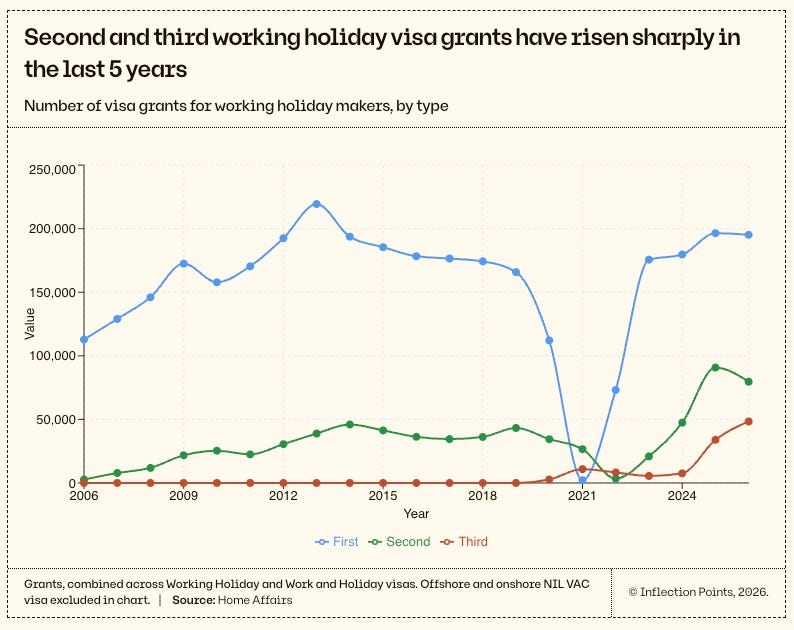
Increasingly, backpackers arrive in Australia with the intent to exclusively work for up to three years. The Federal government has acknowledged this. The 2026-27 Budget states there are pending changes due to be announced shortly on the backpacker visa. These changes should be substantial, instead of tinkering at the margins.
The most pressing change is to eliminate the backpacker visa’s third year, which transforms it into a low-wage work visa by another name.
In addition to removing the third year, a cap should be set on the total number of second-year visas available. A random ballot should be used to pick who gets a second year visa. To enter the ballot, young people should work in regional Australia for about three months.26
Specifying what sectors or jobs to work in must be avoided. This breeds exploitative work environments, as we have witnessed over the past two decades on farms across Australia. Increasingly this is occurring on solar farms, in abattoirs, and across tourism.
These changes would continue to allow as many backpackers to come to Australia for 12 months as they do now, while returning the visa to its rightful identity as a cultural exchange supported by work, instead of a low-wage work visa.
Parent visas should be abolished
There are three parts to the family visa system: partner, child and parent. Australia’s parent visa system is the clearest example of a visa failing on its own terms. Not only does it not promote family unity, it also imposes large costs on Australians.
A large minority of people who apply for this visa die before their visa is assessed. This is gross policy failure, unequalled elsewhere in the visa system. The contributory parent visa costs applicants around $50,000 and the wait for a visa is over a decade. The non-contributory parent visa is cheaper but the wait is now about thirty-five years.
Parent migration is very difficult to run in the broader interests of Australians. People mostly arrive in their 60s or later, meaning they mostly don’t work. When combined with the costs of the aged pension and health support, each parent visa costs the Federal government on average $400,000 over the life of the person—by far the most costly part of our visa system. It would take a visa fee in excess of $250,000 to be net neutral on the Budget, making parent visas the preserve of the ultra-wealthy. This is deeply against our egalitarian instincts.
Australia should abolish the parent visa category entirely. This would be unpopular with communities of recent migrant arrivals, but would end the cruelty of a system that collects visa fees and then generates endless uncertainty.
Abolishing the parent visa would free up roughly 7,000 permanent visa places based on current planning levels. These places should be used to address the years-long wait for partner and child visa applications, bringing down wait times for loved ones. Prioritising partners and kids over parents is a stronger outcome for family unity.
At a minimum, the Federal government should stop accepting new applications for parent visas immediately, rather than continuing to collect fees for a queue that may never move.27 In place of the parent visa, Australia should build on the already established system of visitor visas. A 10-year visa should be permitted, over the course of which parents would be permitted to spend 12 months as a block in Australia and then leave for at least six months.28 Making this form of visa available is a long way from permanent residency but it is a far more honest response than the current system provides.
Community refugee sponsorship is good for Australians
At the moment, Australia allocates 20,000 humanitarian visas each year. These are refugees selected by the United Nations, people who are granted asylum, and those in refugee-like situations sponsored by Australians.
Community sponsored refugees make up about 200 places each year. This means citizens—often through religious communities—play an active role in assisting with housing, getting kids into school, finding jobs, and accessing government support. In Australia, refugees are matched by the UN with community groups.
Canada has run private sponsorship since the late 1970s, whereby community and private groups sponsor a refugee directly, supporting them to settle in their new country. However most are not matched by the UN. Refugees sponsored by the community have the best employment rates and long-term settlement outcomes, as they access the social capital of their supporting community. These refugees are less dependent on welfare and make a larger economic contribution than government-supported refugees, who have lower employment rates and cost the budget much more.
Perhaps most important are the social benefits to Canadians of community sponsorship. Reminiscent of Robert Menzies ‘Good Neighbour’ movement in the early 1950s, there is nothing to compel people to sponsor a refugee.29
Instead, they are choosing to roll up their sleeves. The very act of people chipping in ripples out into society in a way a government-run program can never match.
Community refugee sponsorship is nascent in Australia, with places limited to 200 this year. With a budget battle looming in 2027 over the number of refugees Australia can support, increasing this number is prudent. At the moment, there are a host of rules giving people many reasons not to participate, including the fact that for every community sponsored refugee, the government withdraws a government-sponsored place from the strict annual ceiling of 20,000 refugees. The inability for community support to increase the overall refugee intake saps motivation and signals an enormous bureaucratic distrust of the community.
The Federal Government should make community sponsorship attractive by relaxing the rules imposed on Australians, by trusting them to do the right thing. In return, the community will step up and deliver.
An immigration agenda for Australians
The proposed changes to Australia’s immigration system outlined in this essay would improve the livelihoods of Australians. The changes would help future federal governments control the rate of immigration, and reduce the potential for public attitudes to whiplash alongside highly variable rates of migration.
By creating certainty for Australians, with an explicit one per cent ceiling on our migration flows, we can crowd out an ugly and exclusionary politics that feeds on the uncertainty of the current system. The way to do this is by committing to a migration system that is managed openly and defended honestly, without deflecting from the real problems it currently has, and may have again in the future.
Better enforcement means more public confidence in the system, including more people leaving Australia when they have no future here, penalising employers who do the wrong thing, and seeking a different future for asylum policy.
Better selection of permanent visas would make us richer and our communities would be stronger and less uncertain. More workers in higher wage jobs is good for Australians.
A new limit on the number of years people can spend as a temporary visa would reshape the visa system. Over time, the number of people without recourse to residency would decline, shrinking the number of people ‘permanently temporary’ in Australia.
Combined with a new approach on international education, the prioritisation of high wage jobs, and a limit on backpackers, the government of the day would shift the gains of migration from private interests and toward all Australians.
There is a growing scepticism of immigration in Australia. Those of us who believe immigration can improve the country should not defend the parts of the system that do not work. We must put forward concrete ways to improve things, instead of hectoring those who disagree, and trying to bury the topic within the discourse.
Supporters of immigration too often point to a nobel laureate or a global superstar as evidence that migration is good. But success isn’t picking a handful of incredible individuals from hundreds of thousands of attempts. Any country can achieve that. We should aim to do better. Our migration system makes decisions that shape the lives of millions. We should ensure that each and every one of those decisions is the best possible one we can make.
Note: Both authors write in a personal capacity.
The longer people live in our society, the more they lose connections with their homeland, and disruption to their lives has increasing costs to both them and us. This is true regardless of what visa someone holds. Michael Walzer (Spheres of Justice) and Joseph Carens (the Ethics of Immigration), coming from different philosophical perspectives, make similar claims in relation to non-citizens living in society.
Some may raise the Australian response to Indochinese refugees. But this was a deliberate and successful example of national interest, preventing boat arrivals by providing an ordered and controlled alternative.
40 per cent of nurses in Australia were born overseas, with half of these trained in Australia and half trained overseas. We would be a less healthy country without these people, with our health system under considerable more stress. We would be materially better off if we could figure out how to get more recent migrants to work in construction, building houses and public works.
It is worth noting that this result is largely an artefact of Australia’s low supply elasticity as attributable to land use regulation.
‘Immigration’ here means ‘net migration’, which is the number of arrivals less the number of departures from Australia, as a share of our population. There is a poor track record across many countries when targeting a specific number on net migration.
In both 1949 and 1950, net overseas migration contributed more than a staggering 1.8% population growth.
The residual is driven by a number of factors, including the relatively small number of those on permanent visas who leave Australia.
Migration can self-regulate when macroeconomic conditions turn. However, often the decision to migrate is a relative one, based on whether the destination is significantly better than wherever the person is, combined with other potential countries to migrate to. As one example, Canada has an unemployment rate of close to seven per cent and is still significantly tightening up entry opportunities.
As an example, Canada has a straightforward three year framework to plan both permanent and temporary visas.
To lay out the extent of these rules: the responsible Minister can personally cancel a visa in the “national interest” with the rules of natural justice expressly switched off, and overrule any tribunal that has ruled in the opposite direction.
A recent IPA poll found 77 per cent of people think people should be deported if they don’t uphold Australian values.
More than 1,100 people are in detention, with an average stay of 456 days, at a total program cost of almost $3,000 per day per detainee. Even if you assume the marginal cost of an additional detainee is 50% their share of the total program cost, paying that detainee $30,000 to leave works out cheaper than three weeks’ detention. Even under much lower marginal-cost assumptions, the lump sum payment works out much cheaper for the taxpayer than the status quo.
Changes to our migration system require careful consideration of our foreign policy context. However, abstract foreign policy considerations have historically been prioritised over and above higher material living standards for Australians. Trade policy that subverts the ability of Parliament to shape the visa system should be avoided at all costs.
Our tough border policies mean we are trusted by governments in the West, many of whom struggle with the consequences of the Refugee Convention. Likewise, we have accumulated decades of knowledge and institutional heft on policy and legislative processes concerning asylum applications. In the past, this has been valued in our region, such as the Bali Process under the Howard Government. Lastly, we have a relatively well-run offshore resettlement program, which is likely a critical part of the global puzzle, whereby a tighter set of asylum rules to shape undocumented movement sits alongside expansive resettlement opportunities, in a controlled and ordered manner.
This excludes tourists and New Zealand citizens. Additionally, in the interest of space, we are not canvassing the field of all temporary visas, including Pacific work visas, Maritime Crew visas, training and special event visas, short-stay business visas, or the litany of other small categories. Further, not every person on a temporary visa counts in Australia’s Estimated Resident Population, as some will not remain in Australia for long enough.
These estimates are indicative, modelled using ABS population data and headline growth in relevant visas over time. Exact numbers will be available from the 2026 Census once processed.
‘Skilled’ visas also include the partners and children of skilled migrants. Some argue this means skilled visas only contribute about one third of our permanent visa system. As a group, the partners and children of skilled migrants also have a larger net contribution to the Federal budget compared to Australians.
This is based on ABS Average Weekly Earnings.
For example, there is a long list of sponsorship obligations employers must follow, including matters like telling the Department of Home Affairs when a board director changes. Every sponsored worker must be monitored to ensure they are performing the task of their occupation only. See the full list here.
This includes overtime and additional penalties. Seek.com suggests the average salary for a job advertisement of a Registered Nurse is about $95,000.
Employer-sponsored migrants earn wages around 20-70 per cent higher than other skilled migrants of the same age.
For example, studying in Australia, or English language ability. See a full list of points categories here.
Others may suggest a higher domestic enrolment threshold, as a handful of major universities are already at about 50 per cent international enrolments.
Noting the current figure is likely to fall in the coming two years due to existing policy change over the past few years.
This idea has been proposed by Abul Rizvi, a former Deputy Secretary of the then Department of Immigration.
Regional Australia should mean a genuine regional area. This means excluding all Greater Capital City areas as defined by the ABS, except Darwin. In addition, areas like the Gold Coast, Newcastle, and Wollongong should be excluded.
Government revenue generated by visa fee applications is a practical obstacle to both refusing new applications and abolishing parent visas. Eliminating visa applications in the queue would run into the high hundreds of millions of dollars. Even ceasing to accept new applications shows up in foregone visa fee revenue. This is a good example of how rigid adherence to Budget rules can prevent the impetus for reform over the long-term.
A form of this already exists for Chinese nationals who are permitted to stay for 3 months at a time.
Thankyou for an interesting article. A couple of responses, Firstly I'm surprised you haven't commented on the potential perverse incentive in offering a substantial cash payment to visa-overstayers, is this something that you've considered? If you are at the end of your visa but know that hanging on for six months will net you a lump sum on departure, you might decide that's worth waiting for. Secondly I'm don't think the wages bar for skilled visas passes the sniff test. While I agree "it is very difficult to define 'need'", wages being "as good a measure of economic value as we have" merely demonstrates the paucity of available measures of economic (or other kinds of) value.
I understand the idea of selecting people based on wages, but I feel what we actually need is youth, vitality and ideas. Wages are usually tied to our current market structures, but if we're trying to build a more complex economy we need something else. Of course, "ideas" is nebulous, but we shouldn't overlook that a lot of people committed to innovation can spend a lot of time on low wages honing their work before it takes off. How we screen for potential may be difficult, but we should consider it ways to identify it. The "investor visa" didn't work as it was built on the fantasy of the one great "genius entrepreneur" rather than a more ground-up and cultural approach to innovation.
This is why I'm not sure cutting the WHM visa is a great idea. I feel like we should be vacuuming as many young people out of Europe, East Asia, and North America as possible (especially given our low birthrate). These are youthful, well-educated and adventurous people. They have the spunk (for want of a better word) that we need to inject into Australian society. I feel like we've become a culturally boring people, we need to import some life (both social and economic life).
There's also less housing stress with this cohort, as younger people also tend to live in sharehouses, rather than families migrating in their 30s who will need their own house.