


Today we published Keith Wolahan’s landmark essay, Liberal Foundations. He outlines a path forward for the party in light of its historic electoral collapse.
Listen to him discuss this piece, and the future of the modern Liberal party, with Jonathan O’Brien on the Inflection Points Podcast. And read The Age’s coverage of his essay here.
“Success doesn’t really interest me anymore. It’s too easy. Analysis plus capital plus execution... anyone can do that.“ So declares fictional tech oligarch Lukas Matsson to Roman Roy in season three of Succession, adding: “...but failure, that’s a secret. As much failure as possible, as fast as possible… that’s interesting.”
Beneath the swagger lies a seductive idea that commercial success follows a formula. This essay searches for an equivalent formula for centre-right political success in the hardest political market of all: the modern city. That task must begin with failure.
As recently as 2019, Christopher Pyne described the Liberal Party as an “election-winning machine”. That claim no longer survives contact with reality. The 2025 election delivered the Coalition’s lowest seat total on record, and polling in 2026 is bleaker still.
Our collapse has been sharpest in the cities, where modern Australian elections are decided.1Australia imagines itself a land of wide-open spaces. In reality, it is one of the most urbanised democracies on earth, and is becoming more urban each year. Eighty-eight of the 150 seats in Australia’s House of Representatives are metropolitan (57% of the chamber). In the US Congress, the equivalent figure is 43%.
These metropolitan seats were not lost one by one. They were lost the way Hemingway described bankruptcy in the Sun Also Rises: gradually, then all at once. The Liberal Party held 33 metropolitan seats even after the 2007 Rudd landslide, rising to 44 in 2013. Today only nine remain, and just two sit in the inner metropolitan ring.
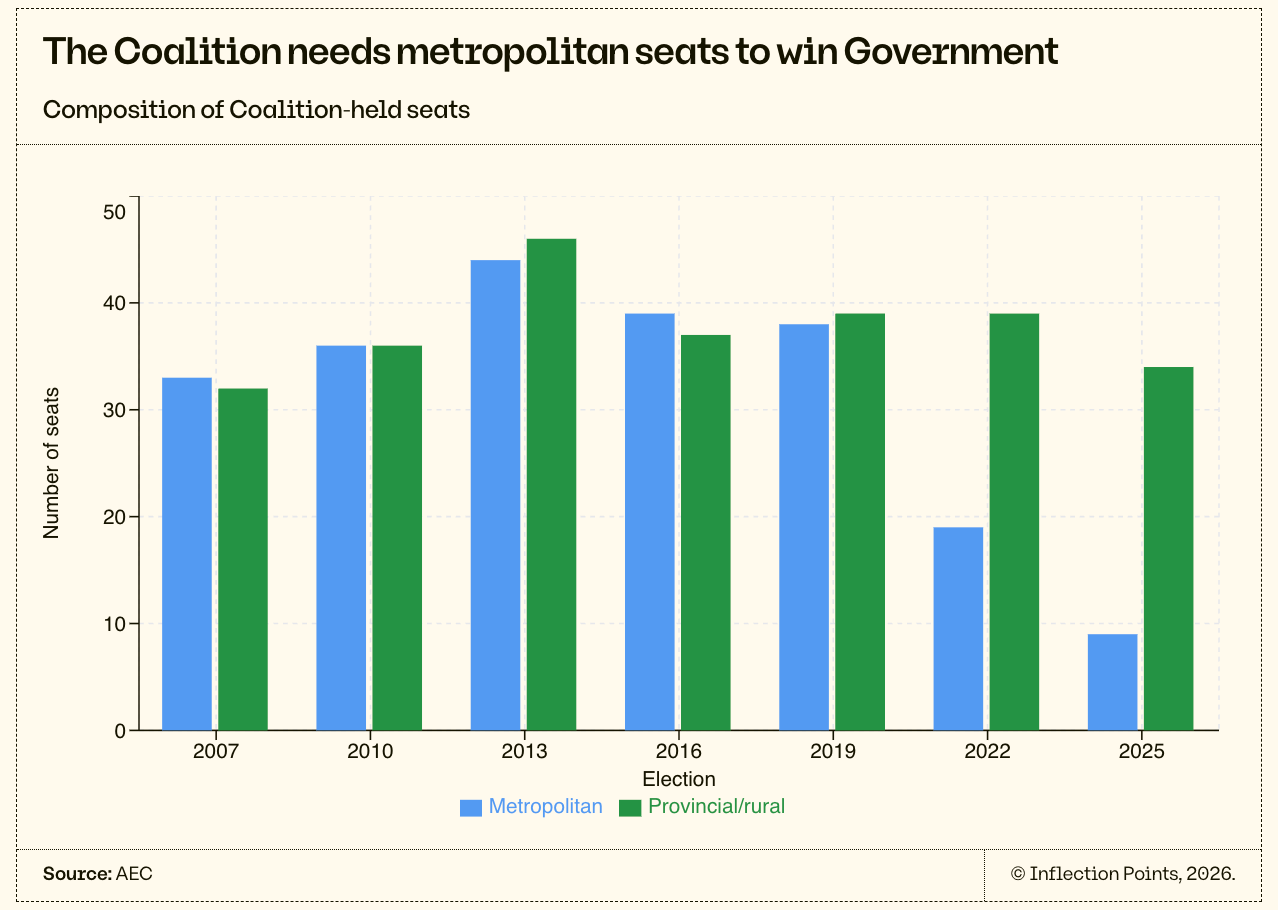
The scale of the challenge should not be underestimated. Across peer democracies, centre-right parties struggle in modern metropolitan centres. Republicans can afford to write off big cities and still govern. In Australia, that is not an option.
Minor or major opponents?
This arithmetic helps frame independent and minor party contests, including One Nation’s recent polling surge. Even if its strongest summer poll is sustained through to election day, One Nation will struggle to win seats where Labor is competitive, which of course includes all our cities.2 And in the regions, Hanson’s party must confront its own structural barrier: Labor and the Greens will almost certainly preference the Coalition.
This is not to downplay the political risk to regional Liberal and National seats or the Senate. But, unlike peer democracies, a party that cannot win in the cities cannot govern Australia.
Much of the commentary about a teal-led realignment of metropolitan politics rests on a misunderstanding of where the Coalition’s losses have actually occurred. Of the 44 metropolitan seats held by the Coalition in 2013, only seven are now held by teal independents or the Greens. Twenty eight, four times as many, have instead been lost to Labor in multicultural middle and outer suburban seats.
These seats differ materially from teal electorates in their demographic profile and voting behaviour, tending to be more diverse and motivated by economic rather than social concerns. In recent elections they have remained major-party contests, not insurgent independents. This distinction matters. While the teal phenomenon is real, it is not the dominant metropolitan story.
Indeed, the Liberal Party occupies a unique position on the centre-right. It is the only party capable of offering economic opportunity, national confidence, and family-focused aspiration to educated, diverse, urban electorates. That makes the Liberal Party the only centre-right movement with a credible path to governing from the cities.
Senator James Paterson explored related themes in the 2025 Tom Hughes Oration. He capably cautioned against populist drift and soulless technocracy. Those on the right who celebrate the Liberal Party’s demise should confront a harder question: what replaces it and can it be competitive in the cities?
The Liberal Party may still die
Writing off any major political party is fraught, because much of what went wrong is cyclical, and the wheel generally turns. But what if, this time, it doesn’t? A worrying portion of the political failure of the Liberal Party in urban Australia has been structural, driven by changes in migration, education, and home ownership.
Structural challenges do not solve themselves. They are not just questions of personnel or leadership. Nor are they fixed by templating campaigns tailored for a different time. Instead, they require diagnosis, honesty, and change. Who are the swinging voters in these seats? What can the Liberal Party offer them? A data-driven analysis will almost certainly conclude they fall into two cohorts: tertiary-educated millennials locked out of home ownership, and migrant families who feel, fairly or not, that the Liberal Party does not fight for them.
It has taken voices outside the party to see it clearly. Labor-aligned strategists like Kos Samaras have been making this case for years. Daniel McNamara penned a prophetic piece in December 2019 lamenting Labor’s loss. But he added this:
Now for the good news... Centre-left parties around the world are winning power by building coalitions of voters who predominantly live in cities... and are increasingly culturally diverse and university-educated... There are plenty of Liberal-held seats... ripe for the picking because their voters are alienated by the Liberals’ drift into right-wing populism... Winning the lion’s share of these... is a viable pathway to government.
Rebuilding is not certain, and nor should it be. No political party has a right to survive. I believe that recovery depends on two things: clarity about what we believe, and people of competence and character to deliver it. Without both, the party will die. With both, there might be a formula for success.
What success means
The Liberal Party exists to do two things: win elections and govern well.
Winning is not optional. A party that cannot win cannot deliver at scale. The noblest principles are worthless if they remain in opposition. In this sense, the pursuit of power is not distasteful. It is the means by which a party turns belief into reality. But winning is not enough. A party that wins without knowing why, or governs without conviction, will drift and disappoint. Victory without purpose is a tenancy.
The purpose of winning is to govern, and the test of governing is whether the country is better for it. What that looks like is more Australians owning homes and raising families, enterprise flourishing, liberties protected, and a stronger, more united nation. The result is a country worth passing on and fighting for, a sentiment Angus Taylor is right to embrace.
Success should not be complicated: win elections, govern well, and hand on a country better than the one we inherited. What follows in this essay is an account of how we have fallen short, and how we can do better.
Australia has changed faster than the party
Before John Howard’s 1996 election victory, pollster Mark Textor created “Phil and Jenny”, fictional composite voters who represented the aspirational battlers the Liberal Party needed to win. They lived in the suburbs, worked hard, did not go to university, worried about interest rates, and wanted their government to get the basics right. The strategy worked. Howard won four elections speaking to Phil and Jenny and the millions of Australians they represented.
But Phil and Jenny have grown old. Their children went to university, took good jobs, and played by the rules. Their children’s reward for following this path? They cannot afford a home, certainly not one where they might imagine raising a family (and certainly not without help from the bank of Phil and Jenny). The dream their parents lived has become a door slammed shut.
How would we describe a decisive composite voter in 2026? My guess is she is thirty-two, tertiary educated, and rents in suburban Melbourne, where her small business owner parents migrated from China three decades ago.3 She works hard. She pays her taxes. She wants to buy a home, start a family, and build a life. She believes in aspiration. She should be a Liberal voter, yet she is not.
The story of this voter highlights the structural failure of the Liberal Party. It is a failure to meet the needs of today’s Australia, told in seismic demographic shifts across migration, education, and home ownership.
Migration
The demographic shift in migration since the Howard years is stark: the share of our population who, like me, were born overseas has increased from 23% in 1996 to 32% today. When considering those who have at least one parent born overseas, this figure climbs to more than 50% of Australians, with seats like Menzies at over 70%. Australia today is not just a nation of immigrants; it is a nation of recent immigrants.
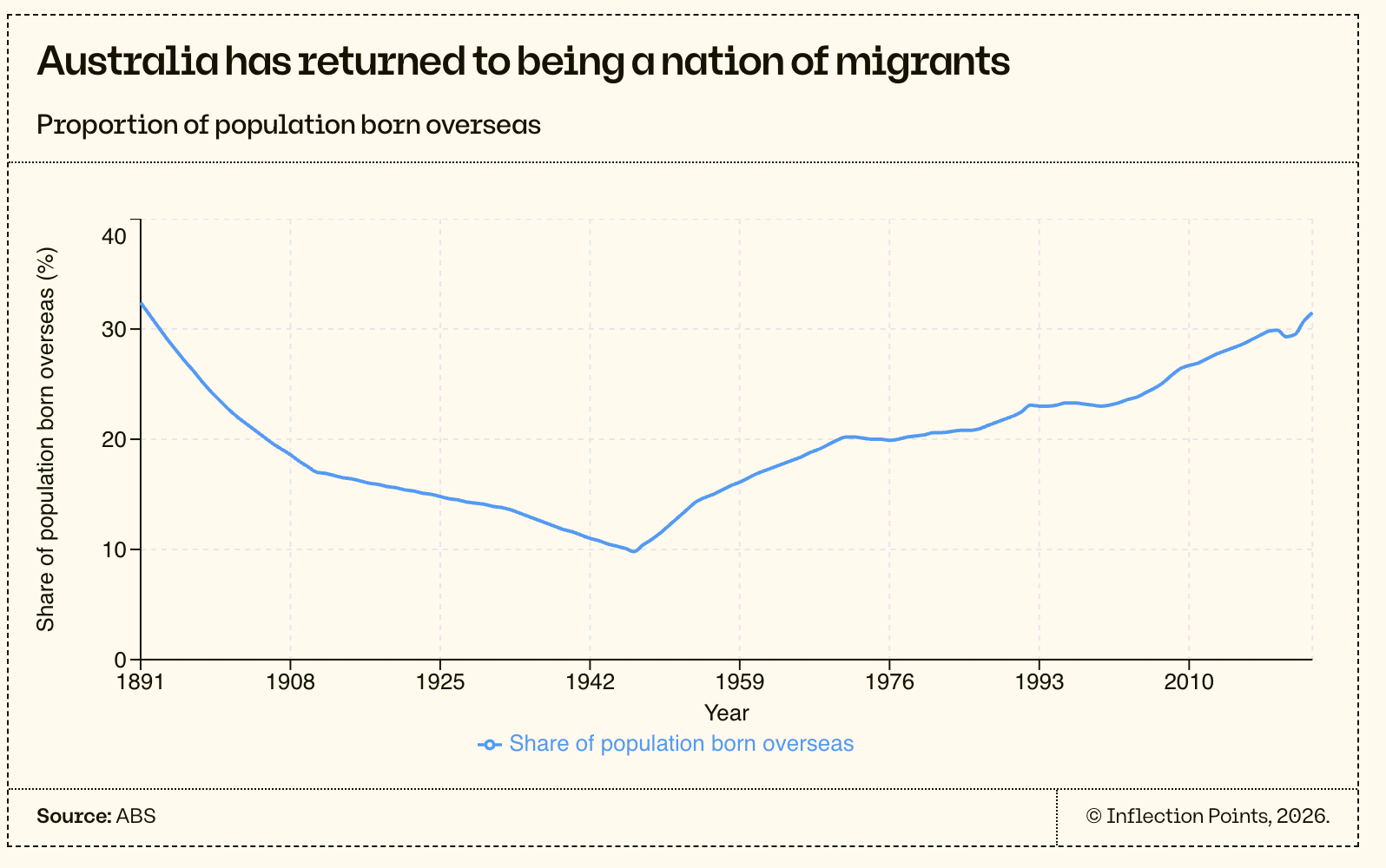
And while this shift has occurred, the Liberal Party has become worse at speaking to diaspora communities. For example, in just two elections, it has gone from holding twelve of the top twenty seats by Chinese heritage to two. This partly explains why so many seats were lost in Melbourne’s eastern suburbs.
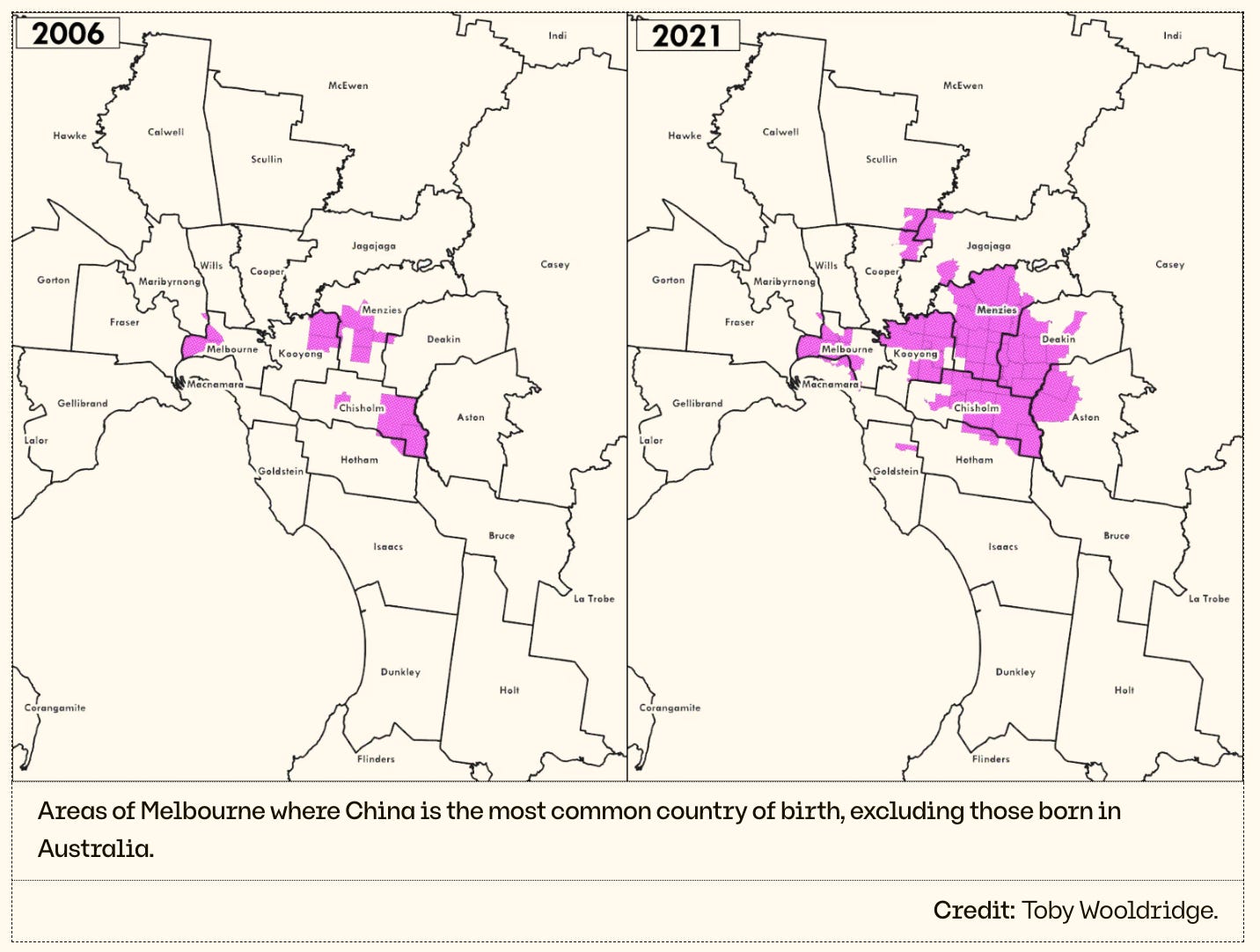
And our challenge is widespread. Of the top 50 seats by any migrant background, the party now holds only two. The collapse has occurred in the multicultural suburbs of our major cities, among voters who came to Australia precisely because they believed in the values the Liberal Party claims to stand for.
Yet this decline is not inevitable. Despite a significant Trump-influenced swing in 2025, the Canadian Conservatives held up well in many multicultural seats, winning key ridings with large Chinese diaspora populations in both Ontario and British Columbia. Former Senator and Australian Ambassador to Canada Scott Ryan explained it simply: the Canadian Conservatives have become a diaspora-focused machine. The Australian Liberals have not, treating it as niche rather than essential.
Education
Australia has undergone a quiet revolution in education, shaping perspectives by generation and gender. Forty per cent of millennials hold a bachelor’s degree or higher, compared to just 12% of baby boomers at the same age. Since the end of the Howard Government, the proportion of people aged 25-34 with at least a bachelor’s degree has risen from just over 30% to nearly 45%. Higher education is not evenly distributed by gender, with 37% of women now holding a bachelor’s degree or above, compared with 30% of men.
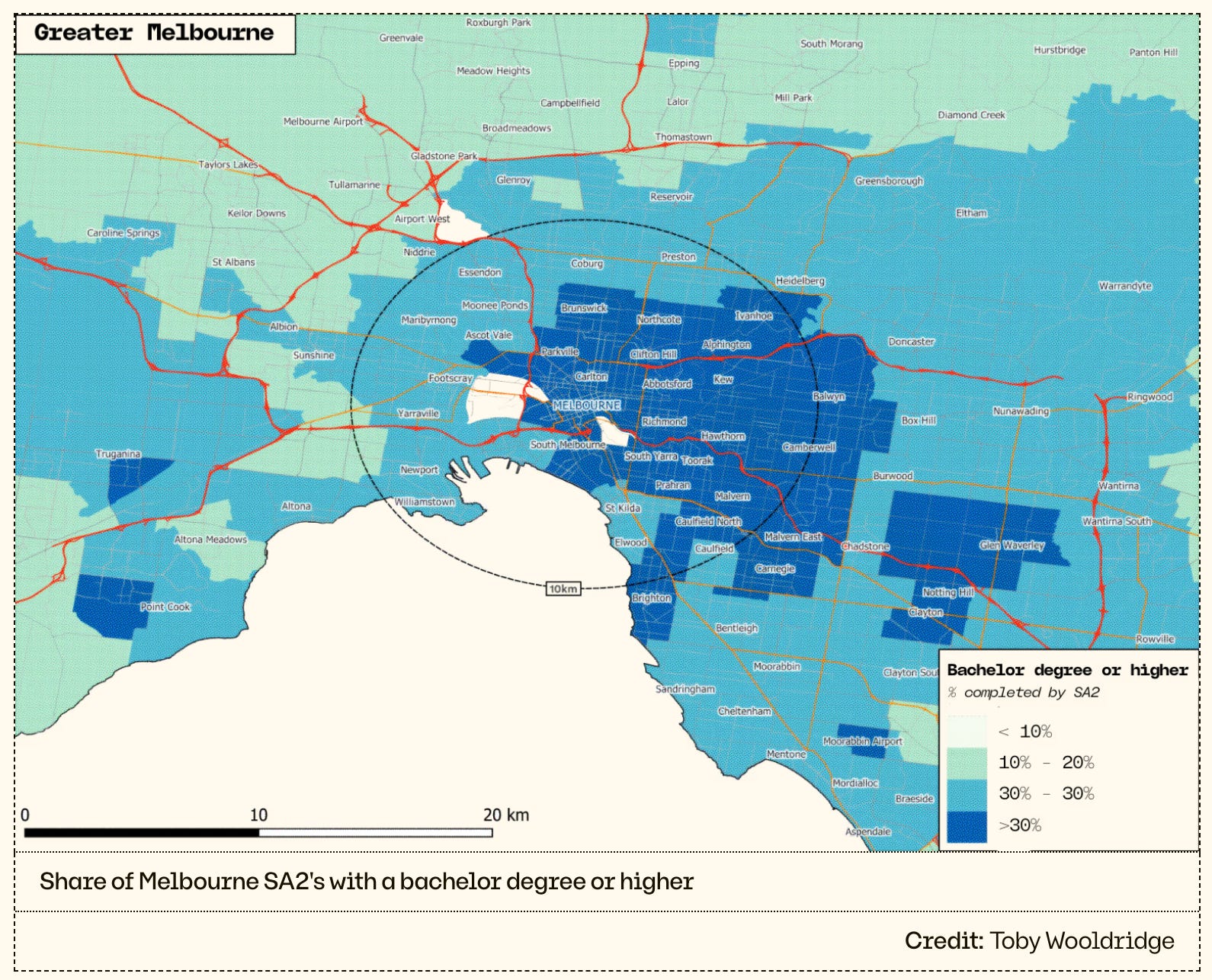
This partly explains the poor performance of the Liberals in the city. In just about every poll, university-educated voters lean Labor, Greens, or independent. And the story has a main character: the shift in higher education is directly related to the growth and influence of white-collar professional women in the cities as a percentage of the labour force, who surpassed professional men in 2004 and tradesmen in 2015. To address this structural slide in support, we must recognise their concerns, hopes, and dreams.
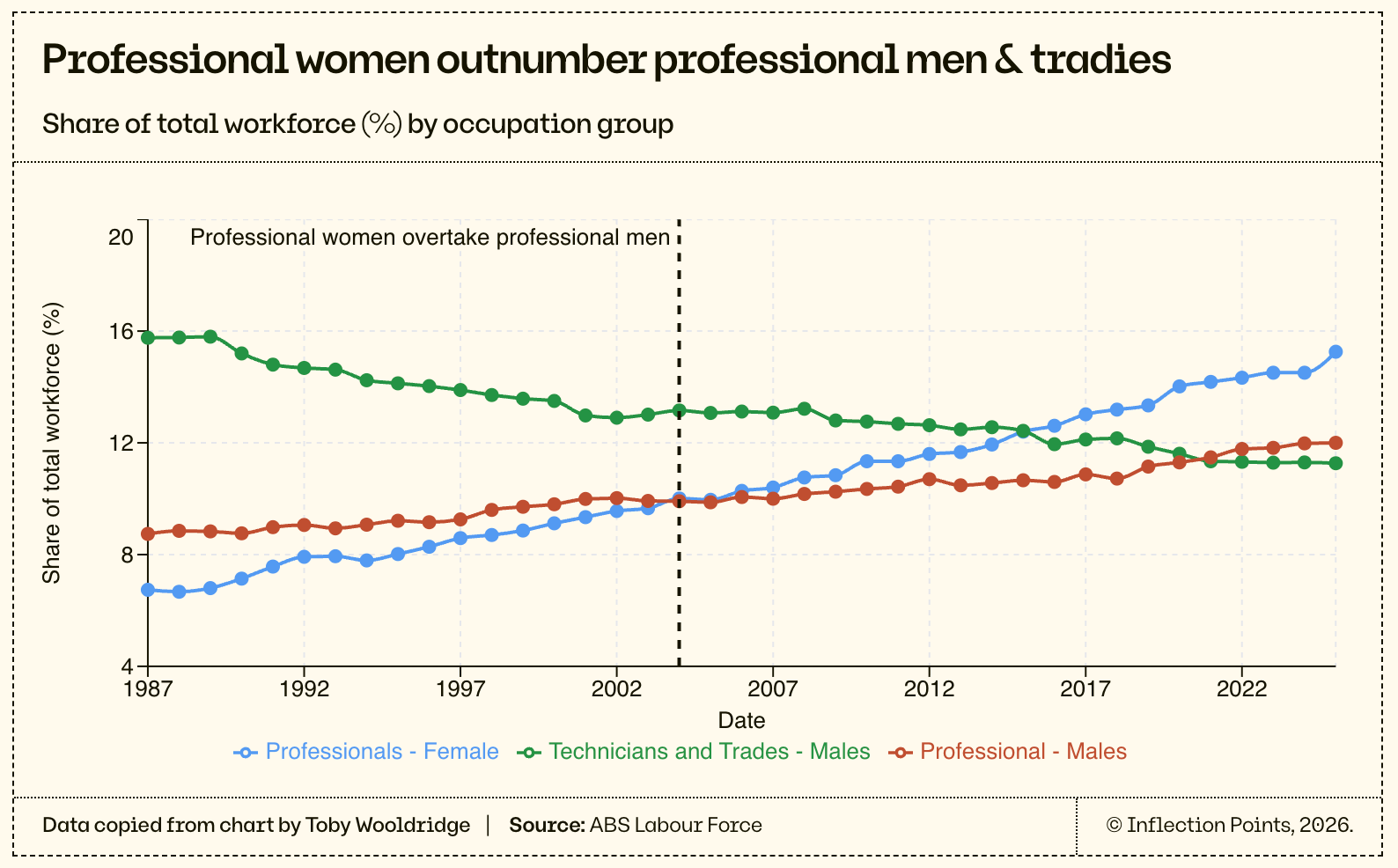
There was no better example of which party better understands this than Labor’s 20% reduction in university debt (HECS) versus the Liberals’ 25c off a litre for petrol. Leaving the merits of each policy to one side, this was a political own goal by Liberals: while each party knew cost of living was the most important issue, Labor better understood how it manifested itself with more swinging voters in more key seats. For young professionals, the difficulty HECS played in getting a home loan was acute. It also mattered to their parents. And the results speak for themselves: in 2010 the Liberals held twelve of the top twenty electorates by percentage of professional women. Today, only one remains.
Re-earning the trust of professional women is serious and deserving of sustained attention in its own right. It encompasses issues as diverse as algorithm-driven polarisation, job insecurity in an economy increasingly shaped by AI, parliamentary representation, and the pressures faced by the “sandwich generation” (including burnout and the extra demands of caring for children and parents).
Many capable Liberal women, including Charlotte Mortlock and her Hilma’s Network, have made efforts to address this. But they should not have to do it alone, and Charlotte’s recent departure from the party highlights how we cannot assume those who genuinely care will wait forever.
And while there is something to be said for far-left bias in universities, reforming academic culture is a complex generational project. It has no clear or immediate policy lever.
Home ownership
Home ownership is both existential and amenable to action in the near term. It is an issue that cuts across gender and generation alike. And it is one the Liberal Party urgently needs to confront.
In 1981, around 61% of Australians aged 25–34 owned their home; today, that figure sits in the low 40s, and for those aged 25–29 it has fallen to around 36%. On current measures, millennials are the first generation in modern Australian history less likely to own a home than their parents were at the same age. Over the past three decades, the ratio of median house prices to median incomes has roughly doubled.
Even allowing for deposit assistance schemes, the time required to save a deposit now stretches well beyond a decade for many households. Survey research analysed by Rebecca Huntley reinforces the shift in sentiment: more than 60% of Australians, and around three-quarters of renters, now believe the dream of home ownership is no longer attainable for young people.
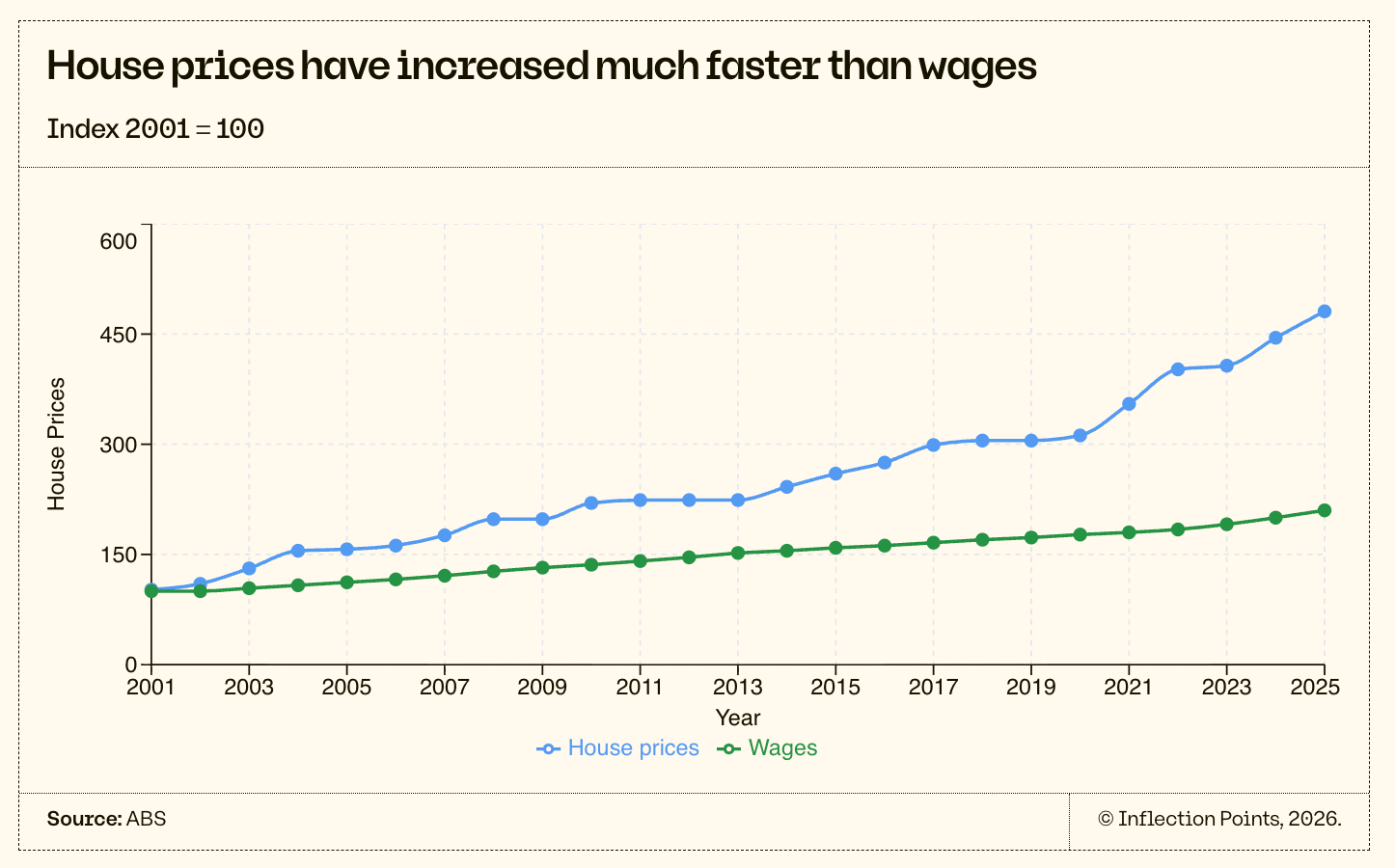
The disconnect between wages and house prices risks killing the Australian dream. Success in life will become less about hard work and more about the lottery of birth or marrying well. That is how most countries operate, but not here. It is why my family fled Ireland, where even your accent was key to whether you would make it or not. Many Australians don’t realise what a rare and fragile thing equality of opportunity is. If there is something worth fighting for, this is it.
The fact that this is most acute in the cities should not come as a surprise. Property prices are proportional to the distance from a city. e61 research found this has led to the dominance in metropolitan seats of younger renting Generation Z and older home-owned-outright baby boomers, with mortgage-paying millennials fleeing.
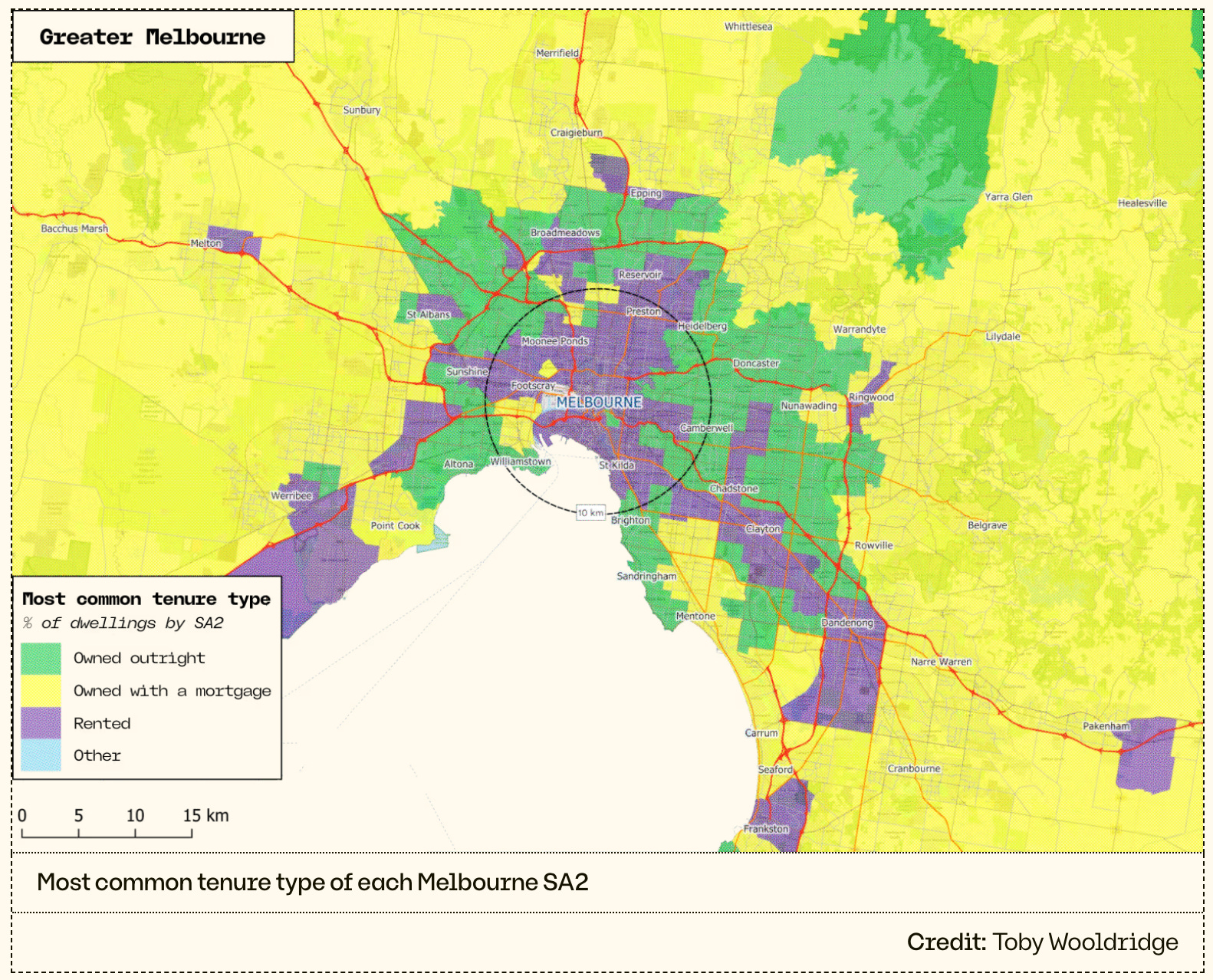
Most commentary rightly focuses on the financial benefits of home ownership, which are real and well-understood. What tends to be underexplored are the behavioural effects. Home ownership creates a series of small but cumulative incentives to invest in place and community.
As my friend, millennial demographer Toby Wooldridge, recently put it after buying his first home in the outer Melbourne suburb of Croydon:
For me, that has meant maintaining a garden, paying closer attention to neighbours including elderly residents and families with young children, doing small reciprocal favours, joining the local tennis club, and engaging with local forums like the Croydon Facebook group. It has also shifted how I think about time horizons and risk, including the confidence to plan for starting a family.
As has been widely reported, this impacts when young Australians achieve life milestones. National birthrates, for example, dropped 3.8% between 2019 and 2024, with capital cities’ rates falling most by 6.5% (Sydney dropping by 8.6% and Melbourne by 7.3%). That should alarm all of us. Some argue that young people simply don’t want families anymore. But if that were true, the decline would be uniform. It isn’t: regional Australia grew by 2.5%. Birthrates have fallen most where housing is least affordable.
The crisis is material, not cultural. Menzies spoke of the “forgotten people“ and their desire for “a home of their own.” If that is no longer within reach, the party’s core offer is hollow. A generation locked out of the property market is not listening to lectures about enterprise and aspiration. It is not that they are hostile to Liberal values: they simply do not believe the party is serious about the one thing that would make those values real.
The polling bears this out. Among renters, Labor wins 65% of the two-party preferred vote. With the electorate shifting structurally towards renting, the historical home-owner foundations of the Liberal Party are becoming shaky.
However, the political risk for the Labor Party is also real, particularly in inner-city contests against the Greens. New York City is arguably the global headquarters of capitalism, yet it serves as a cautionary tale of when young people lose hope. Zohran Mamdani is on any measure a socialist, yet has now been elected as mayor after running on an affordability agenda with housing at its core. This is the one issue that can see the politics of cities move from the centre-left to the far-left.
There’s a familiar saying that people start out on the left and drift right as they get older. What should worry the Liberal Party is that this shift is no longer happening. Millennials, now in their thirties and forties, are not moving right as they age. Instead, worryingly, they are moving left. According to the Australian Election Study, millennial support for the Coalition fell from 38% in 2016 to just 21% in 2025.
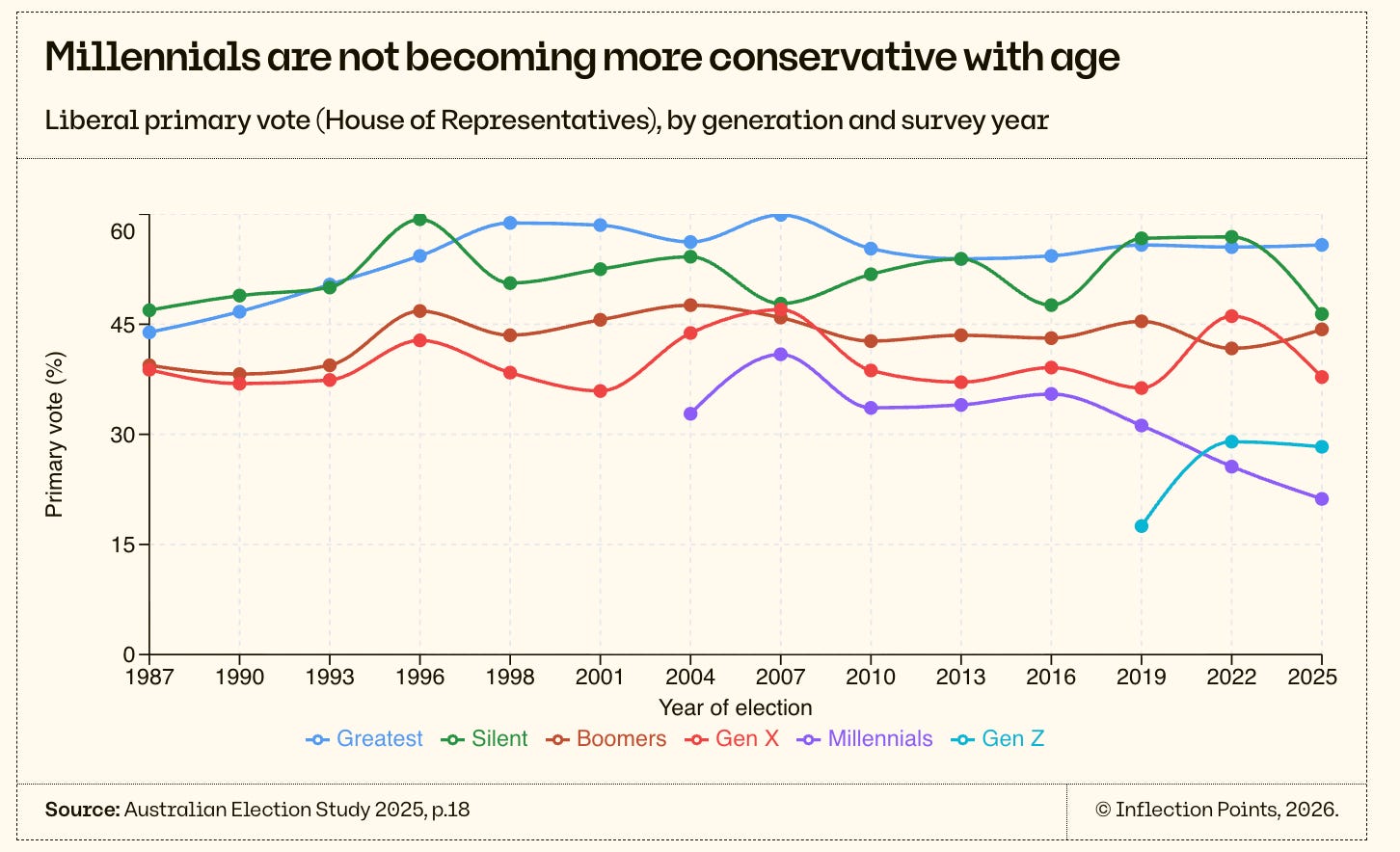
Home ownership once pulled voters toward stability. Its absence is now pushing them the other way. I am not the first to make this claim.
As Tim Wilson has argued, when access to home ownership erodes, the social contract itself weakens, and with it the legitimacy of the economic and political system. In a widely reported January 2020 email to Mark Zuckerberg and other Facebook executives, Peter Thiel warned that a generation burdened by student debt and locked out of housing was accumulating what he described as “negative capital”. People without a stake in the system, he argued, should not be expected to defend it. As Sydney barrister and fellow veteran Gray Connolly has often put it, “why would people vote conservative if they have nothing to conserve?”
Australia has changed, and so must we
Yet when asked, too many in the Liberal Party still hold on to an image three decades out of date, placing a premium on their own intuition over data, demography, and psychography.4A challenge this fundamental demands a willingness to question the Liberal Party’s most settled assumptions. Is it an institution which respects facts and data? Does it understand how to appeal to a new generation of multicultural aspirational Australians? How does its founding values stand up to a changing world?
What we believe: A Liberal House
Values mark the foundation of an enduring yet contemporary Liberal House. Foundations do not change with fashion. They bear weight. They hold firm when storms come. Get them wrong and nothing built above will last. Today, we need to inspect our foundations.
We’ve not made our own case
Last year I attended a major multicultural small business awards ceremony in Melbourne’s eastern suburbs. Hundreds of migrant small business owners filled Melbourne’s Exhibition Centre. The organisers, fiercely and fairly non-partisan, invited elected officials to address them. Given Melbourne’s state and federal seats are overwhelmingly Labor, almost every speech came from their side.
I sat there imagining I had arrived in Australia six years ago. What would I conclude? That Victorian Labor is the party of small business. The claim is preposterous in the context of the burden that Victorian Labor has placed on business in the past few years. But it would be a fair assumption if that room was all I knew.
A generation that has never heard the Liberal case clearly stated cannot be blamed for not believing it. The failure is not theirs. It is ours. We have assumed that values are self-evident, when they must be argued. We have assumed that history speaks for itself, when it must be taught. This is doubly true for migrant communities.
The daughter of parents who arrived from Vietnam or Iran or China did not grow up hearing grandad talk about Menzies or mum about Howard. She has no inherited loyalty, nor any reservoir of goodwill built over decades. Australian politics is new to her family. There are no core equities to draw upon.
Nor can we rely on the family being gathered around the television for the evening news, where grabs of both sides of politics reached whole households at once. That world is gone. Today, each family member scrolls a separate feed, shaped by algorithms that reward outrage and skip explanation.
Core equities must be earned with each generation, explained to each new audience, and demonstrated in each term of government. The onus is on us to build them. In our cities, we have to start again.
Seventeen statements today
In 1944, Robert Menzies formed the Liberal Party. Ten years later he gathered delegates in Canberra to settle seventeen statements beginning with “We believe.” They remain true today. But ask any Liberal to recite them and you will be met with a summary or silence. This is not a criticism: seventeen statements are too many to remember, let alone act upon.
So what did Menzies and his delegates write? To paraphrase, that we believe in parliamentary democracy, in the rule of law, in institutions that outlast any single government. In free thought, free speech, and free association. In the family as the foundation of society. In private enterprise, fair reward for effort, and the dignity of work. In equality of opportunity, not equality of outcome. In a nation united, secure, and worth defending. These are the load-bearing walls of a decent society and a party that Australians have trusted with power more than any other.
But while the foundation is fixed, the furniture is not. Reasonable people and reasonable Liberals can disagree about how a room should be arranged. They can argue about the size of the table, the placement of the chairs, whether the curtains should be drawn. These are questions of policy. They are the domain of democratic contest. A party that confuses furniture for foundations will tear itself apart over trivialities. A party that forgets its foundations will have nothing to hold it together.
Our task today is to distil seventeen statements into something that can be remembered, repeated, and acted upon. Many claim to speak for Menzies, but I am confident he would enjoy condensing them for his Instagram and WeChat followers. There are many ways to do this and there is no right answer. But we owe it to the electorate to try.
In my first speech I put it as democratising prosperity and democratising power. Giving people agency and freedom only works if monopolists and government have less. I saw the conservative tradition being expressed in gratitude for the past, and the classical liberal tradition as hope for the future. Today, I would lean into gratitude and hope:
We believe in a nation where free people dream, families flourish, and enterprise thrives: a nation worth passing on and fighting for.
Let’s break that down.
Free people dream
This is the Liberal commitment to individual liberty: the freedom to speak (the foundational right), worship, own property, and associate. It rejects the paternalism that says government knows best or that we should be judged by group characteristics. It trusts citizens to make their own decisions and bear their own consequences. To dream is to hope for a better tomorrow, to cherish opportunity, and take a chance.
Families flourish
This is the recognition that society is not built by the state but by the institutions that precede it: the family, the community, the voluntary association. These are the nurseries of character and citizenship. But families also require a home and support from an efficient state, including in health and education.
Enterprise thrives
This is the belief that prosperity comes from work, risk, and reward; that the small business owner and the entrepreneur are the engines of a free economy. That government should encourage effort, not punish it. And that government should live within its means, keeping taxes lower, and debt sustainable.
A nation worth passing on
This is the conservative instinct: that we are stewards, not owners. That we show gratitude for the institutions built by those who came before and owe a debt to those who come after. Stewardship also extends to nature. Caring for the environment must be the natural expression of a philosophy that refuses to leave the next generation poorer than we found it.
And fighting for
Freedom takes sacrifice. A nation must be defended: its borders, its values, its way of life. This is about more than hardware and alliances. It is about our collective will to put service above self when required most. It is about inviting migrant communities into our most sacred story. ANZAC cannot remain the inheritance of some Australians; it must become the covenant of all. A defaced war memorial offends all of us, not just veterans.
***
These ideas are not new. But for many voters, they might as well be. The task is not to rediscover what Liberals believe. It is to say it clearly, mean it, and field candidates and leaders who prove it.
Who we should aspire to be
In two elections, no one stopped to tell me they disliked what the Liberal Party stood for. No doubt those people are out there. But those who wanted a word had a different complaint: they disliked or were disappointed by those who spoke for it.
At times that criticism was directed at me personally or a leader. Some of this was driven by unfair and predictable scare campaigns. But much more of it was sincere and valid, a plea for us to do and be better.
If the values are sound, the question becomes one of people: how the party selects, supports, and develops them. This must apply at both a parliamentary and leadership level. What should the party demand of those who seek to represent it?
People of competence & character
In isolation, competence and character are rare. In combination, they are rarer still.
Competence comes from a healthy combination of academic smarts, experience, work-ethic, self-awareness, appetite for risk, and judgment. In politics, being a good communicator is essential. It requires understanding contemporary Australia as it is, not as it was or as you wish it to be. It also demands an open mind, an open heart, and a commitment to favour perspective over perception.
Character is about what motivates you. People who put their hand up for elected office are driven, perhaps irrationally so. It takes hunger to get there and resilience to keep going. But what drives you? Is it something higher than your own advancement? Do you conduct yourself differently when you think no one is watching? Do you truly believe in the party’s values or are they a rhetorical device when safe? When it counts, will you show courage or give in to fear?
It also matters in the little things. It is the discipline to resist easy outrage in favour of patient explanation. It is in how you treat people when they offer you nothing. It means at key moments choosing truth over tribe and principle over power. This is what sets us apart from the populist right. And it is what has built a reservoir of trust over decades.
The problems facing Australia are complex, and governing is hard. Competence and character are the minimum requirements for being trusted with either.
Candidates & membership
If the party wants better representatives, it must select its best candidates. Preselection is where our renewal begins in earnest or fails altogether.
A preselection process that rewards loyalty over merit will yield representatives who lack the standing to persuade anyone beyond the already converted. It also makes politics overly transactional and unpredictable.
This points to a deeper imperative: the party must remain a broad movement, with membership that reflects the communities it seeks to represent. A narrow membership produces narrow candidates, and fewer of them.
As Tony Barry has often stated, there are more members of the Melbourne Storm rugby league team than the Victorian Division of the Liberal Party. And Melbourne is an AFL town.
A membership drawn from across the community, including the migrant families and young professionals now absent from our ranks, will demand representatives who understand their concerns and can speak to them credibly. Many of these members should become great candidates themselves.
Evidence-led decision making
Quality candidates and committed members alone are not enough. A modern political party requires professional infrastructure, organised to produce superior policy developed and executed at scale.
The Liberal Party has professional and dedicated staff in its various wings. But it is lacking in its capacity to fuse and analyse intelligence from multiple sources. What is missing is a fusion team. This is not a policy team (parliamentary led) or a campaign team (secretariat led).
What is missing is a separate cell that works with the secretariat and parliamentarian wings, fusing data, demography, geography, psychography, polling, mapping, as well as human-to-human feedback from members and candidates. A capable fusion team would help both wings make better decisions, searching for causations, interrogating correlations, moving from complexity to clarity, from ‘what’ to ‘so what’ to ‘now what’.
Today, the culture of the Liberal Party more often than not relies upon the intuition of key people, especially the parliamentary leader or a preferred pollster. That can work from time to time, but it is akin to flying a plane without instruments. Deference to ‘judgment’ has contributed to the failure to notice seismic demographic changes outlined here. And this has led to an unforgivable misallocation of scarce resources.
To that end, it was not lost on me that the first people Labor head strategist Paul Erickson thanked in his post-election press club speech were the data teams. This is one of many fronts the Labor Party is outplaying the Liberal Party. But they weren’t always like that. More than a year out from the election, Labor posted LinkedIn job ads seeking more data analysts. Evidence-based decision making has become core to who they are.
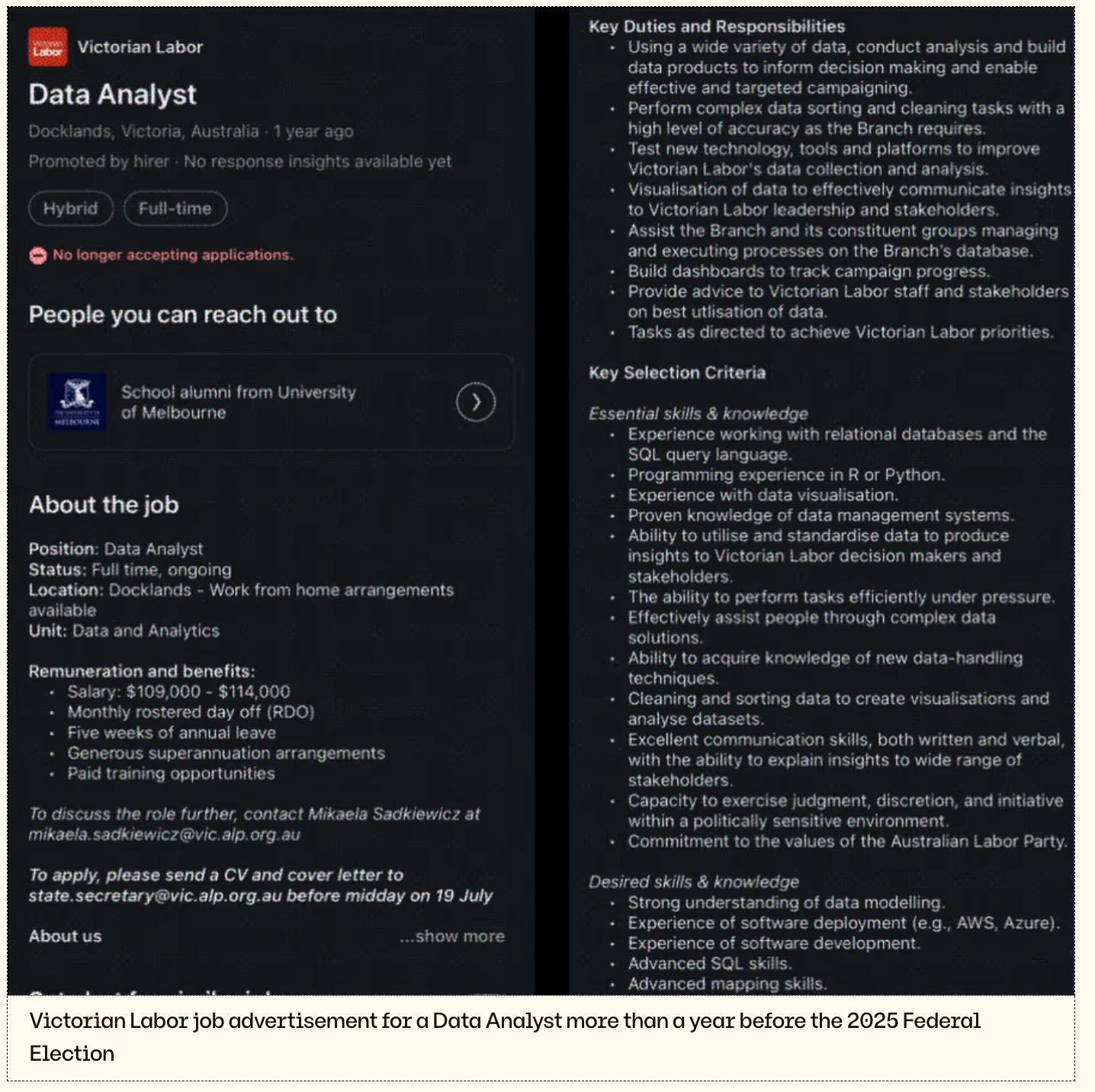
Building a fusion team is an urgent fix that money, talent, and software can address. It needs to be embedded in how the party thinks, not bolted on as an afterthought. This only works if the shift is led from the top.
Too often I saw well-meaning policy ideas fail because they were not intelligence-led or wargamed. A capable fusion team would help with both. For example, such a team could have assisted in avoiding the acknowledged missteps on tax cuts, HECS, and work from home at the last election.
A fusion team would ensure that policy formation and campaign execution operate as one system, guided by evidence rather than instinct alone. It would challenge inherited assumptions early and direct scarce resources where they matter most. Winning parties institutionalise learning; losing parties rely on chance. The difference is organisational capability.
Tone
Finally, Australian voters have a finely tuned ear for authenticity. They recoil from nastiness and performative outrage. They reward representatives who explain rather than denounce, who seek to persuade rather than score points. A party confident in its values does not need to shout down views it disagrees with. It listens, engages, and trusts the strength of its own case. To put it another way, if we speak from the heart we will connect to the heart.
This particularly matters in key debates that touch on identity, including gender, migration, and climate/energy. We can and should have fierce contests driven by values and the national interest, but do so in a way that makes people feel heard and appreciated.
I don’t know why, but my sense is metropolitan seats are more attuned to tone. There must be conviction in politics, and there is a place for passion and fire in the Parliament. Nonetheless, bar some exceptions, the spectacle of Question Time is not one that makes Australians proud or pushes the country forward.
There is no one fix to increasing polarisation, but how we debate has to be part of the solution.5
Markers of policy principle
Policy is usually where papers on the revival of the Liberal Party begin. That instinct is understandable, but misguided. Unless we first reconcile our values for modern Australia, put our best people forward, and make better decisions, policy proposals will miss more than they hit.
Even so, we know enough about who we are and the country we seek to serve to set urgent markers of principle. Fair minded Liberals will of course have many views. These are questions of furniture, not foundation. That is why the contest of ideas is not a weakness, provided it is anchored in shared purpose. Accordingly, here are five markers of policy principle:
The party of balanced budgets
The Intergenerational Report looks over the horizon to 2063, and notes our current government spending trajectory (not including states and local government) is entirely unsustainable. Addressing that is about more than inflation and interest rates. It is about intergenerational equity.
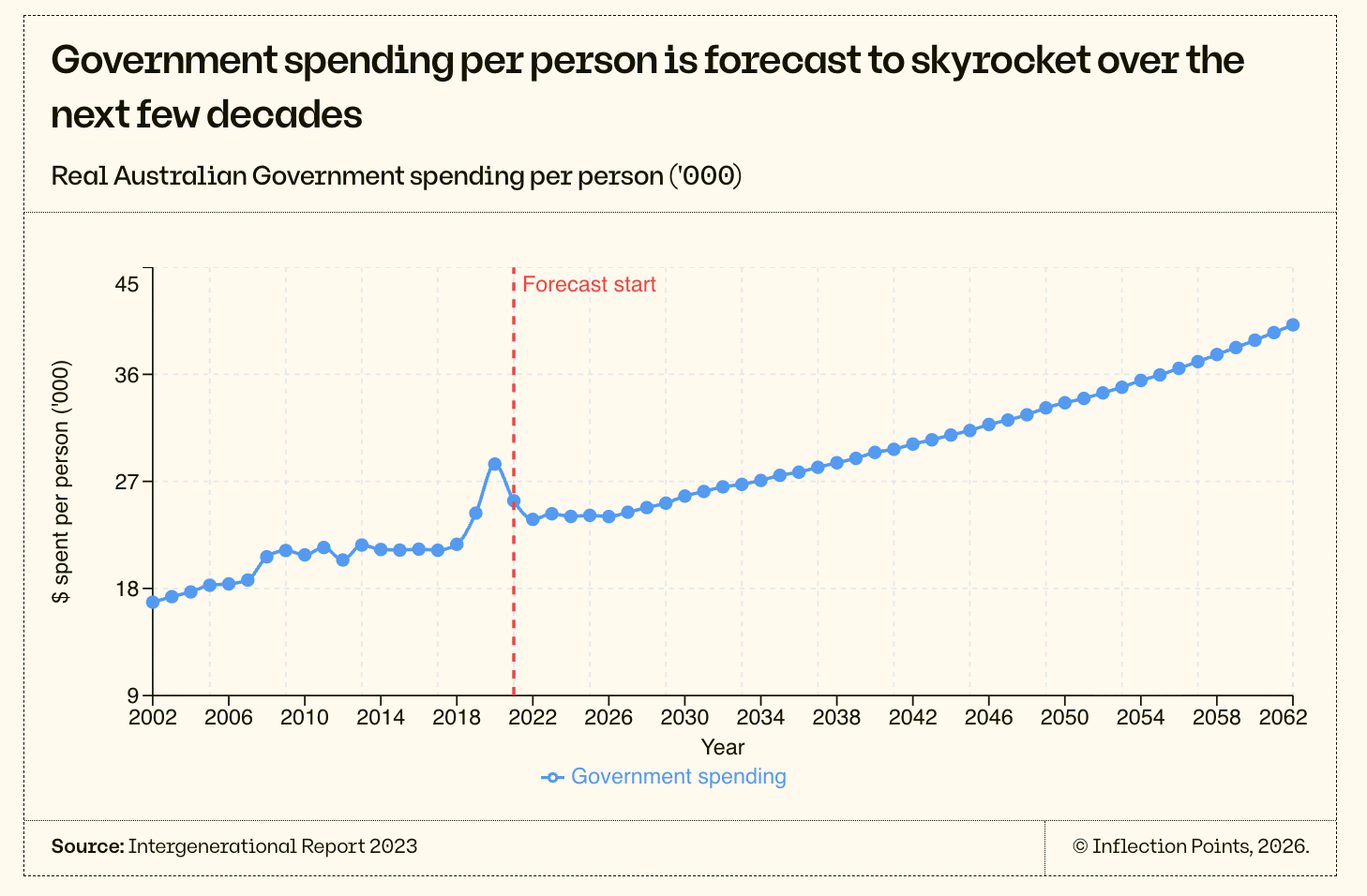
Let’s rededicate ourselves to being the party of limited government and balanced budgets. We have reputational ground to make up post COVID. This demands a serious audit of Commonwealth functions and a willingness to say what we would stop doing, not just differently. This includes functions the Commonwealth has accumulated that duplicate state responsibilities or exist to manage problems government created.
The party of lower income tax
Australia’s income tax burden is too high and unfairly concentrated on working households, discouraging effort and constraining economic growth. We should never again go to an election as the party of higher income tax.
First, eliminate bracket creep permanently through legislated indexation.
Second, propose a voluntary system of capped income splitting for couples. Treating families as economic partnerships would correct inequities between households on similar incomes and allow families, not the tax system, to determine how work and care are shared.
The party of proportionate migration
Migration volume and standards should be explicitly linked to demonstrated capacity in housing construction, infrastructure delivery, and social cohesion. These metrics should be transparent and reviewed regularly.
We cherish those who have made their lives here and cannot fold to populism. That requires recognising that a generous migration policy operates on social license, grounded in public consent. In making this case, we must be vigilant to how the migration debate can be heard by diaspora communities. For this reason, we must clearly distinguish ourselves on migration from One Nation on both policy and tone.
A broader population policy must also consider how we grow, not just by how much. This should include a whole-of-federation analysis on distribution and decentralisation. Fast rail, fast internet, and zonal taxation, within constitutional constraints, are worth exploring as incentives for people to move out of stressed metropolitan centres.
The party that values service & higher education
Australia faces a deteriorating strategic environment and, despite recent upticks, an ADF struggling to meet recruitment targets. At the same time, universities have become disconnected from, and sometimes hostile to, military service.
The party should expand the already proven ADF Gap Year program, with an additional incentive linked to HECS. If a person successfully completes a gap year (which does not necessarily have to fall immediately after secondary school), followed by a period of ongoing effective reserve service, they qualify for a 50 per cent reduction in HECS, capped at four years of study. No compulsion, but a genuine incentive.
This avoids the illiberal and unconstitutional dimensions of national service. The ADF receives a deeper, more experienced reserve base. Universities regain a connection to national purpose. And young Australians receive meaningful debt relief from a grateful nation. This should all be at a cost certain to be less than a full-time ADF position.
Over time, such a scheme could be considered for other forms of service.
The party for first home buyers
An existential crisis requires existential action. Housing supply matters most, but supply alone will not solve the problem. Migration settings and the balance between owner-occupiers and investors also shape outcomes.
Current tax settings tilt incentives toward investors, particularly in existing stock. They reward bidding rather than building. The result is predictable: higher prices in constrained markets and too little new housing. Debate about tax has become unnecessarily binary. At a time when young Australians are delaying families and the Liberal Party faces electoral collapse, maintaining the status quo is not an option.
Rather than abolishing negative gearing, its operation should be refocused toward new supply. The Liberal Party should lead with this: cap negative gearing for established dwellings at one property per investor, while allowing the deduction for up to five newly constructed homes. The case for rebalancing is clear. In 2025, 82% of loans to investors were for established dwellings. Economist Leith Van Onselen makes the valid point that this is pumping demand far more than contributing to new supply.
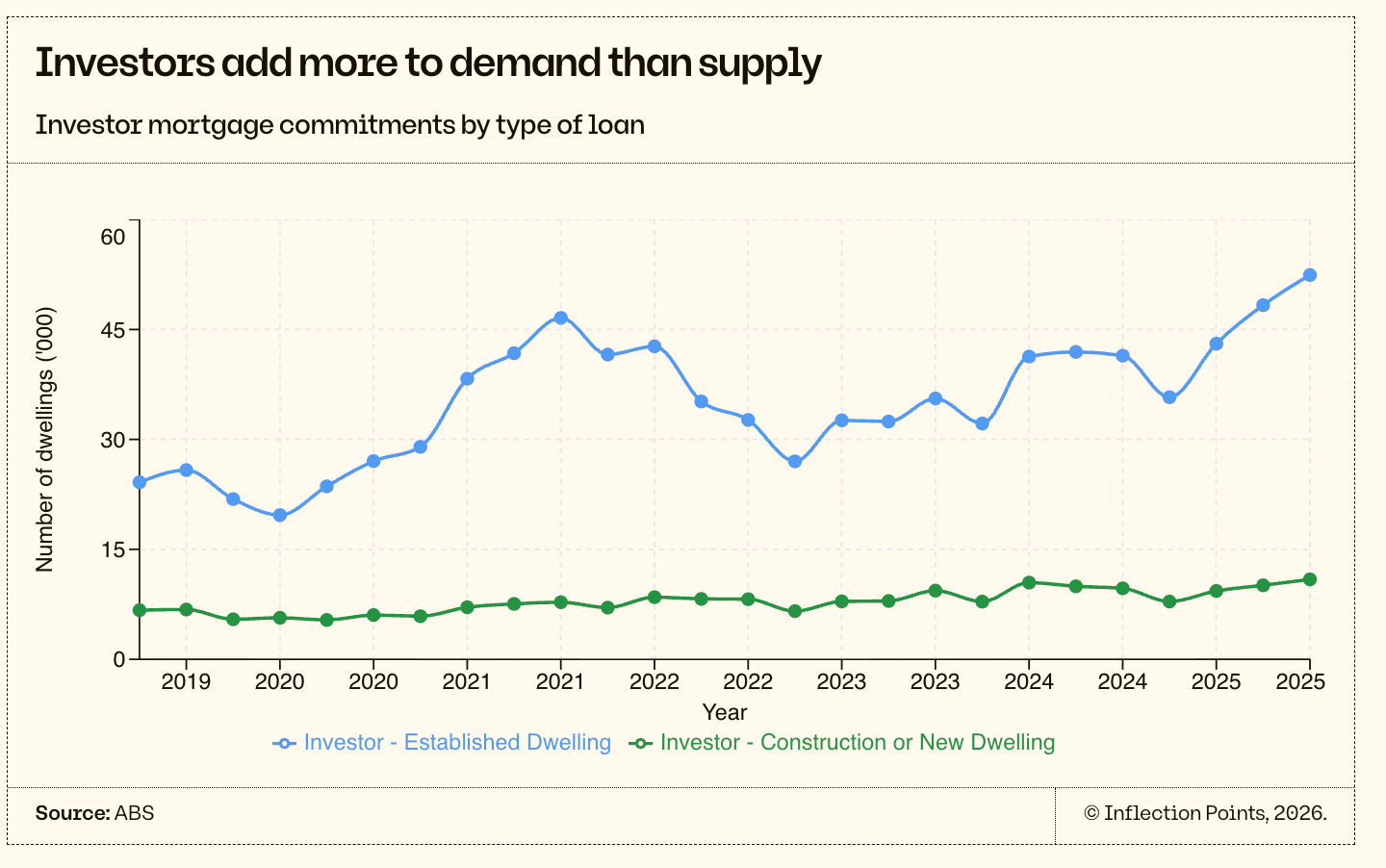
Australia has changed since 2019, and so must the politics. That is why, in addition to providing certainty, existing arrangements must be fully grandfathered. To demonstrate that this is more than an election tactic, the offer should be made to pass this reform now. Young Australians might just look at the Liberal Party with fresh eyes.
A formula
Returning to Succession, Lukas Matsson was right: failure is interesting, but only if it teaches us something. Perhaps the formula is obvious: values plus people equals success. Here is my plea:
If we believe in a nation where free people dream, families flourish, and enterprise thrives; a nation worth passing on and fighting for.
And if we become a party that nurtures leaders of competence and character; a party that bends to truth over tribe, principle over power, and perspective over perception.
Then the Liberal Party will once again earn trust, win elections, and govern well.
If the Liberal Party is to have a future, we can’t be fainthearted.
We must be brave.
Keith is a barrister and the former Liberal Member for federal seat of Menzies (2022-2025).
Including Menzies, the seat I was honoured to represent. It is a loss I take responsibility for.
In the May 2025 federal election, the top ten marginal non-Liberal metro seats saw an average One Nation primary of 3.57%, compared with the top ten marginal non-Liberal regional seats at 7.35%.
I refer to Melbourne most, partly because it will soon be Australia’s largest city, but also because its wagon-wheel layout makes for clearer heat maps. Conclusions equally apply to other major cities.
Demography refers to statistical data (age, gender, income, etc.) collected for a particular population. Psychography refers to data about attitudes, aspirations, and other psychological criteria.
Tim Urban, What’s our Problem? A self-help book for societies should be essential reading.