


This essay was recently published in Inflection Points. You can read it now at inflectionpoints.work. You can also listen to Jonathan O’Brien discuss the essay with Stuart on the latest episode of the Inflection Points Podcast.
By Stuart Donovan & Kade Sorensen
When a policymaker is drawn into a discussion of so-called ‘Econ 101’, they probably think of Adam Smith.1 They imagine his invisible hand, and a story of a builder who constructs a home in spite of their benevolence, rather than because of it. This conception of Econ 101 provides a compelling and useful set of stories, but Smith is not actually the source of the most useful economic frameworks still used today.
For those, we have to turn to the work of another British economist: Alfred Marshall. Marshall was a former mathematics prodigy from Cambridge, and brought a more austere view of the economic world than Adam Smith. His seminal 1890 publication, Principles of Economics, was as influential as any text in the field, in particular because it laid out a crucial tool of economic reasoning still useful to us today: the supply-and-demand graph.
Marshall’s representation of supply and demand in a single chart is beautiful in its simplicity. The chart clearly distinguishes between buyers—represented by the demand curve—and sellers—represented by the supply curve.
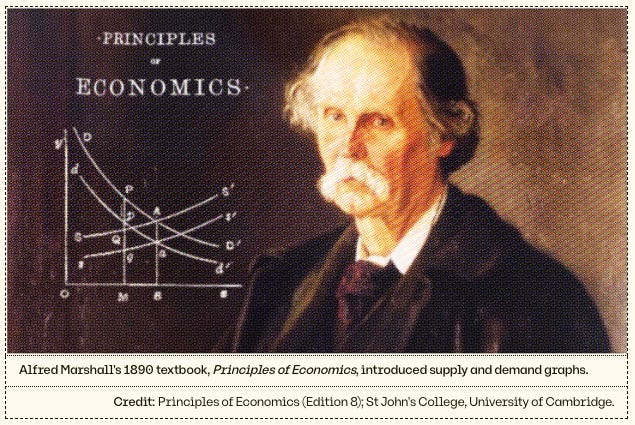
Using just these two lines, Marshall’s graph captures crucial aspects of how the behaviour of individual people and firms can combine to produce market outcomes. And, most notably for our purposes, the framework elegantly shows how shifts in supply and demand can be expected to affect market outcomes like prices and quantities.
In our experience, Marshall’s framework describes the behaviour of people and firms in a way that can generate useful predictions about real-world market outcomes. A crucial point is that these frameworks need not be detailed or precise. Instead, their value lies in their ability to abstract from complexity and generate predictions in simple directional terms.
One benefit of Marshall’s framework is that economists have applied it to many different types of goods and services. The results of these applications provide us with a large reservoir of social scientific knowledge and insight to draw upon. Of course, this isn’t to suggest that all markets behave the same—indeed, and as we shall see, housing markets have some unusual characteristics which necessitate the addition of some ‘bells and whistles’.
However before we complicate Marshall’s basic model, we should first seek to understand the direction of its predictions. And so we begin.
The housing model of supply and demand
When we talk about housing in this essay, we focus mostly on quantities—for instance, the total number of rental homes—and prices—for instance, how much those homes might typically cost to rent.2
Marshall’s model is particularly well-suited to analysing changes in quantities and prices: the chart’s horizontal axis represents quantity, while the chart’s vertical axis represents price. The basic interpretation of a single point on the chart, therefore, is a combination of a given quantity of a good that is delivered at a given price.
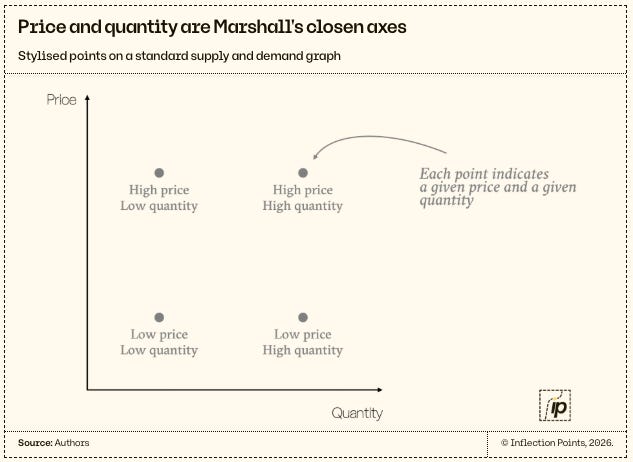
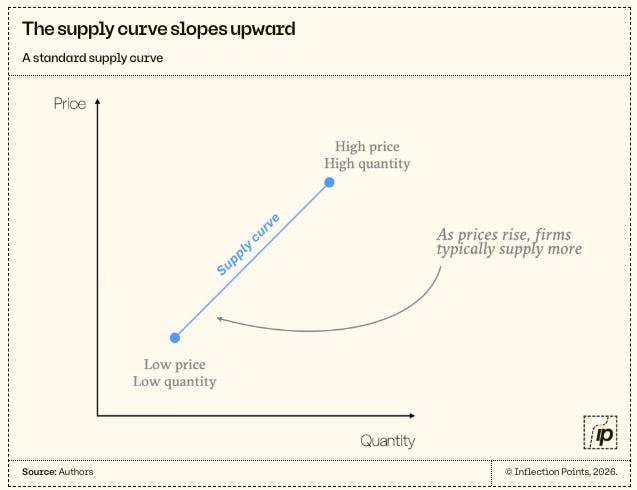
First, the supply curve describes what it costs firms—often referred to as “developers”, in the case of housing—to produce a good or service. For housing, the supply curve will incorporate the costs of inputs like labour, building materials, and land.3 We usually assume that as prices rise, firms produce more: that is, the supply-curve slopes upward. We can represent this on the chart by joining two of the points on the chart above.
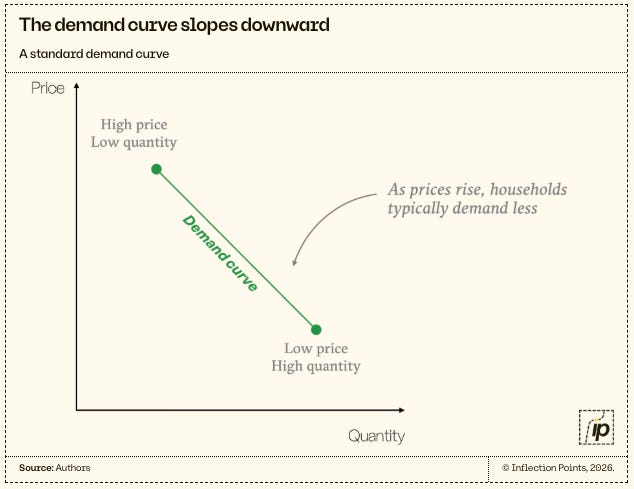
The second line is the demand curve. This describes what households are willing to pay for a good or service based on their incomes and preferences. For housing, like most goods, this relationship is negative: as prices rise, households demand less of it. That is, the demand curve slopes downward.
The point where supply and demand curves cross over (“intersect”) is called the equilibrium. At this price, producers and consumers are only just willing to trade, because the costs of production for firms exactly equals what households are willing to pay.
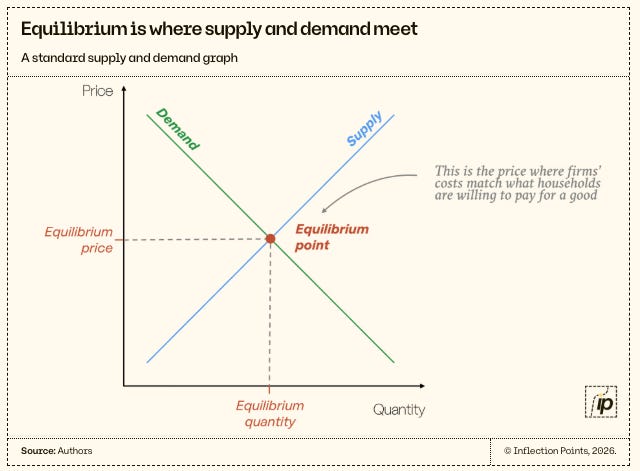
The basic shape is a cross, but Alfred Marshall found it more useful to think of the framework as a pair of scissors. Just as you can’t cut a piece of paper with one blade of scissors, he argued, you shouldn’t try to determine the equilibrium of a market without defining both the supply and the demand curves.
Supply and demand “shocks” move the model’s curves
Notwithstanding the highly stylised nature of Marshall’s framework, the basic division of markets into supply and demand is extremely useful for predicting how they will respond to the economic effects of a variety of real-world events—often referred to by economists as “shocks”.
Take, for instance, the Iran War and the subsequent closure of the Straits of Hormuz to sea freight. This event presents a recent example of a straightforward negative supply shock for many commodities, such as oil. In the latter’s case, about one-fifth of global oil production was suddenly and unexpectedly unable to reach consumers.
In this framework, the effects of this shock to oil markets can be represented as a leftward (“inwards”) shift in the supply curve. The implication is clear: when oil becomes physically more scarce, equilibrium quantities are lower and prices are higher. It’s also intuitive when you consider the lengths Australians went to secure fuel in advance of the anticipated price rise.
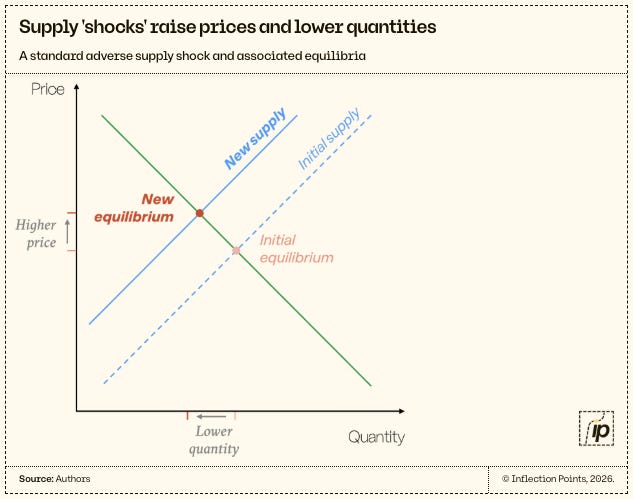
In a similar vein, we can consider how the equilibrium is impacted by demand shocks. Take, for instance, the recent emergence of AI technologies - these represent a positive demand shock for computer hardware, which has led to higher prices and, consequently, stratospheric rises in valuations of supplier firms.
The basic model can be adapted for durable housing supply
It is not uncommon for people to argue that while the economic framework of supply and demand may apply to “simple”, consumable goods and services, like oil and computer hardware, it doesn’t apply to housing. These arguments are right in one sense but wrong in another. Although the canonical framework does not accurately reflect some aspects of housing markets, research shows us how it can be straightforwardly adapted to do so.
Influential urban economists, Ed Glaeser and Jo Gyourko (henceforth “G&G”) provide us with an example of how to adapt the conventional framework to housing in their seminal work, Urban Decline and Durable Housing. In this paper, G&G observed that housing market outcomes witnessed in growing cities appear to fundamentally differ from those observed in declining cities. G&G reason this is because housing is durable—once a home is built, it will usually remain available for a long time, regardless of changes in market outcomes.
G&G then adapt the basic Marshallian framework to reflect the durability of housing. Their solution is to replace the standard upwards-sloping supply curve—as shown in the earlier examples—with a curve that kinks at the equilibrium point. At prices above this kink, the supply curve has the conventional upwards-sloping appearance. However, at prices below this kink, supply is vertical.
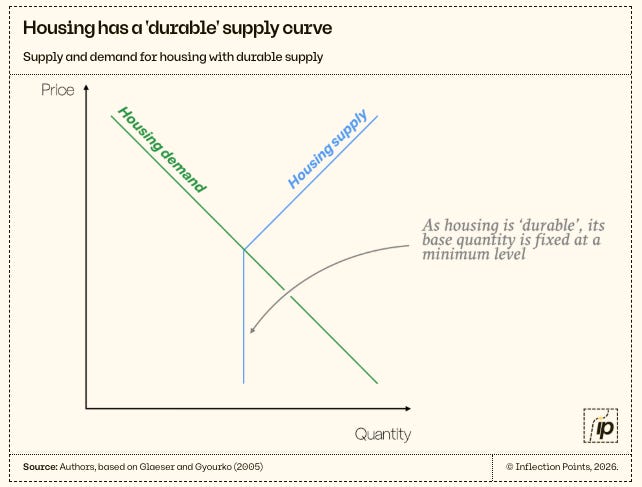
This change reflects the durability of housing in the market. With this new supply curve, rightward shifts in the demand curve continue to manifest in both higher prices and higher quantities, whereas leftwards shifts in the demand curve—negative demand shocks—manifest solely in lower prices.
This is the first way in which markets for housing are different from markets for typical goods. While housing quantities and prices do respond in the conventional way above the equilibrium point, below the equilibrium point we might better conceive of housing quantities as being fixed—at least in the short run—such that all the market response happens via changes in prices.
The basic model can be adapted for fixed land supply
Most conversations on the economics of housing need to engage with land markets. Like housing, land also has its own unique supply characteristics, articulated nicely in the frequently misattributed quote: “Buy land, they aren’t making any more of it.”4
In the spirit of G&G, we can adopt the canonical Marshallian framework to reflect the unique aspects of land markets. All that needs to be done is to represent the market for land with a vertical supply curve.
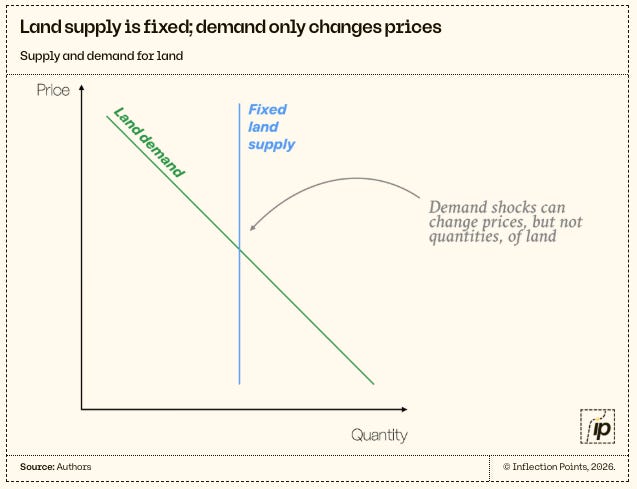
The simple implication is that there is no price point at which the supply of land can change.5Interpreting this is straightforward: changes in the demand for land, positive or negative, manifest solely as changes in the price of land, with no impact on quantity.
Putting supply and demand to work
Now that we have adapted Marshall’s framework to housing, we can formulate hypotheses about the direction of effects on prices and quantities from four examples of real-world shocks.
Christchurch’s earthquake was a negative housing supply shock
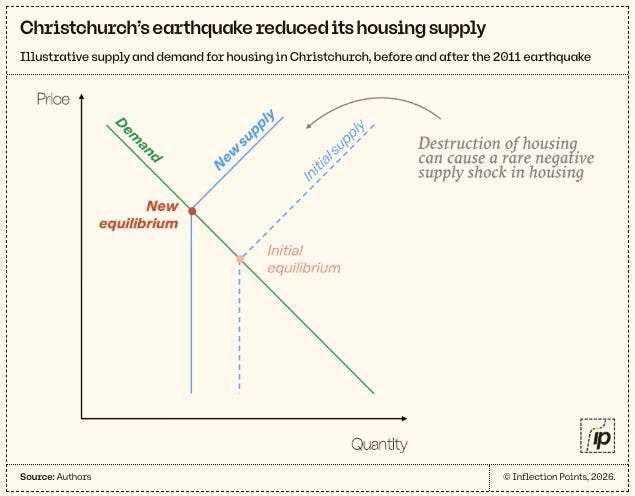
In 2011, Christchurch endured a large and tragic earthquake. In a matter of minutes, the earthquake rendered over 23,000 homes in the Christchurch City Council area uninhabitable: a large and unexpected contraction in housing supply.
Amongst the chaos, Marshall’s model was working away in the background. The loss of housing resulted in a rare leftwards shift in the ‘kinked’ housing supply curve: a reduction in the quantity of housing available in the market, accompanied by an increase in prices.6
While the earthquake’s physical damage was largely concentrated in Christchurch’s urban area, its economic damage was not. The sudden displacement of people from Christchurch meant that some households had to find alternative accommodation in neighbouring areas. In the Marshallian sense, we can think of this as a rightwards shift in the demand curve for housing in these locations, which would be predicted to increase prices and quantities.
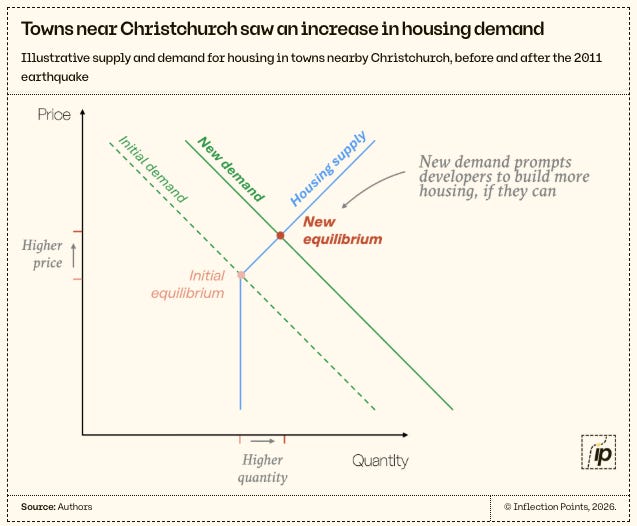
Given the immense tragedy of the event, debating the particulars of an abstract model is almost inconsequential. But Marshall’s model does help us make sense of the market response that followed: rents rose immediately after the earthquake, not just in Christchurch but also its satellite towns, confirming both of these two predictions of the simple framework.7
Flint, Michigan’s population decline is a negative demand shock
Flint, Michigan is, in many ways, a city that is struggling. Its economy was built around the now-declining automotive industry and its water supply was, more recently, contaminated by lead due to outdated infrastructure. In 1960, Flint’s population peaked at around 200,000. By 2024, that population had declined to approximately 80,000. The figure below illustrates a hypothetical decline in housing demand within our framework.
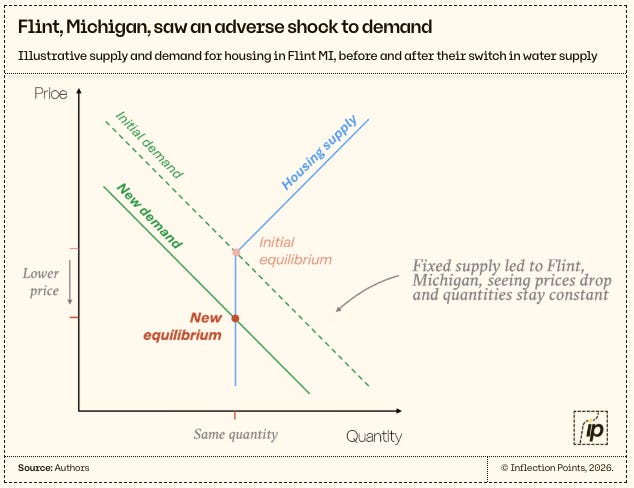
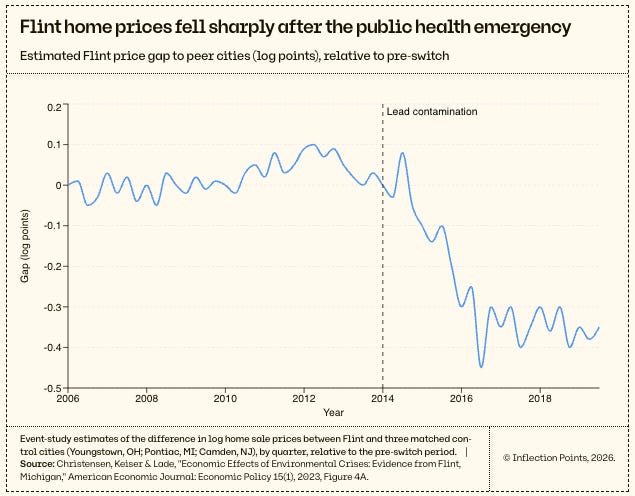
Per G&G, given the durability of housing we might expect this decline in demand to cause large falls in prices. A paper in the American Economic Journal confirms such effects. Specifically, this paper finds that lead contamination of the water supply caused house prices in Flint to decline by up to 43% relative to comparable cities. Importantly, contamination left the size of the housing stock largely unchanged—impacted houses were neither deemed off limits and nor were they demolished.8 As such, contamination is a clean negative demand shock. Quantity did not move as a result: only prices.9
For the residents of Flint, water contamination has been doubly devastating. It has both damaged public health and led to a significant decline in their wealth. Our introductory economics framework does not in itself solve these problems, but it helps us to understand why they’re in this mess and how we might begin to help them.
Australia’s first home buyer support is a positive demand shock
The last of our tragic examples originates in Canberra. In 2025, the federal Labor government announced an expansion of financial support for first home buyers. For those first home buyers purchasing properties under a given price cap, the policy provides access to 5% deposit requirements without lenders mortgage insurance (LMI).10 The policy was intended to make it easier for young Australians to buy a house.
By reducing the upfront capital that is needed to buy housing, the policy increased willingness to pay for housing, at least for some buyers. Previously, a buyer with a deposit of $150,000, for example, could borrow up to $600,000 based on a standard 20% deposit for a $750,000 house. With the first home buyer support, however, the same buyer could now afford up to $950,000 in Melbourne or $1.5 million in Sydney.
As this policy has larger effects for people who previously had lower willingness to pay, we represent the effects of this shock in our basic framework with an anticlockwise pivot, or rotation, of the demand curve. Although this is more complex than the two shifts in Flint and Christchurch, it is still a positive demand shock and has the same general direction of effect: higher prices and higher quantities in equilibrium.
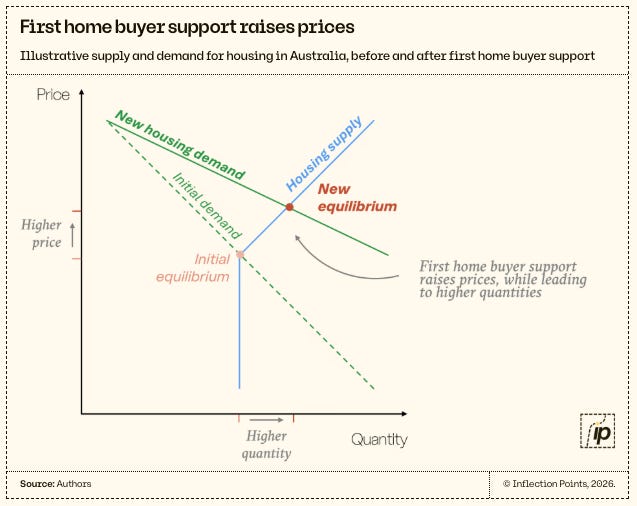
While the policy undoubtedly sounds straightforward and defensible — almost everyone agrees we should support young Australians to achieve home ownership — Alfred Marshall’s century-old model helps us to understand the likely direction and nature of its economic effects.
Auckland’s upzoning was a positive supply shock
We return now to New Zealand. This story begins in 2011, when seven councils in Auckland region were amalgamated into a single entity known as Auckland Council. Legislation required that the new Auckland Council produce a unitary plan that simplified and harmonised planning regulation across the wider region.11
In 2013, Auckland Council published the Draft Unitary Plan, which set off a three year process of consultation, hearings, and deliberations. In 2016, the Auckland Unitary Plan (AUP) was adopted, which had the effect of increasing allowable dwelling density (upzoning) across approximately 75% of Auckland’s urban land. Auckland’s experience brings the fixed land question back into the picture. But this time, it requires some slightly more careful thinking about counterfactuals.
Consider two possible situations. In the first situation, let us assume that land use policies were not, prior to the AUP, a binding constraint on the supply of housing in Auckland.12 In this situation, our economic framework would predict that the adoption of the AUP would have no effect on housing supply and, by extension, no effect on the related land market.
In the second situation, let us assume that land use policies were, prior to the AUP, a binding constraint on the supply of housing in Auckland. Here, we might use Marshall’s framework to hypothesise that the adoption of the AUP would have the following two effects:
First, the AUP pushes the supply curve for housing to the right, which causes the supply of housing to increase and prices to fall; and
Second, in doing so, the AUP also shifts the demand curve for attractive upzoned parcels to the right, which causes the land price to rise.13
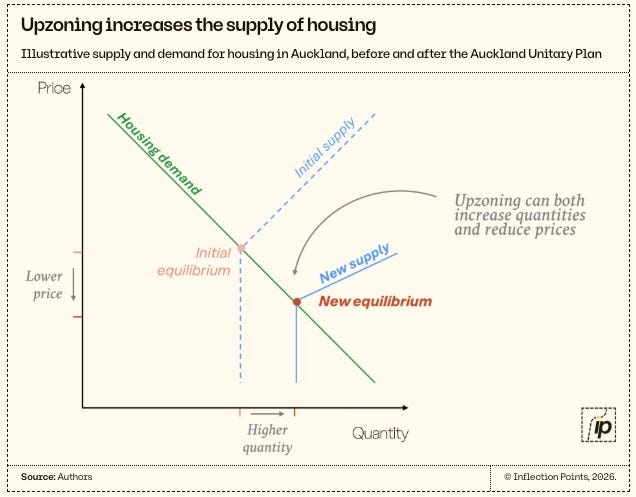
The logic behind these scenarios is simple: If land use policies were not a binding constraint on the supply of housing, then the AUP would not have affected either the housing market or the land market. In contrast, if land use policies were a binding constraint on the supply of housing, then we might expect the AUP to affect both the housing and the land markets as illustrated above.
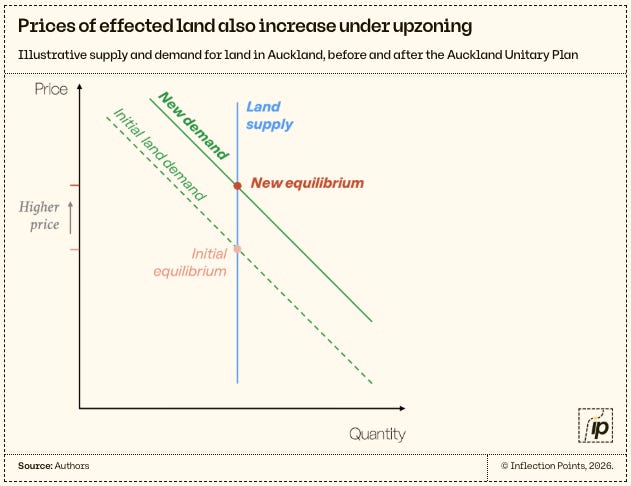
Empirical economics research finds evidence to suggest that land use policies were a binding constraint on housing supply prior to the AUP. Specifically, research finds the AUP caused:
The supply of housing to increase (as measured by consents and the supply of floorspace),
The price of housing to fall (as measured by rents and the price of floorspace), and
The price of upzoned land to increase, especially for less developed parcels.
Simply put, evidence suggests that the changes to land use policies contained in the AUP helped to reduce housing prices in Auckland—a positive supply shock as an antidote to the outcomes of events in the three previous examples.
Clear economic models can be an antidote to problematic reasoning
Each of these four case studies highlight how our introductory economics model can generate useful predictions about the direction of housing market outcomes. However, we must now consider the other side of the coin: That is, examples where economic reasoning is invoked in a manner that might cause Alfred Marshall to roll in his grave. To help the old geezer rest in peace, we see value in confronting these examples of problematic reasoning with the model the man gifted us himself.
If we want to increase housing supply, then don’t we need prices to rise?
Some commentators have argued that house prices in Australia must rise if we are to increase the supply of housing. The linked article is persuasively written and includes a graph showing housing commencements in Australia rising and falling in near-perfect tandem with movements in prices. The argument is intuitive and seductive, but unfortunately also incomplete.
First, a strong positive correlation between supply (in this case, “commencements”) and prices is entirely consistent with Marshall’s economic framework. Specifically, the framework predicts that positive demand shocks will lead to higher prices and increased quantities, and vice versa for negative demand shocks.
As such, we should not be at all surprised to observe a positive correlation between prices and supply in the data.
The problem with the argument, however, is that it makes the mistake of going further and attributing all variation in prices and quantities to shifts in demand. In doing so, it essentially ignores the potential role of supply, both in the past and in the future. This is equivalent to assuming that the housing supply curve is rigidly fixed everywhere all at once, such that it doesn’t have any role in explaining variation in prices and quantities over time.
Yet, we know that the housing supply curve can shift in response to technology, productivity, input costs, and – yes – policy. It’s hard to believe, for example, that a large subsidy to developers would have no impact on the quantity of housing supplied. Similarly, it is easy to imagine that an increase in construction costs would shift the housing supply curve left, at least initially until it partly flows through into land markets.
Simply put, it’s entirely possible for shifts in the supply curve to also affect prices and quantities.
Why would developers supply housing when prices are falling?
In a similar vein to the previous example, we’ve often seen people ask why private developers would supply housing when prices are falling.14
Although this concern seems superficially reasonable, our trusty framework already captures this behaviour in the supply curve. More specifically, the reason the supply curve slopes up is precisely because we expect individual developers will indeed supply more housing when prices are high and vice versa.
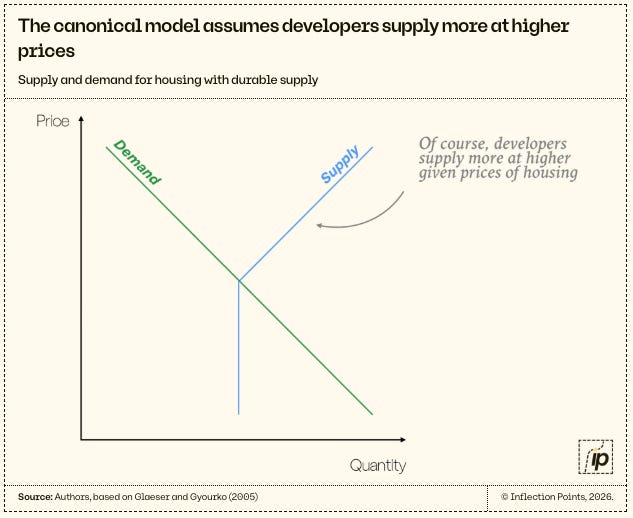
But there is another, more subtle problem with this question: it attempts to predict broader market outcomes by reasoning from price movements and individual behaviour. In doing so, the argument implicitly reverses the direction of causality in the Marshallian framework. Specifically, within the standard model—equilibrium prices are caused, or result from, the intersection of supply and demand, not the other way around.
Prices are something we can readily observe in data, so it is unsurprising that they receive a lot of attention. In our canonical framework, however, equilibrium prices are caused by supply and demand, and associated shocks. If prices are rising, then we should ask if this is due to increased demand (e.g. due to a positive demand shock, like Australia’s first home buyer grants), reduced supply (e.g. due to a negative supply shock, like the Christchurch Earthquake), or possibly a combination of both.
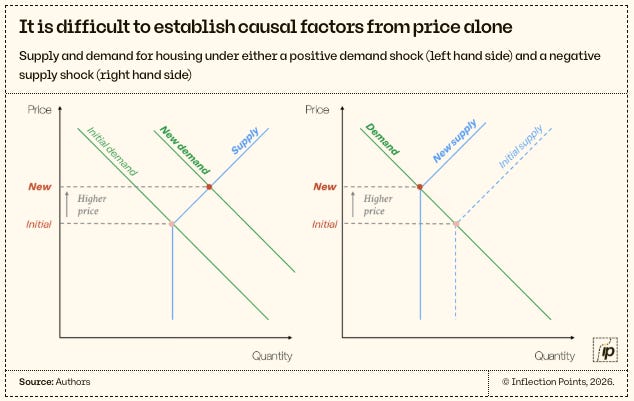
Reasoning from prices is intuitive when you think about the behaviour of individual developers. Of course, some individual developers will reduce their supply of housing when prices fall—indeed, this is why the supply curve slopes up.
However, the market is not represented by a single housing developer; instead, the supply curve includes a multitude of active developers, all of whom will face different cost structures. Developers with high holding costs, for example, will be less inclined to wait when prices fall, whereas developers with low holding costs will be more inclined to wait. Even in markets where prices are falling, the most profitable course of action for some developers will be to continue to supply housing.
It is critical to remember that price movements on their own don’t tell us much about the underlying causes of market outcomes. If, for example, prices are falling because the supply curve has shifted outwards, as appears to have happened with the AUP in Auckland, then we might expect quantities to increase. Similarly, if the government were to subsidise construction costs (e.g. through the removal of GST) it is likely we would see developers expanding production in the face of declining housing prices.
The lesson here is that we need to look at both price and quantities to get useful insights into what is happening in the market. In this case, Marshall’s scissors analogy can help us to cut through.
But we upzoned and (still) got higher prices?
Our third and final problematic example highlights the need to apply this conventional economic framework somewhat judiciously.
We have often encountered arguments along the lines of, “average rents in a city increased after upzoning”. This argument is superficially appealing because it reasons about the change in outcomes before and after a policy intervention.
However, the key issue with these arguments is that they do not carefully define the “counterfactual”—that is, what would have happened in the absence of upzoning. In situations where some locations in a city were upzoned whereas others were not, we need to think about this carefully before concluding any policy effects.
To use a medical analogy, we do not evaluate new medicines based on how people felt before and after taking the medicine. Rather, we compare outcomes for people who received the medicine with those who did not. In this case, the latter group provides the counterfactual to which we can compare outcomes.
Returning to the example of the Auckland Unitary Plan, data shows that prior to upzoning Auckland shared a similar rental price trend to the rest of New Zealand. We also see that, along with the rest of the country, rents in Auckland continued to increase following upzoning.
Notably, though, the growth in rents experienced in Auckland after the Unitary Plan was significantly lower than the growth observed in other comparable urban centres that did not change their land use policies. This is particularly remarkable when you also consider the high levels of income and population growth that Auckland experienced compared to other urban areas.
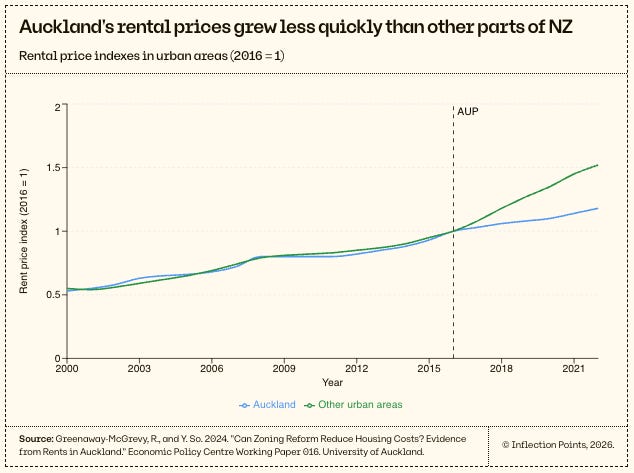
The key implication here is that rents in Auckland do, in fact, appear to have declined (in real terms) after the AUP compared to what we would otherwise expect them to be. These effects are entirely consistent with the conventional Marshallian framework when we compare outcomes to an appropriate counterfactual.
The core takeaway here is that in all housing policy analysis, be wary of any conclusions that reason purely from the basis of what was observed to have happened without considering carefully what might have otherwise occurred had we done something else, or even nothing at all.
Econ 101 is neither useless nor sacred
While we recommend adopting the conventional supply and demand framework as a useful starting point, we do not want to suggest that it also represents our final destination. Simple models are suited to understanding simple problems. Unfortunately, our problems are rarely simple. Does complexity invalidate the conventional economic framework? No. In our view it just means the conventional framework may need to be further enriched to better capture real-world complexity.
In fact, much of the modern economic research into housing seeks to adapt basic models to capture salient facts about housing markets. Most research begins with a basic model, even if it doesn’t end there. The economic literature is awash with advanced theoretical and empirical research that seeks to extend basic models to capture more complex phenomena, such as spatial spillovers and other complex dynamics. Look into these models in depth though, and you will almost certainly see a common theme—no matter which way they have been cut, they almost always invoke Marshall’s scissors, and usually in multiple markets at once.
As a final remark: one of the fallacies of humans is their tendency towards the complex. It should be seen as no coincidence that many of history’s greatest thinkers are those who have delivered simplicity and elegance to what seemed to be wickedly complex subjects—Newton, Einstein, Russell, Darwin, Curie, the list goes on. Were these great minds around today, we suspect their advice would almost certainly be to follow the path of simplicity as far as it will take you, and to only then begin to complicate things: carefully, judiciously, and with humility.
Stuart is a Senior Fellow at Motu Research.
Kade is an Associate at SGS Economics and Planning.
This article has been written by Stuart and Kade in a personal capacity. All views and opinions expressed in this article are their own and should not be considered to reflect those of their employers.
A range of other housing outcomes, including questions of quality and distribution, are clearly also important. Though, they represent clear extensions to the basic model which are best left to a subsequent essay once the foundations are established.
With the notable exception of land, this essay does not consider the economic mechanisms through which the prices of inputs into the production of housing are set.
This quote is often attributed to Mark Twain, although no original citation is available.
In technical terms, economists would describe land as having perfectly inelastic supply. That said, policy can and does affect the supply of land for housing.
Specifically, rents.
It is worth noting that prices subsequently fell, possibly because of the sorts of the supply-side reforms that we discuss in the fourth example.
Such processes can have second order effects, whereby the significant decline in house values had a negative impact on the wealth and mobility of the affected population.
Panel A (Figure 4 from the original paper) shows Flint home prices were flat relative to control cities before the 2014 water switch. They then progressively dropped following the switch away from the Detroit water system (the cause of the lead contamination) and the declaration of a public health emergency.
Although the LMI costs still exist, the policy spreads these costs across all tax payers. In addition to these, there are additional State-level stackable incentives which are also available to first home buyers. Examples are Stamp Duty and $10,000 first home grants in NSW.
A binding constraint can be thought of as a policy position which forces a market to operate at a point below (or above) its optimal equilibrium price point, as given by the intersection of supply and demand. These can be either forced upon the market directly (e.g. via a price ceiling) or through policy which impacts the shape or level of the supply or demand curve.
The AUP could cause supply curves to shift via various channels. For example, the AUP required less land to be bundled with each dwelling (i.e. the density effect), leading to lower costs of land per dwelling. Similarly, the AUP allows the fixed costs of construction to be spread over more dwellings. Finally, the AUP increased the supply of developable parcels, which would be expected to increase competition between land owners and temper the effects of the increase in land prices.
Note that in a competitive development market we can consider developers to be distinct from landowners in that they generate value added output. Developers can profit from the delivery of housing whereas landowners profit from speculation on current versus future potential pay-offs. We emphasise that this does not preclude situations where the landowner is also the developer.
Excellent piece, I really appreciated how the updated housing supply model is linked to observable real world events. 👏🏻
One further complication is that new housing does not enter the market at a price determined simply by construction costs. Its selling price is anchored to comparable homes in the existing stock. A developer has little reason to sell substantially below what buyers are already willing to pay for a similar location and product. Lower costs may therefore improve feasibility or increase residual land value without passing fully into lower house prices.
Land also functions as a financial asset and, in effect, as an option on future development. The owner compares the return from developing and selling now with the expected return from waiting, after accounting for holding costs, financing, future prices and policy changes. Feasibility is therefore necessary, but not always sufficient to trigger construction.
Government measures intended to increase production can themselves alter that calculation. If developers expect future subsidies, guarantees, infrastructure investment or more favourable planning conditions, starting today may mean giving up benefits available tomorrow. Measures that raise expected future house or land values can similarly increase the value of waiting.
This does not mean that support always delays construction. Well-designed, time-limited and conditional measures can accelerate it. But repeated rescue packages or open-ended negotiations may teach landowners and developers that delay will eventually be rewarded.
A housing-market model therefore needs to explain more than how many homes can be built at a given price. It also needs to explain when owners choose to develop, what they expect government to do next, and how policy changes the relative returns from building and waiting.