


Danielle Wood is the Chair of the Productivity Commission.
You can read this article in-full at inflectionpoints.work.
The green and golden bell frog is about as Australian as an amphibian gets.1 The native frog is named for its pea-green colouring, with racing stripes of gold. It’s one of the few Australian frogs known to sunbake. And it’s a big eater, chowing down on flying insects, water snails, and other delicacies.
A green and gold sunbather—it could be our national emblem. But unfortunately, the frog is emblematic less of our sun-kissed national identity and more of our sclerotic regulatory system.
The frog, once common on the New South Wales coast and tablelands, is endangered.
In 2022, the non-profit Mulloon Institute and a local landowner hatched a plan to restore the frog’s habitat in the Southern Tablelands. They would install logs and rocks in the Molonglo River, restore flood flows through minor earthworks, and construct two wetlands. The project received about $170,000 of NSW Government funding.
The plans were finished that year. But work on the project was far from beginning.
First, the Institute had to obtain a Biodiversity Development Assessment Report. Then the approvals marathon began. Initially, the Institute thought the work could be approved by the local council. But in December 2022, state legislation changed, and a different application had to go to the NSW government. They submitted their application in June 2023. Seven months later, they were told it was the wrong type of application, and they had to submit a different application to a different body.2
The project was eventually approved in December 2024, more than two years after the plans were finished. The works were completed in February 2025. Sadly, it was too late for the green and golden bell frog, which had become locally extinct while the approval process stalled.3

Tell this anecdote at a party and you will get knowing laughs and eye rolls.
It confirms what we suspect: regulation can be cumbersome and its outcomes an affront to common sense. What are those idiots in the bureaucracy doing?
But as much as we malign politicians and public servants, no regulation began with a vision to kill off a rare frog. Or to make it slow and expensive to supply new housing. Or to make a national retailer comply with half a dozen rules defining an acceptable plastic bag. But this is where we have ended up.
Regulations reflect our social preferences—the things we collectively want to see more or less of. Those preferences are expressed in legal rules that dictate what can be done, when, where, how, and by whom.
Regulations are demanded, designed, and enforced by humans. And so it is no surprise they are shaped by the incentives, fears, and biases of those humans.
These forces have pushed us towards outcomes that satisfy no one.
We can build a better approach—one that makes it easier to build, innovate, provide services, and save frogs. But to do that, we first need to understand why efforts to regulate away our problems all too often create new ones.
Regulatory hairballs all the way down
Everyone has a Kafka story to share: home extension approval dramas, labyrinthine business reporting rules, liquor licensing delays that threaten the school fete. Wasn’t it easier to just get things done back in the day?
As a matter of fact, it was. Our regulatory burden has grown: the number of restrictive terms in Commonwealth Acts of Parliament and legislative instruments grew dramatically in the two decades to 2020.
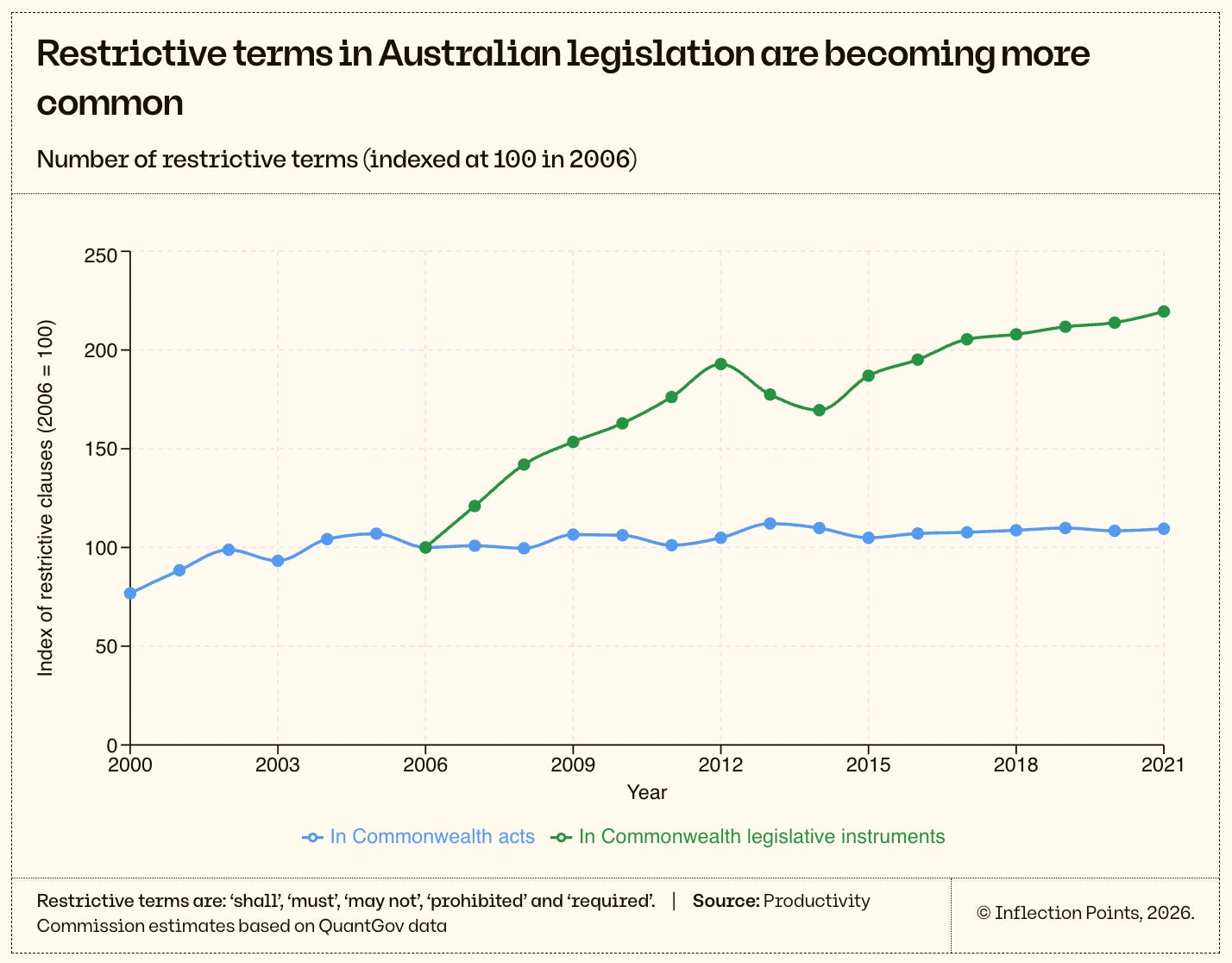
In practice, this looks like ever-more approval hoops to get anything done. In Brisbane, it takes 31 approval steps to open a café.4 Until recently, federal environmental approvals for wind energy projects could add $5 million in costs and months of delays.5
No wonder that Australia’s ranking in the World Bank’s Ease of Doing Business Index has fallen in the past 20 years.
Governments aren’t the only ones tying themselves in red-tape knots. Anyone who has worked in a large business will tell you that their stock of policies and procedures grows faster than remuneration packages.
The cost to comply with all this regulation can be eye-watering. Macquarie estimated it spent $1.2 billion on compliance in 2025, up from $405 million in 2017. AGL expects to spend $28 million meeting new and changing regulations in 2026.
Ticking all these boxes takes time. Corporate boards devoted 55% of their time to risk and compliance issues in 2025, up from 24% in 2015. For small business owners, it means less time on the tools, and less time to think about how they might expand.
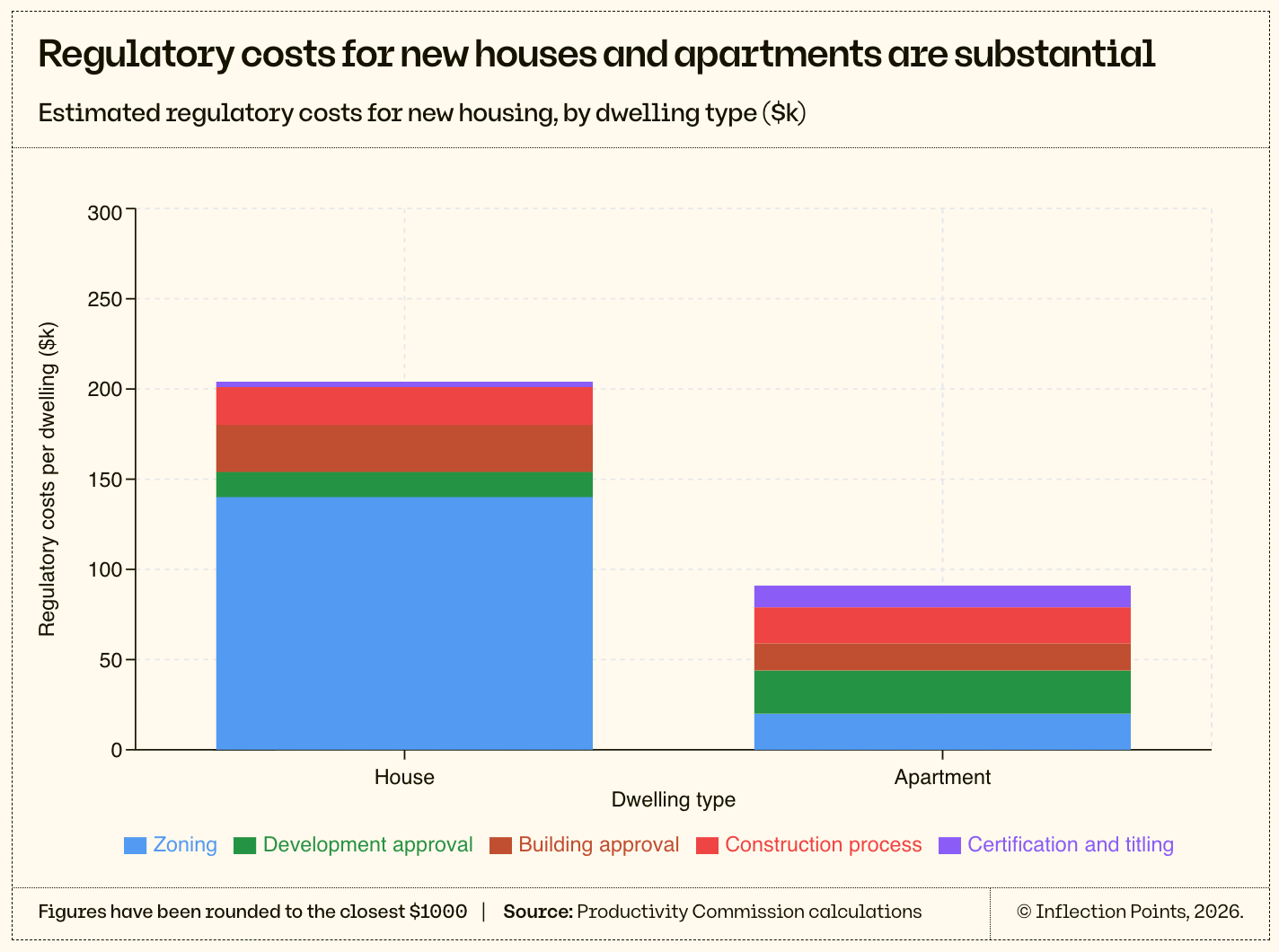
The burden of regulation isn’t just about volume. The oppressiveness—the bite—of the rules also matters: how much activity they prohibit that would have otherwise occurred. In our major cities, for example, regulations add about $200,000 to the cost of a new house, and $90,000 to the cost of a new unit. That pushes a lot of potentially feasible developments into the ‘doesn’t stack up’ column, leading to fewer houses being built.
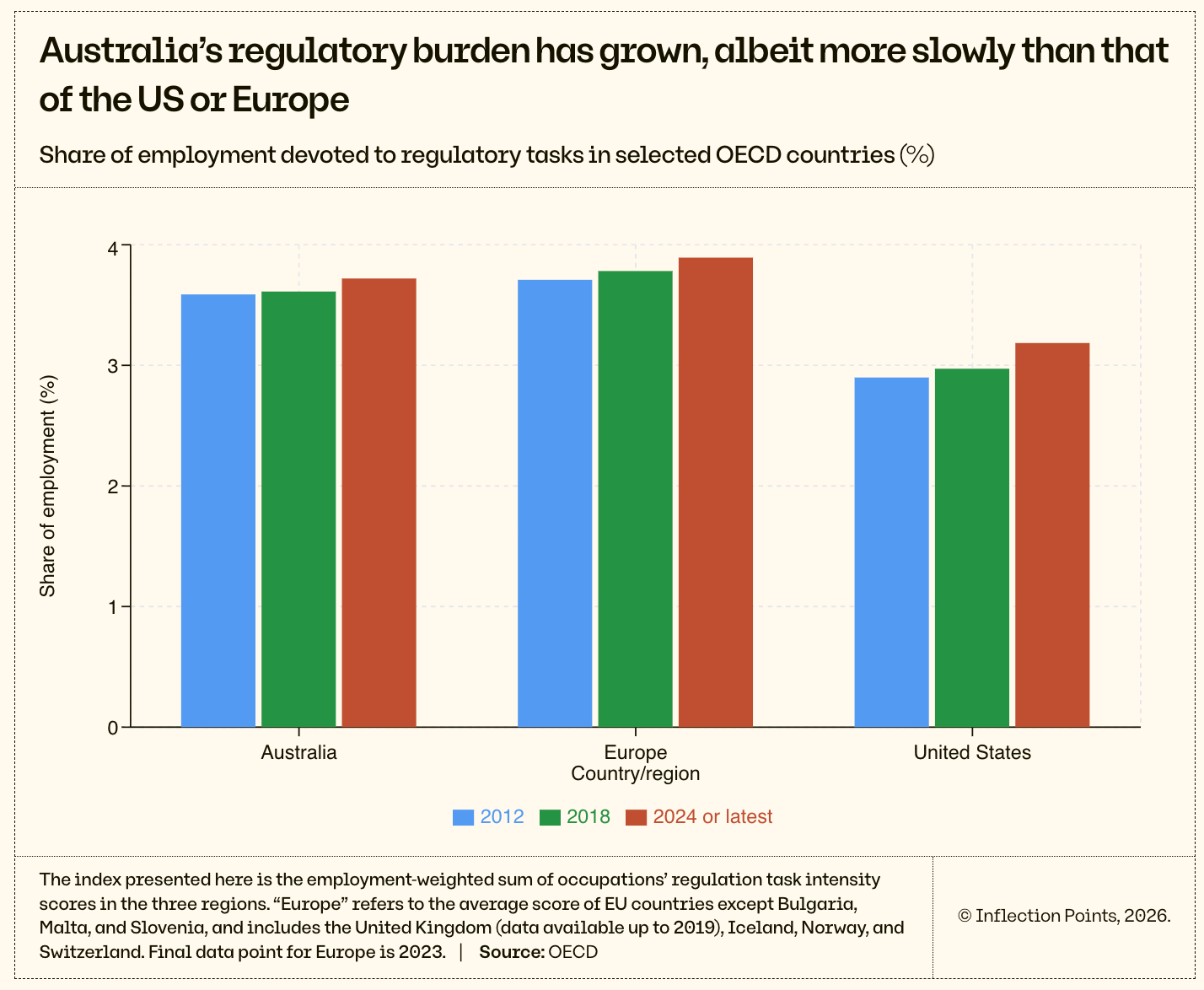
This isn’t just because Australia is a nation of rule-loving shiny-shoed prefects; the same regulatory drift can be seen in many developed countries. Indeed, on some measures, our regulatory burden has grown less than the US or Europe.
To regulate is human
Red tape hasn’t proliferated by accident. Our changing social risk appetite drives demand for new regulations. And that demand is supercharged by our political structures, which mean more regulation is the reflex response to any crisis or thorny issue.
A declining risk appetite leads to a growing regulation appetite
We can’t lay all the red-tape blame at the feet of hapless bureaucrats or politicians. The desire for more regulation ultimately stems from Australians’ risk appetite. Across the world, the prevalence of red tape is correlated with a society’s preference for ‘uncertainty avoidance’ – in other words, risk appetite. As we get richer and more comfortable, we can afford to be less tolerant of risks.
Economists have earned their stripes as ‘the dismal profession’ by studying how much people are willing to pay to avoid a death. For Australia, it’s estimated to be about $9 million.6 And that value only grows as we get richer.7
Higher-income households are also typically willing to pay more for less risk to their services, such as reducing electricity blackouts.
This changing risk appetite manifests in greater expectations on governments to prevent and minimise harms— more regulation.
Our demand for more and better regulation has led to positive outcomes—fewer deaths from workplace accidents8 and car crashes,9 and less lead in the atmosphere.10
But we’re predictably irrational in the way we assess risk.11 We can be swept into frenzies about risks that weren’t even on our radar before (was anyone tracking the risk of needles in strawberries before 2018?), demanding politicians ‘do something’ before a cost-benefit analysis can even get its shoes on.
This creates asymmetric incentives. Non-existent entities—the business that didn’t get started, the granny flat that didn’t get built, the tradie who didn’t move across state lines—are by definition less visible and vocal.
Yet a policy maker or regulator who fails to foresee and mitigate a risk that materialises will be castigated. Coronial inquests, royal commissions, and Senate Estimates have the benefit of hindsight: it’s easy to see the errors that were made and the tears in the net. As a South Australian coroner admitted:
The temptation to criticise the minutiae of every decision that was taken by a group of individuals or by the individuals themselves is sometimes difficult to resist.
The incentive for ‘just in case’ regulations, and a cautious interpretation of those on the books, is strong. And there’s not much pull in the other direction. How many policy makers get a public commendation when they choose not to regulate?
Crises trigger a regulatory reflex
Nowhere are these dynamics more evident than in a crisis. When a tragedy occurs, we want to know why it happened, and how we can stop it happening again.
Governments face immense and immediate pressure to serve a response up in the media and parliament. Experts might be called on for solutions within hours of a calamity. Like giving a three-year-old a band-aid for a headache, it’s the gesture that counts more than the outcome.
Some have termed this ‘performative empathy’, but I think this is too harsh. Politicians’ empathy is real, but in the heat of the moment it is very hard to admit that sometimes bad things happen, or even that a good policy response will take time.
Performative regulation is closer to the mark.
We’ve seen this regulatory reflex in response to many crises, from live cattle exports to alcohol-fuelled violence.
A flash ban on live cattle exports created a decade of problems
On 30 May 2011, Four Corners aired shocking footage of cruelty to Australian cattle in overseas abattoirs. There was an immediate public outcry. Within days, a petition for live exports to be banned received 100,000 signatures, and independent and Greens MPs called on the government to respond.
Ten days later, the Gillard Government banned all live cattle exports to Indonesia for six months, announced an independent review, and began developing a new regulatory regime, the Exporter Supply Chain Assurance System (ESCAS). The system was in place by 6 July, and exports resumed from 10 August, before the independent reviewer had even reported back, on 31 August.
The lightning-fast policy response created more than a decade of headaches. In 2020, a court ruled that the initial export ban was invalid: the Minister was ‘capricious and unreasonable’ in not considering a more nuanced policy response that recognised some exporters already had animal welfare assurance systems in place. Compensation claims are still being contested.
In 2020, a review of the regulatory regime found that, while it had lifted animal welfare standards, some of the technical details had been neglected:
The business processes for ESCAS applications, from both an industry and a departmental perspective, were outdated. The underpinning technology does not facilitate accurate and easy applications from industry and does not support departmental decision makers in reaching efficient decisions.
No matter how worthy the goal, good policy takes time.
Fast-tracked lockout laws decimated Sydney’s nightlife
A similar rush to regulate was evident in the NSW Government’s response to an awful incident in 2014 in which an 18-year-old man died after a random, alcohol-fuelled punch in Sydney. His grieving family and community urged politicians to tackle alcohol-fuelled violence.
Facing intense media pressure, the NSW Government announced changes to liquor licensing three weeks later to specify lockout and ‘last drinks’ times. The laws were passed before a regulatory impact statement or broader consultation could be undertaken, and were in force barely a month after the tragedy.
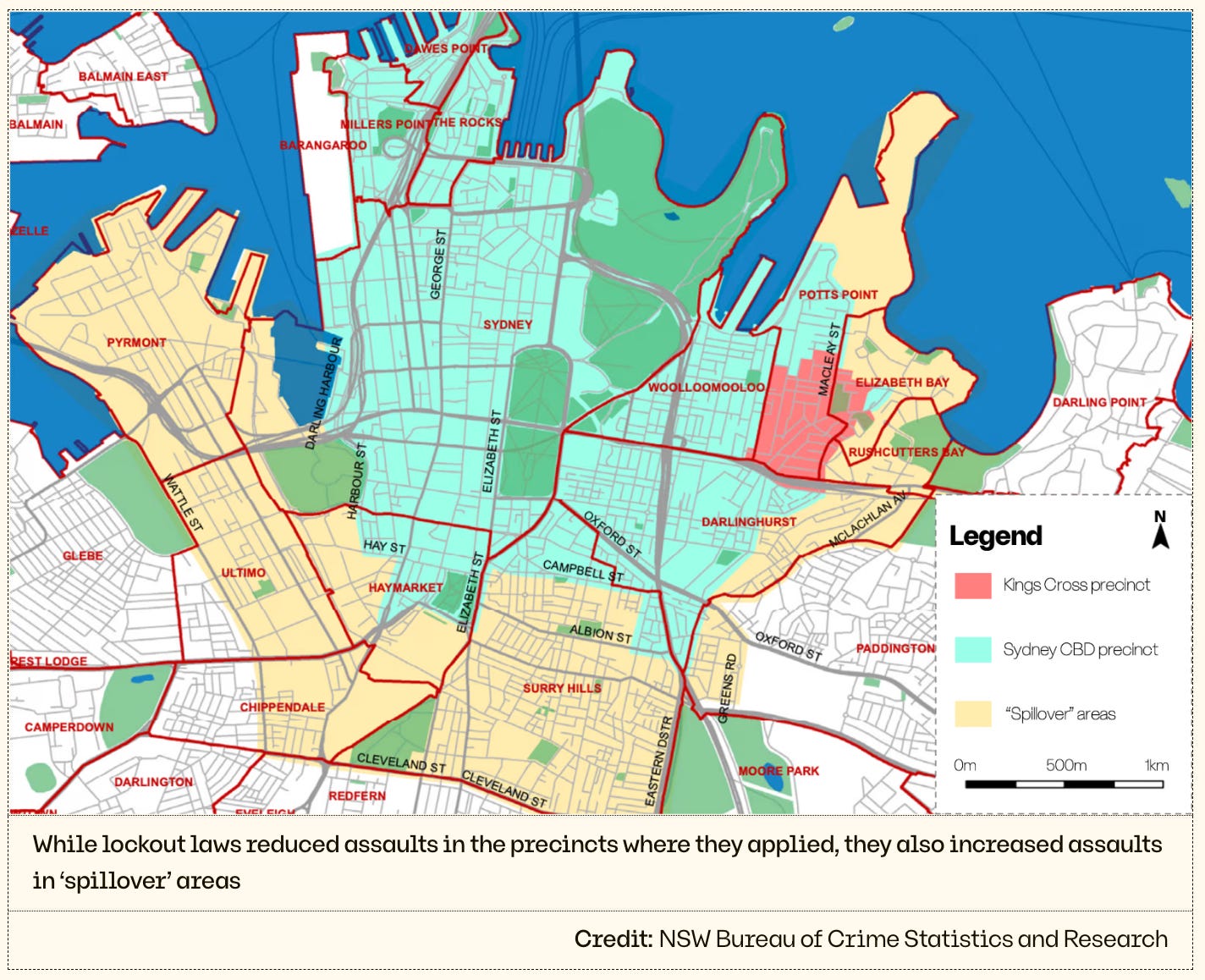
Lockout laws reduced assaults in the precincts where they applied. But they also increased assaults in nearby ‘spillover’ areas and decimated Sydney’s night-time economy. The tide of public opinion turned, and they were ultimately relaxed from 2020.
Staring down a crisis
It takes a brave politician to stare down a crisis. As one American lobbyist put it: ‘the things Congress does best are nothing and overreacting’.
But there are a few willing to hold the line until level heads can assess the right response. As UK Prime Minister, Tony Blair signalled he would not respond to every crisis with a regulatory reflex:
Instead of the ‘something must be done’ cry that goes up every time there is a problem or a ‘scandal’, we make it clear we will reflect first and regulate only after reflection… We cannot respond to every accident by trying to guarantee ever more tiny margins of safety. We cannot eliminate risk. We have to live with it, manage it. Sometimes we have to accept: no-one is to blame.
The only recent Australian example I can recall is the South Australian premier resisting calls for an inquiry following a serious accident at the Tour Down Under. “I’m reluctant to overreact to it given that it is such a freak occurrence,” he said. If only more were willing to utter those words.
Regulations seem like an easy response to hard problems
Governments increasingly default to regulation when they can’t, or aren’t willing to, actually ‘solve’ a tough problem. It feels like a get-out-of-jail-free card: a way to stake out a position with minimal budgetary cost.
This is particularly evident in our growing business reporting requirements. Businesses are now required to report on slavery in their supply chains, on the climate emissions of their suppliers, and on their gender pay gaps.
Publishing information that enables customers and workers to make informed decisions might feel like an unambiguously good, even pro-market, thing to do. But, like everything, it has a cost.12 The original estimate of the costs for businesses to comply with climate-related financial disclosures exceeded $1.4 billion a year, although the government has since reduced the number of businesses that will be required to report.13
Still, even smaller businesses can be caught in the compliance net. Some regulations oblige larger firms to report on the impacts of their whole supply chain, so small businesses can find themselves drowning in ‘white tape’ imposed by a larger business. Modern slavery laws ask businesses with revenue over $100 million to report on the activities of their suppliers—typically hundreds, if not thousands, of other firms.14 And there are fears that white tape will proliferate further as sustainability disclosure requirements are fully phased in.15
Yet, while painful for businesses, these costs may be less salient to a politician looking for a way to ‘do something’ without hitting the underlying cash balance. No one wants to be the heartless bastard who admits that there are no easy solutions to the hard problems.
The impulse to add, but not subtract, is strong
Another cause of our regulatory bloat is that the incentives in the system push us to add but not subtract.
Every interest group pushes its own barrow making the case for some new rule to be introduced. But the cumulative effect of all these individual causes can be an administrative ‘tragedy of the commons’. As an early scholar of red tape put it in 1977:
Every restraint and requirement originates in somebody’s demand for it. Of course, each person does not will them all... But there are so many of us, and such a diversity of interests among us, that modest individual demands result in great stacks of official paper and bewildering procedural mazes.
And when new problems arise, the common response is to patch the existing framework—carve out an exception, tighten a standard, add reporting, create a new oversight body—rather than to repeal or simplify. Businesses themselves take some of the blame: every creative loophole exploited demands another layer of increasingly prescriptive rules to try to close it.
Yet it is the cumulative effect of these regulatory patches, and the associated overlap and complexity created, that businesses most commonly complain of. Even regulators acknowledge the challenge. In the words of former ASIC Chair Joe Longo:
Each new legislative reform is, of course, well-intended. It’s meant to solve a real and present problem at a particular time. But done in isolation, short term, reactive and specific legislative threads woven together can look less like an elegant tapestry and more like a painting by Jackson Pollock.
Once a regulatory approach is chosen, institutions, expertise, and systems are built around it, making reversal costly and politically difficult. And so even when regulations are reviewed, it is rare that this exercise starts with a ‘blank sheet of paper’. Most reviews are set up with narrow terms of reference and asked to consider how to make a particular patch of policy better.

This primes reviewers to fortify rather than unwind. Demanding more data, more coordination bodies, and more strategies is easier than getting dirty in the often-contested details of calling for a policy change which has clear winners and losers.16
I won’t lie: my Productivity Commission colleagues and I struggle with this in our own work every day. It is very difficult to resist the impulse to make the messy world neater and more manageable on paper.
On top of the ongoing discipline required to make sure reviewers aren’t simply adding to the problem, there is a question of whether the number of reviews themselves represent a form of regulatory burden.
Damien Nicks, the CEO of AGL, confessed that his organisation had engaged in 250 regulatory consultation processes in a single year—almost one per working day. Non-profit organisations aren’t exempt either: one review estimated the sector had lodged 29,000 pages of submissions to various inquiries over 30 years.17
Even as a member of the ‘review industrial complex’, I find these figures confronting.
The answer is not to eliminate reviews or consultation; both are absolutely part of good policy making. But when you have sector reviews tripping over each other or when you have reviews recommending ever more reviews, at some point the music has to stop.18
It’s hard to give up regulatory control
One last reason for the proliferation of regulations is the proliferation of jurisdictions with regulations.
Driving a truck along a single road can require permission from several local governments, each imposing different rules. A business operating across state borders might contend with different standards for everything from carpets to beef to household electronics.
Even if nationally harmonised, importing or exporting businesses face additional barriers when Australia’s standards differ from international counterparts. For instance, Australian sunscreen producers have to undertake a different broad-spectrum test to supply another country, while furniture retailers must unbox and label products to comply with Australian rules on toppling furniture.
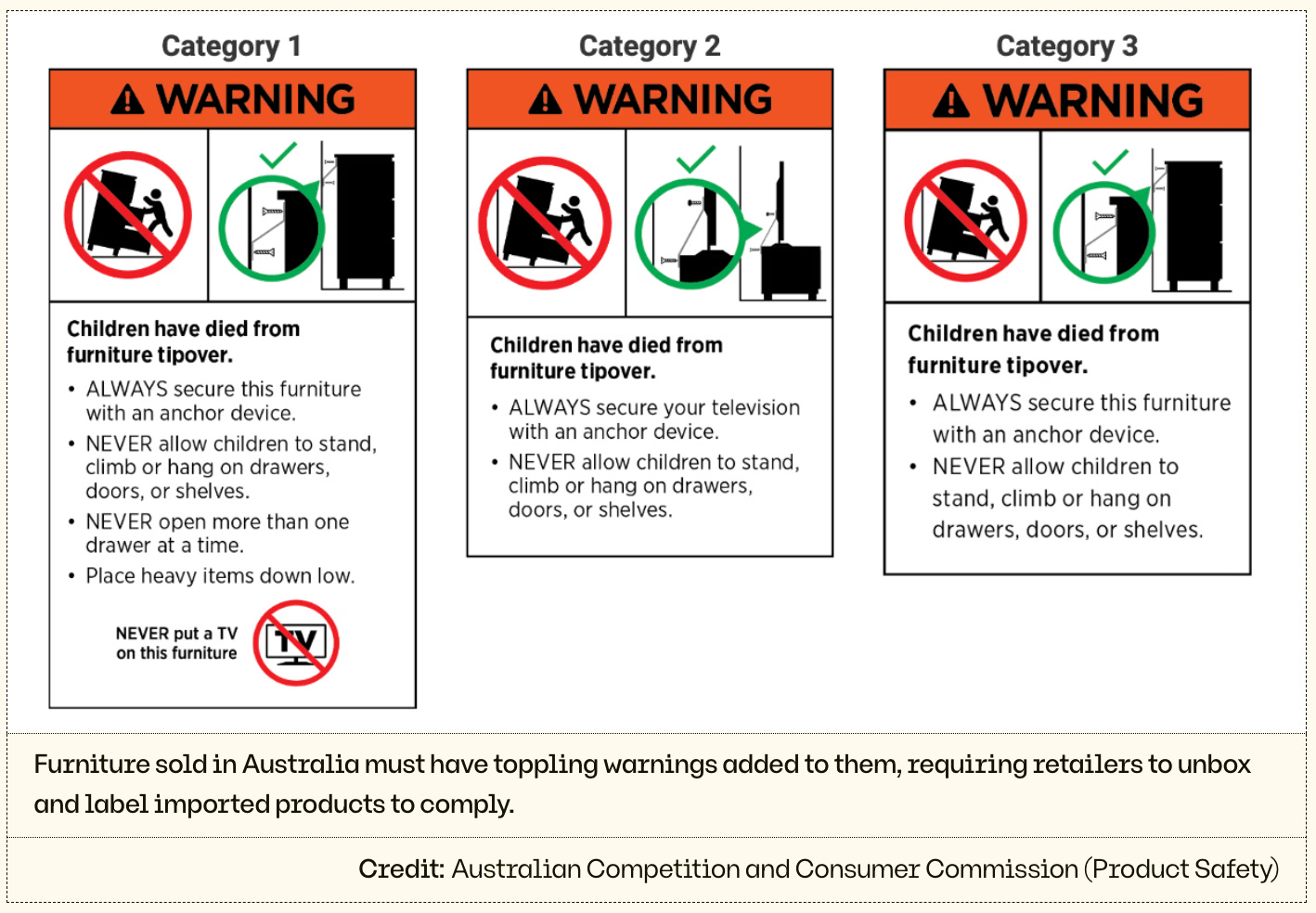
It’s a leap of faith for local leaders to give up regulatory sovereignty to a national or international regulator they can’t directly influence, and whose processes and risk tolerances they can’t fully see. Keeping local restrictions in place ‘just in case’ can feel easier. In housing, we have a gargantuan National Construction Code that’s 2,000 pages long—600 pages of which are devoted to state and territory variations. Local governments bolt on their own requirements too.
This dynamic plays out regularly in the European Union. Countries often ‘gold-plate’ EU regulations—retaining national legislation and creating a dual regulatory regime, or applying the regulation more broadly or more stringently than agreed—adding to complexity for consumers and businesses operating in the (theoretically) single market.
It’s tempting to believe that every state or council area is special in its own way, and needs a custom regulatory approach that takes account of its local circumstances. That’s true in some cases—the benefit from cyclone-proofing housing codes looks very different in Tasmania compared to the Northern Territory.
But too often, this looks more like a narcissism of small differences than genuinely different circumstances requiring a different approach. There’s no amount of state pride that can justify eight subtly different container deposit schemes.
Good enforcement is hard to find
New laws and regulations are only as good as their enforcement. And the uncomfortable fact is that the regulator most policy makers have in their head when they design a regime isn’t the regulator they get in practice. Yes, dynamic, risk-responsive, and consistent regulators exist, but they are not the norm.
Regulators are set up with a mandate to guard the public interest. It is in their interest to avoid missing a problem in their patch. New technologies—a new building technique or process for sharing information—look an awful lot like downside risk for a regulator. The gains from greater productivity are accrued by others.
Under this incentive structure, it is a steely leader who takes a cost-benefit approach through demands that nothing go wrong. “Computer says no” is the far easier answer.
The regulator’s talent and culture also matter. Sometimes long timelines and convoluted processes come not from excessive caution but from apathy and poor accountability.
This is where Kafka begins to rear his head: the staff member that fails to make the critical decision or brief in a colleague before going on leave; the request for information that is impossible to produce; the Gordian knot of interdependent approvals; the business seeking information about how to comply that is told the regulator won’t give advice.
Long assessment times, a disproportionate focus on low-grade conduct, inconsistency or arbitrariness in decisions can all be warning signs of problems with regulatory culture. And they have real world consequences. As one Queensland tourism operator said:
We have downsized our business as the regulatory headaches were excessive and stressful. I have been reduced to tears when dealing with inflexible regulatory bodies, including being threatened with fines for not providing ABS information (for a business that no longer operates), and threatened with having permits cancelled when I forgot to lodge a return. The bureaucrats who work in government appear to have no idea about running a business where you spend your own money and mortgage your home as bank security for the business.
Tipping the scales back
Regulations will always have an essential role in the flourishing of society.
They ensure our food is safe, our houses don’t collapse, and markets function fairly. And as technologies and social preferences change, new regulations should be developed.
But given the strong psychological and social forces that push us towards ever-more regulation, we need some ballast to bring more balance to regulatory decisions.
Hold the line on red tape across government
The Albanese Government recently committed to cutting red tape costs by $10.2 billion a year, following a similar recommendation in our recent report. Red tape targets like these send a crucial signal from ministers that deregulation is a government priority.
But periodically tackling the build-up of regulation isn’t enough.19 Without steps to stem the flow, new regulations quickly replace those repealed. The regulatory reforms in the budget are a good start, but the harder task will be holding the line in future.
The government should double down on its headline target with a strong commitment to reducing inappropriate regulation and ensuring new regulation supports growth. Like the Charter of Budget Honesty for public finance, a strong statement of principles can tie governments to the mast. It creates accountability and a strong public expectation, helping to counter politicians’ incentives to deliver ever-more regulation.
Those principles should be accompanied by more rigorous processes for introducing new regulations.
Each department should be required to offset new regulations with deregulation elsewhere, similar to offset requirements for spending proposals. That will put a lid on the growth of new regulations and ensure the $10 billion in red tape cuts aren’t quickly overtaken by new requirements elsewhere.
Regulatory proposals should also be subject to more thorough review.20 Major spending and tax proposals are typically scrutinised by the Expenditure Review Committee with detailed input from economic ministers and central agencies on their merits and overall budget alignment. Regulatory proposals, by contrast, can skate through with much less scrutiny.21
That should be changed. The Office of Impact Analysis—the office that oversees regulation impact analyses—should be strengthened. It should be more independent from government, with a statutory commissioner to oversee it. That commissioner should be accountable for raising the bar on impact assessment processes and quality throughout government.
Central agencies should be engaged earlier in the policy development process for significant regulatory proposals, and provide advice to Cabinet on whether they are consistent with the government’s overarching deregulation objectives.
Senate committees should play a greater role too. These committees should have their terms of reference expanded to report to parliament on whether regulation is justified, its costs, and the adequacy of the explanatory materials and impact analysis. And the Senate Standing Committee for the Scrutiny of Delegated Legislation should consider tabling disallowance motions for instruments without a satisfactory impact analysis.
Cynics might complain that trying to address regulatory burden by tinkering with these tools is hopeless—we’ve tried it all before. And it’s true that governments have experimented with many of these tools—including impact analyses, best practice regulation frameworks, and regulator capability building—over the years.
But it is unnecessarily defeatist to suggest they have reached the limit of their usefulness. These tools are never going to be a perfect foil on a government’s incentives for ever-more regulation. But they have improved over time and could be better still at holding back the tide.
Supercharge National Competition Policy
One of the most powerful tools we have to improve regulation at the state and territory level is National Competition Policy (NCP).
The beauty of NCP is that it is an architecture for regulatory reform in a federation. Under NCP, the Australian Government provides payments to states that make progress on an agreed set of reforms, such as reducing the burden of regulation in certain sectors or harmonising regulation across states.
This architecture helps reduce some of the political barriers to regulatory reform: it packages up smaller and less sexy reforms into something big enough to be exciting. It gives the states cover for doing politically tricky things (“we have to do this, or we will lose money from the Feds”). And it provides an ongoing forum for federal and state governments to discuss regulatory reform priorities.
The first round of National Competition Policy in the 1990s delivered structural separation and corporatisation of government enterprises in the energy and telecommunications sectors. It also got rid of many rats-and-mice state regulations that impeded productivity—from restraints on retail trading hours, to milk supply restrictions, to laws governing the protection of homing pigeons during flights.22
It was welcome then that the Albanese government relaunched National Competition Policy in 2024. This time around, the process kicked off with reforms to commercial zoning rules. The government added some more reforms in the recent budget, promising to harmonise payroll tax collections, retail tenancy frameworks, and standards for agricultural and veterinary chemicals. We estimate other proposals to streamline heavy vehicle regulation and to adopt international standards where possible could add billions to GDP.23
But there’s scope to be substantially more ambitious. One constraint to doing so is the amount of money on the table. The $900 million National Productivity Fund is around one tenth of the original NCP fund.24 It should be made bigger so that NCP can drive reform in important areas where bigger incentives will be necessary, such as state planning reforms.
Promote culture shift in regulators
Finally, we need to shift some of those human impulses and incentives within regulatory agencies.
Ministers should set the tone, using statements of expectations to give regulators permission to move away from the default zero-risk-tolerance stance. The right approach will differ across regulators. As a society, we can probably accept more risk in advertising sign regulations than in aviation.
Regulatory ‘sandboxes’—where rules are relaxed while businesses trial innovative new projects, with the regulator monitoring outcomes—are one way for regulators to facilitate more innovation while balancing consumer protection.
Leaders can also set clear KPIs for performance—encompassing enforcement, time taken to make decisions, growth, and regulatory risk—that help sharpen regulators’ focus on a wide range of impacts of their decisions.
Yet, as the business truism goes, ‘culture eats strategy for breakfast’. Australia’s regulators need a mindset shift, seeing themselves as regulatory stewards who consider the overall costs and benefits to society, not just their narrow objectives.
At present, many are constrained from taking a broad view by legislation, government expectations and their operating environments. Governments should make clear that regulatory stewardship is expected of all regulators—it does not need explicit authorisation.
Regulators should build a constructive understanding about the impacts of their choices on the businesses they regulate. This doesn’t mean ‘going soft’. But it does give the regulator a sense of the relative costs and benefits of their various regulatory processes and interactions.
Western Australia’s Small Business Friendly Approvals program is one powerful example. The program facilitated conversations between council officers and small business owners. The owners explained their licensing frustrations and the impact on their business: sleepless nights, lost income, even having to remortgage a house.
The process brought home the humans at the end of their decisions in a profound way—some council officers were literally in tears. Local governments committed to improve communication, auto-approve some applications, and set up a business liaison to help navigate trickier approvals. But business owners reported the biggest change was in the attitude and helpfulness of the council staff.
Resisting the red tape impulse
If the impulse to regulate is profoundly human, so too are the solutions. Better processes to encourage governments to pause and reflect on the broad social impacts of each new regulation will help stem the flow. And finding ways to remind regulators of the people submitting the forms would ease the burden of those we do have.
It’s sadly too late for the green and golden bell frog. But if we start tipping the scales back now, we might give another endangered Australian species—economic dynamism—a fighting chance.
This essay draws on the research in the Productivity Commission’s 2025 report, Creating a more dynamic and resilient economy.
The proposed works met the definition of Landscape Rehydration Infrastructure in the guideline, so the Institute submitted a Controlled Activity Approval application. Seven months later, they were advised that the works went beyond a bed control function and were considered impoundment works requiring Water Supply Works approval through WaterNSW.
The details on the outcome of the project were provided in personal correspondence from the Mulloon Institute, May 2026.
If you really want to see a bureaucracy in full stride, check out the 42 pages of Brisbane City Council’s Advertising Design and Device Assessment Rules. If you have ever pondered where a sign really begins and ends, the rules have a hand drawn answer for you…
These estimates preceded amendments to the Environmental Protection and Biodiversity Act in 2025, and the federal government’s initiative to create a single sign-off with states and territories.
This is the 2017 value of $7 million inflated to 2025 dollars.
On average, a 1% increase in income is associated with a 0.55% increase in someone’s willingness to pay for a ‘statistical life’.
In 2004, there were 3 deaths per 100,000 workers; in 2024, there were 1.3 deaths per 100,000 workers. Safety regulations and interventions are associated with fewer accidents at work.
Monash University’s Accident Research Centre estimates that improvements in vehicle safety standards saved 2000 lives between 2000 and 2010.
Annual Australian lead emissions declined from a high of 7,869 tonnes in 1974 to 100 tonnes in 2002, as leaded petrol was phased out.
We’re typically willing to pay less to avoid risks that feel familiar or within our control (such as drinking a sugary beverage) than those outside our control (such as air pollution), and even more to avoid really scary, unpredictable, ‘dread risks’ such as terrorism.
Australia isn’t alone. In the EU, it’s been estimated that reporting obligations cost the typical listed firm €1 million.
Estimated compliance cost from impact analysis, inflated to 2025 dollars. In the 2026-27 budget, the government announced that the revenue and asset thresholds that govern which firms must complete sustainability reports would be increased.
37% of surveyed businesses asked their suppliers for information to complete their most recent modern slavery report.
Large businesses are required to report on the greenhouse gas emissions of their value chain, including their suppliers and customers. Reporting businesses can use estimates and industry averages to meet this obligation, but small businesses may be asked to provide material too. The government has committed to consulting on ways to make this process less cumbersome, including clearer boundaries on supplier information requests.
This has been described as ‘analysis paralysis’ in the context of public health: ‘evidence increasingly functions as an alibi—a means of legitimising deferral of decisions and displacing responsibility onto uncertainty rather than being a guide for decision making.’
The resulting inquiries would take 3.5 months to read.
For example, this year alone, there are five concurrent water sector reviews: the Productivity Commission’s National Water Initiative review, an independent review of the Water Act 2007, the Murray-Darling Basin Authority’s review of the Murray-Darling Basin Plan, an independent review of the role of the Inspector-General of Water Compliance, and an independent review of the Snowy Water Inquiry Outcomes Implementation Deed.
Our political history is replete with red-tape bonfires. The Howard government committed to 158 reforms to cut red tape in response to a Rethinking Regulation report in 2006. Kevin Rudd signed a National Partnership Agreement to Deliver a Seamless National Economy in 2008, establishing a new deregulation agenda with the states and territories. Tony Abbott aimed to cut at least $1 billion in red tape with headline-grabbing ‘repeal days’.
While all major proposals are subject to impact analysis, the thoroughness and timeliness of those analyses varies greatly. We reviewed a sample of ten ‘adequate’ impact analyses and found big variation in how thoroughly the compliance costs were considered, with two analyses not attempting any quantification at all.
For instance, the Albanese government banned ‘price gouging’ by major supermarkets by amending existing regulations, without introducing new legislation into parliament. The changes were finalised on 14 December 2025, after a short public consultation period from 20 October to 3 November.
Good content. Overlapping themes with Abundance.
Another example of performative regulation - the knee-jerk firearms laws in response to Bondi.