


A few updates from the Inflection Points team.
We are hosting a free live podcast in Canberra on Wednesday June 24 with New Zealand’s Stuart Donovan, one of the people who saw Auckland’s landmark upzoning up close. Hosted by Jonathan O’Brien, the conversation will unpack how Auckland loosened housing restrictions and what Australia can learn from it. Get tickets here.
Submissions for our inaugural writing prize close on June 30, with $5,000 awarded to the best new piece about the big problems our nation faces and the solutions within reach. Read more here.
The article below, by Ingrid Burfurd and Reuben Finighan, was published today in Inflection Points. You can read it in full at inflectionpoints.work
For a brief moment at the start of the 2010s, Australia was driving an EV down a freeway. We had a world-leading carbon pricing scheme, and what appeared to be a robust road to net zero emissions. But it did not last. To extend the metaphor, we hit the pothole of politics, and swerved right off the fresh bitumen and onto a road much more like Cape York’s Old Telegraph Track—an improvised four-wheel drive route of creek crossings, detours, and multiple tyre changes.
Off-roading makes for a fun long weekend, but it’s a painfully slow, bumpy, and inefficient way to get anywhere fast. An unpredictable policy path is much the same: it creates and amplifies frictions, and the temptation to simply give up and turn back makes it very difficult to reach any long-term goal.
Over the past decade and a half Australia’s patchwork approach to climate policy has accumulated a series of disconnected rules, subsidies, and workarounds to manage the transition to net zero. This approach has made progress—but it is costly, complex, and poorly suited to the enormous task of cutting emissions while also protecting households and growing the economy.
The cost of that policy detour is also getting harder to bear. Australia now faces sustained budget pressure, a cost-of-living crisis, renewed exposure to global fossil-fuel shocks, and the task of building the industries that will replace declining fossil exports.
The question is not whether the transition will occur, but how smoothly, cheaply, and fairly Australia can manage it. This is not an abstract technocratic concern. If the transition is more expensive than it needs to be, it will make public support harder to sustain, and the politics of climate action more fragile.
That is what makes the government’s coming review of the Safeguard Mechanism—Australia’s centrepiece policy for reaching net-zero emissions—so important. The review will naturally be framed as a technical discussion about baselines, coverage, and compliance. But the stakes demand a broader discussion that reaches beyond the particulars of this policy. We should ask whether there is a lower-cost, more coherent, and fairer way of managing the transition as a whole. If there is, settling for anything less would needlessly increase costs and shrink the opportunities available to Australians.
The Polluter Pays Levy, or PPL, is a simple upstream levy on fossil fuels that would replace much of the current patchwork of transition policies. It would fall first on the approximately 60 fossil-fuel extractors and importers whose fuels account for around 80 per cent of Australia’s emissions. It would lower the overall cost of the transition, and raise revenue to shield households and small businesses from the costs that flow through.
The obvious objection to the PPL is political. Australia has tried carbon pricing before, and the memory of that fight still shapes what many policymakers think is possible. But polluter-pays policies have consistently attracted strong community support, and the 2026-27 Federal Budget has shown that “political impossibility” is not a permanent condition. Before accepting the costs of the present system, we should ask whether a Polluter Pays Levy that funds and prioritises fair support for households, could now succeed where earlier carbon pricing failed.
Australia’s climate policy detour
Australia has approached the energy transition incrementally, adding new schemes over time to cover more sectors and emissions. The result is a complex patchwork of subsidies, regulations and sector-specific obligations.
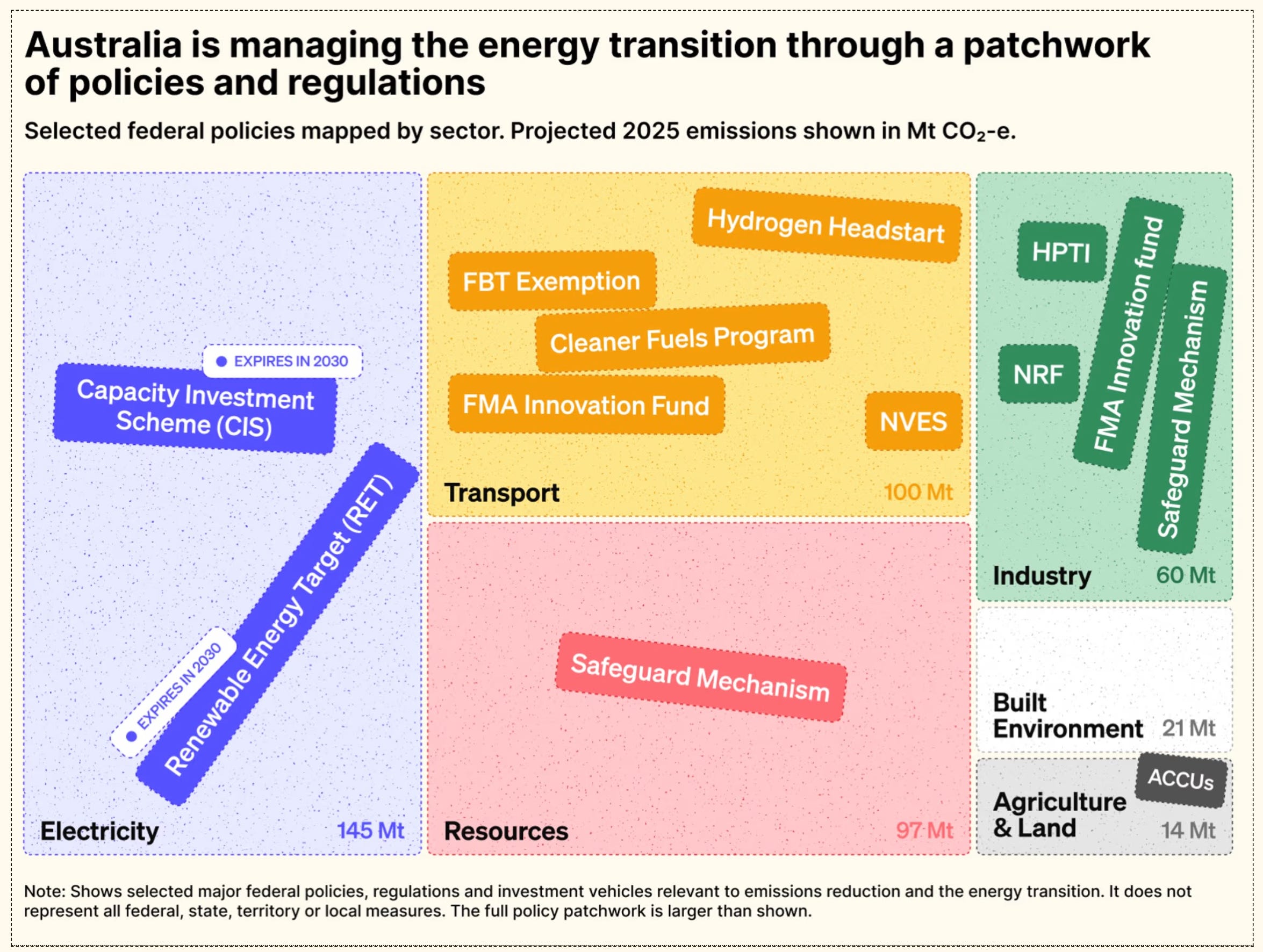
At the centre of the patchwork sits the Safeguard Mechanism, designed by the Abbott Government and implemented by the Turnbull Government in 2016. It covers about 30 per cent of emissions, all outside the electricity sector. 208 facilities with annual emissions above 100,000 tonnes are subject to product-based emissions ‘baselines,’ which ratchet down each year.
Despite Minister Bowen exerting serious effort, under difficult constraints, to strengthen the mechanism, emissions cuts have been too slow. From 2023-24 to 2024-25, they were less than half the rate required to achieve Australia’s target of a 43% reduction in emissions by 2030 (relative to 2005).
The Safeguard Mechanism is administratively costly, relying on extensive government oversight and imperfect judgements. The regulator calculates product-specific emissions-intensity values, often expressed to four or five decimal places, which are used to calculate facility baselines across around one hundred products—from distilling grain to steel products. The difference between one baseline and another can determine whether millions of dollars flow to or from a facility. Errors, large and small, are inevitable. Lobbyists will enlarge them, harming some industries and delivering windfalls to others.
The scheme is also complex for business. Firms must forecast changing baselines, manage emissions and compliance obligations across multiple facilities and products, and plan major investments against an administrative framework that, because of its complexity, will continue to require intervention.
Reducing emissions at the lowest cost is, at its core, about resolving a coordination problem. Some emission reductions are cheap and should come early; others remain difficult and expensive and should be delayed until technologies improve. Each household and firm knows more than government about its own circumstances, constraints, and the cheapest opportunities to reduce emissions.
A patchwork approach requires the Government to guess how much it would cost each business and household to decrease their emissions. The government imposes “shadow” carbon prices across the economy. In a least-cost system this signal would be the same strength everywhere, leveraging the private information individuals have about their own situations and allowing them to make their own choices. Under patchwork policies the transition signal varies by orders of magnitude.
The effective shadow price has been as high as $20,000 per tonne of CO2e in the case of the EV fringe benefits tax exemption, up to $274 for biofuel excise concessions, around $41 for NSW household energy efficiency upgrades, and zero dollars for many upgrades in the majority of businesses that are too small to be covered by the Safeguard Mechanism. Many easy, low-cost opportunities to switch from old to new energy sources are neglected, while others are mandated too early, at much higher cost than is necessary.
Then there is the question of fairness: who bears the cost of the transition under different policies? Under the current patchwork, costs are passed through the economy in opaque ways. Firms facing compliance obligations will pass on what costs they can to customers; governments fund subsidies and programs through general taxation; and households ultimately bear a significant share of costs through both price changes and taxation. But because these costs arise from different schemes, with different mechanisms, different coverage, and implicit carbon prices that vary and are often unknown, the household impact is extremely difficult to assess.
Not only does the current policy patchwork make it difficult to observe how much compensation households require, but it provides no means for funding that compensation. None of its elements raise meaningful revenue and some come at great cost to the federal budget. Although it is possible to protect households’ welfare through the energy transition, it does mean governments need to be able to generate and distribute revenue without weakening the budget or stoking inflation. Amid a cost-of-living crisis, current policies make the transition harder to sustain politically and less fair to Australians.
As the Safeguard Mechanism falls under review later this year, we have an opportunity to ask not only how the existing patchwork might be refined, but whether alternative approaches may better coordinate the transition, raise revenue, and deliver a fairer outcome for Australians.
Australia needs a fairer, system-wide signal
If the problem is coordination, the solution must provide it. The mechanism we propose is the Polluter Pays Levy (PPL). It is a simple upstream levy on the carbon contained in fossil fuels, applied at the point where these fuels enter the economy. In the case of coal and gas, this is at the point of extraction from the ground; in the case of petrol and diesel, it is mainly at the point of import. For example, a company mining a tonne of black coal would pay a levy reflecting the 2.5 tonnes of carbon dioxide that will be released when that coal is combusted to generate electricity.
The combustion of fossil fuels creates nearly 80 per cent of Australia’s emissions, so the PPL provides the system-wide price signal that the transition needs.
The PPL is not an additional cost on households and businesses on top of the status quo; rather, it is a replacement for the patchwork, and its purpose is to be a lower-cost and fairer way of achieving the same net-zero goal, while helping to address some of Australia’s most difficult challenges. Higher costs to households and businesses occur under the patchwork – they are just harder to identify.
There are two main reasons this design will raise efficiency and lower costs.
First, it provides a consistent price signal across sectors, not a basket of signals determined case-by-case for each sector. A price on fossil fuel carbon allows the lowest-cost transition pathway to emerge from millions of decisions made by the people and firms who actually know their costs.
Second, it is administratively straightforward: a simple levy applied to a small number of firms will cover 80 per cent of Australian emissions. There are no complex rules to design or enforce, so little opportunity for firms to game those rules or lobby for special treatment. Nearly all of the firms covered by the Safeguard Mechanism would not be regulated under the PPL; they would simply face the price signal through their costs of fuel. The administrative cost savings would be significant.
The PPL will also be fairer. The levy falls first on fossil fuel producers and importers. Some of that cost will be passed through to businesses and households, especially in the short term. How much is passed through depends on three factors. First, the size of economic rents, or excess profits, enjoyed by these firms. Second, the “elasticity” of energy demand, or how much these firms can raise fossil fuel prices without losing sales. And third, the degree to which the levy drives efficient substitution away from fossil fuels and towards cheaper alternatives. Large rents, and high long-term elasticities, mean that pass-through will be partial for both the Safeguard Mechanism and the PPL.
For the third of these factors, the PPL has an advantage. It increases the price of fuel directly, creating a clear signal to which businesses respond. The Safeguard Mechanism creates a diffuse compliance obligation that must be reinterpreted by the firm as an effective increase in the price of fuel — and that interpretation may often not occur, or may occur imprecisely. It is more likely to leave costs sitting as overhead, lower margins, or higher consumer prices. To the extent that this produces weaker substitution away from fossil fuels, more of the cost of the Safeguard Mechanism is borne by households and downstream businesses, and less falls on fossil fuel rents.
A central feature of the PPL is that it generates a predictable stream of revenue. This is integral to the design: the same mechanism that raises costs also generates the means to offset them.
We propose using this revenue to protect households through two payments.
The first is a Household Compensation Payment (HCP), designed to cover the direct increase in energy costs for the share of the PPL that is passed on to households. It is consistent with Treasury and Grattan Institute expectations about how much households will electrify their homes and transport over time, reducing their use of fossil fuels and therefore the need for compensation over time.
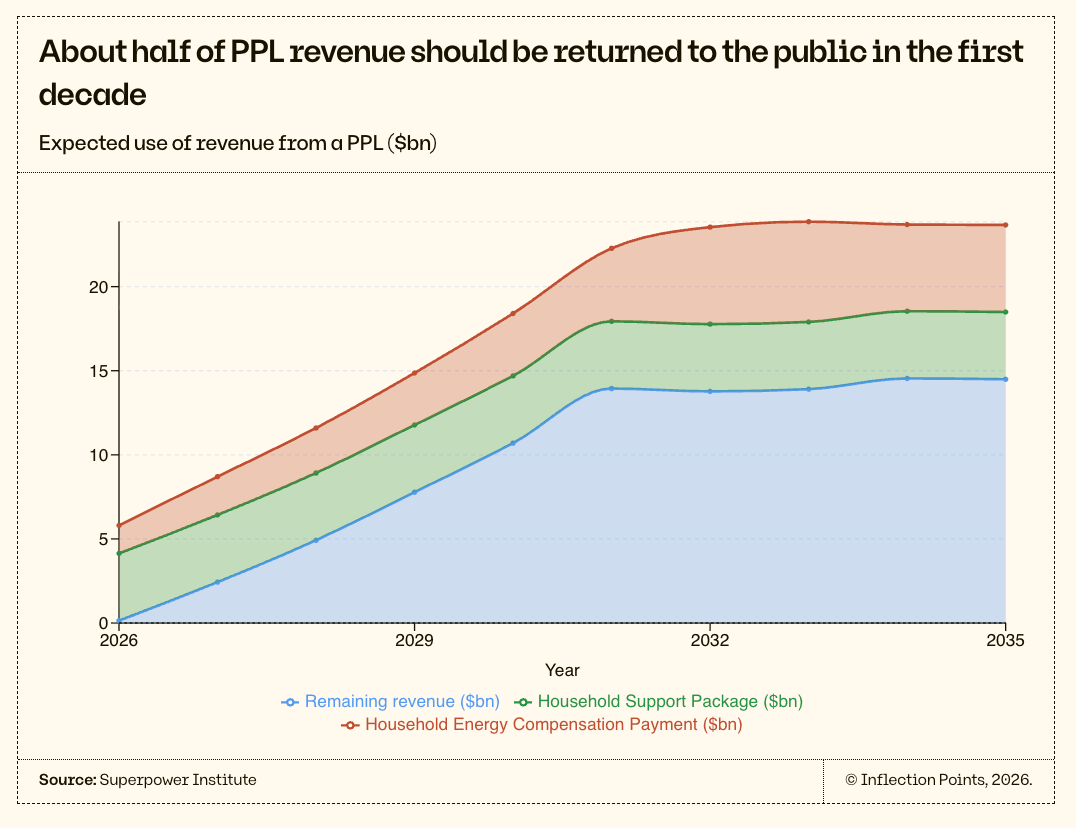
The HCP would be worth an estimated average of $4.1 billion each year through to 2050 – or $330 per household each year, delivered as a quarterly lump-sum ‘PPL payment’.
The second is a Household Support Package (HSP), designed to provide additional support for households facing practical and financial barriers to electrification, and for households with lower incomes that spend a larger share of their income on energy. We propose this additional payment in a package valued at an additional $4 billion each year for the first decade of the PPL. It would be worth $490, initially paid to the bottom 75% of households by income, becoming more targeted over time.
The HCP and HSP payments would initially provide around $820 a year to the large majority of households. This should fully compensate, or over-compensate, the large majority of those households for the direct increase in energy costs.
Taken together, the Household Compensation Payment and Household Support Package would return nearly all PPL revenue to households in the first year, and about half over its first decade. This design preserves the economic signal to reduce emissions, while ensuring households are not left carrying the cost of the transition.
Revenue could also be used to provide a Small Business Energy Compensation Payment of $325 for an estimated 1 million small businesses.
Even after compensating households and businesses, PPL revenues leave billions to either provide further support, help pay for healthcare, education, housing, and infrastructure, or help pay down the debt—and so reduce other tax burdens on households.
The PPL combines two crucial elements that are missing in the current approach: a system-wide signal to better coordinate the transition, and a fiscal mechanism to manage its distributional effects. That combination provides the foundation for a transition that is simpler, more coherent, and more durable than Australia’s current path.
The positive payoff for getting carbon pricing right
Implementing the PPL would help to ease the major challenges confronting Australia today: the immediate cost of living crisis, strain on the budget, exposure to international fossil fuel shocks and the longer-term energy and industrial transition.
Let us begin with the cost of living. Treasury and various other analysts expect that moving away from fossil fuels will ultimately leave households substantially better off, with energy bills to fall by between $700 and $4,300 compared to today. Whether it occurs through the Safeguard Mechanism or the PPL, the transition will involve some costs in the meantime. Because the PPL achieves emissions reductions at lower overall cost than the Safeguard Mechanism, it places less upward pressure on prices across the economy. Our proposed Household Compensation Payment and Household Support Package would more than offset expected price increases for the large majority of households, with additional funds available to support electrification. General equilibrium modelling indicates that the PPL would lift national consumption compared to the Safeguard Mechanism.
Even when transition policies subsidise new energy sources, rather than increasing the cost of fossil fuels, households still bear the cost. This is because subsidies require higher taxes – or for the government to find savings from aged care, disability care, healthcare, social services, and other programs. These costs are not captured by cost-of-living measures, but are felt by all Australians.
It is fortunate, then, that the second payoff from a PPL is fiscal. The existing approach places significant demands on the budget without raising revenue. The PPL would allow much of the policy patchwork to be wound back—including the Safeguard Mechanism – while raising an average of $22 billion in revenue each year. This will give government the fiscal headroom to fund compensation, support productive investment, and to fund spending in areas such as housing, health, education, and infrastructure.
The third payoff is greater protection from fossil-fuel shocks. Australia imports at least 80 per cent of its liquid fuels, and domestic gas prices are linked to international oil and gas prices through LNG exports. As recent events have shown, this leaves the economy extremely vulnerable to supply disruption. The PPL will accelerate electrification—both through incentives created by the price signal and the judicious use of revenue—and so reduce that exposure over time, bringing forward the shift to an energy-secure economy.
The fourth payoff is that the efficient PPL supports other national objectives, including industrial policy. Fossil fuel export revenues are vulnerable, with the International Energy Agency observing that international commitments are consistent with a 50 per cent reduction in fossil fuel consumption by 2050, and announced pledges with an 80 per cent reduction. Emerging green export industries offer a more durable revenue source: Australia can produce green iron, green aluminium, green fuels, and various other products using its abundant renewable resources. By encouraging the transition from fossil fuels to new energy sources, the PPL better aligns domestic price signals with Australia’s export opportunities.
Finally, there is climate mitigation. Lower-cost abatement means that more emissions are cut for any given economic sacrifice. Modelling employing the widely used “Victoria University Regional Model” computable general equilibrium model suggests that the PPL will nearly triple the emissions reductions of the current Safeguard Mechanism to 2035—with lower costs to households and the economy.
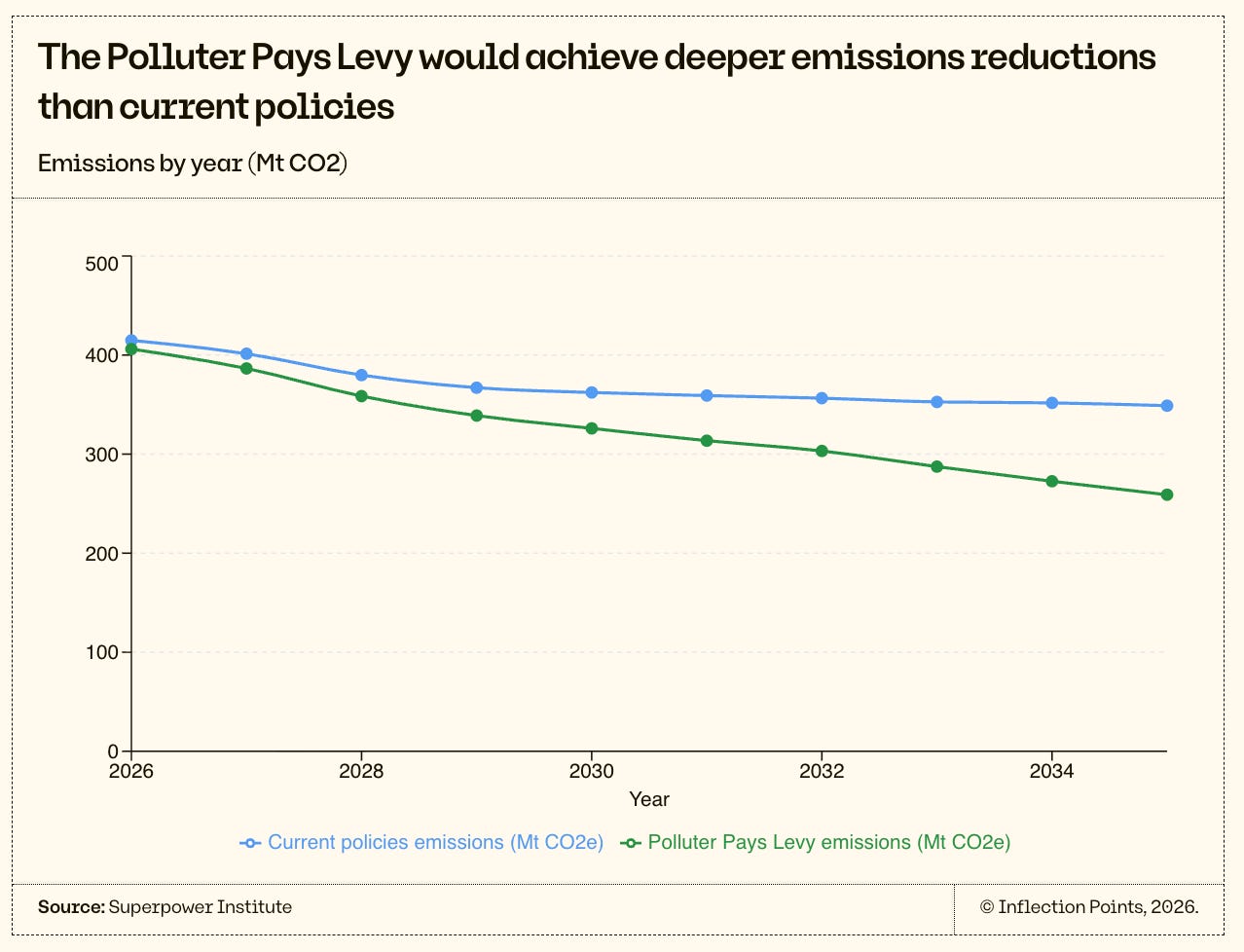
The PPL improves the chances that Australia will meet its targets, and it makes those targets easier to sustain politically. Progress on climate change becomes less fragile when the underlying policy is simpler, cheaper, and fairer.
These benefits answer the question posed at the start of the article. A better transition framework would leave Australia with lower overall costs, stronger public finances, less exposure to fossil-fuel shocks, better prospects for new industries, and a more credible path to net zero. It would achieve all this while leaving most households better off. These outcomes are worth working for.
The politics of carbon pricing have changed
Our PPL proposal is usually met with the question, ‘But what about the politics?’
It is a fair question. Carbon pricing in Australia has a troubled history. Then-Prime Minister Howard, of the Liberal-National Coalition, first announced a carbon price in 2007, to be implemented with a 2012 emissions trading scheme. After the 2007 change in government, Labor came close to legislating an emissions trading scheme in 2009, then successfully introduced a carbon price under the Gillard Government in 2012. In 2013 the Coalition won office, and in July 2014 the carbon price was repealed.
The short life of Australia’s first carbon price still shapes assumptions about what is politically possible. But the lesson of Labor’s defeat in 2013 is not so straightforward.
The carbon price was caught up in a broader collapse of political authority: between 2010 and 2013 the party devoted itself to self-destructive leadership battles, with Gillard ousting then-Prime Minister Rudd as leader in 2010, before the party returned Rudd to the leadership before the 2013 election. This back-and-forth conflict created two problems for the carbon price. The first was that internal politics demanded politicians’ attention at the expense of policy leadership and stewardship. The second was that the Australian public resented the political chaos.
The combined effect was that the carbon price did not have a chance to thrive, and it was tainted by association. The electorate voted out the government associated with the carbon price; it did not settle, for all time, the question of whether Australians could support a well-designed price on pollution. Any serious proposal today must learn from that experience, without treating it as a permanent veto on good policy.
There are real political challenges. Now, as in 2013, voters are concerned about the cost of living. A necessary, but not sufficient, condition for political success is a fair compensation and support package. But success will also depend on political leadership, and a willingness to bring voters on board with three truths: the energy transition is in Australia’s collective interest; the transition will create costs for households and small businesses, with policy choice determining the magnitude and distribution of costs; and a carbon price is lower-cost than a patchwork approach, and its revenues can make sure no households are left behind.
Immediate pressures facing Australia— fossil fuel volatility, fiscal weakness, and the cost of living—make this a better moment to revisit carbon pricing. As we have argued, the PPL performs better on each of them.
But deeper political changes also open a pathway to success.
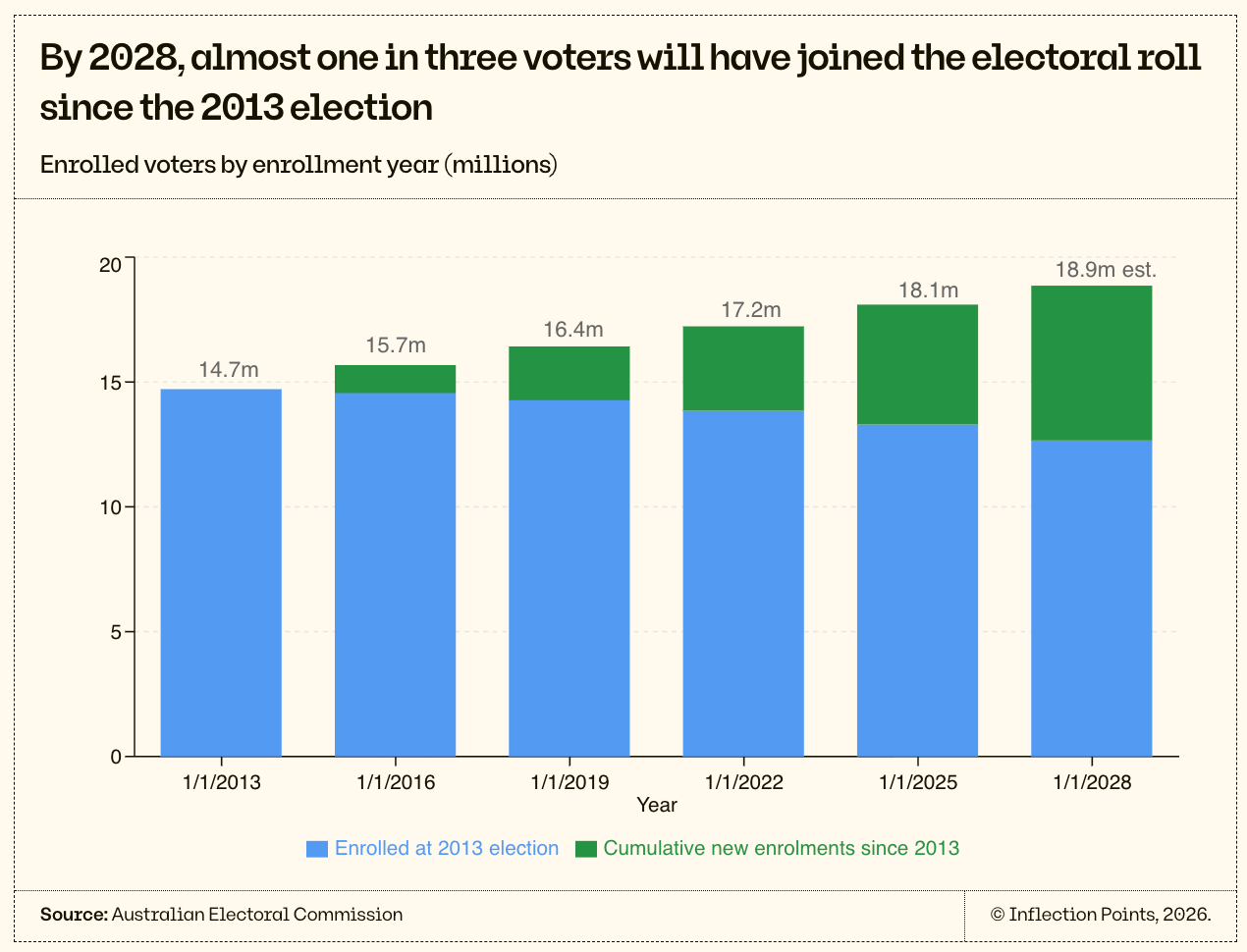
The electorate that rejected the government associated with the carbon price in 2013 is not the electorate that will vote in 2028. The 2025 Australian Election Study found that Millennials and Gen Z already made up 42 per cent of the 2025 electorate, and that Millennials, Gen Z and the first Gen Alpha voters will be very close to constituting a majority by the time of the next federal election in 2028.
These cohorts are not behaving like younger versions of older voters: Millennial support for the Coalition has fallen from 38 per cent in 2016 to 21 per cent in 2025, defying the old assumption that voters reliably drift conservative as they age. With this generational renewal, the political memory of Australia’s previous carbon price debate is fading. At the next federal election in 2028, there will be at least 6 million voters turning up to the polls who did not vote in 2013. For these voters, the debates that still haunt many policy makers are not lived memory. The electoral baggage around carbon pricing is lighter than the political class assumes.
More recent evidence on public attitudes also provides a compelling case for reconsidering carbon pricing. Research by Redbridge Group in November 2025 found strong support for a polluter pays mechanism. When voters were asked whether the Australian Government should introduce a Pollution Levy on the country’s 100 biggest polluting companies, which collectively account for around 80 per cent of Australia’s emissions, support was broad: 66 per cent in regional NSW, Vic and QLD agreed with the proposal, compared with 20 per cent who disagreed. Across the rest of Australia, 69 per cent agreed.
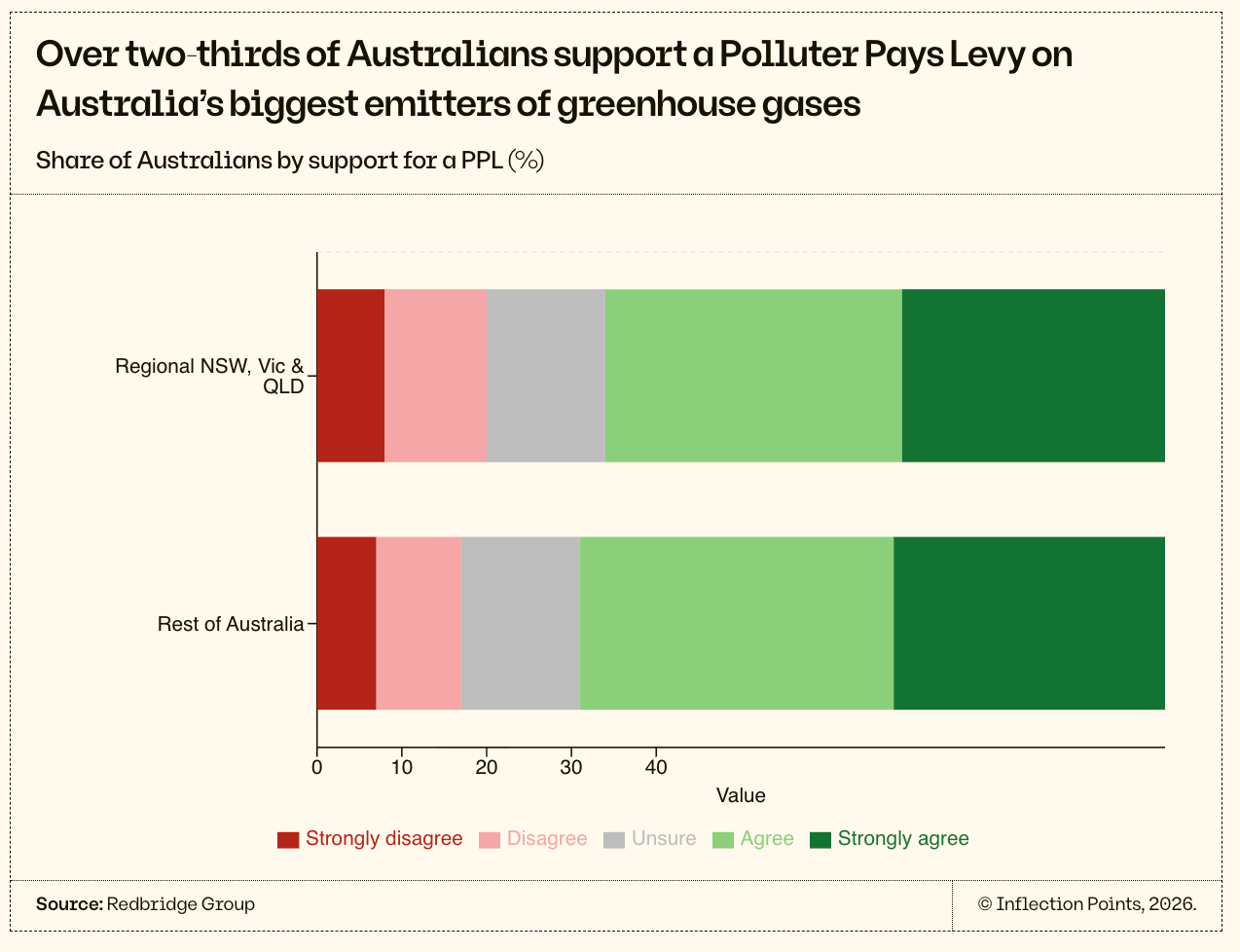
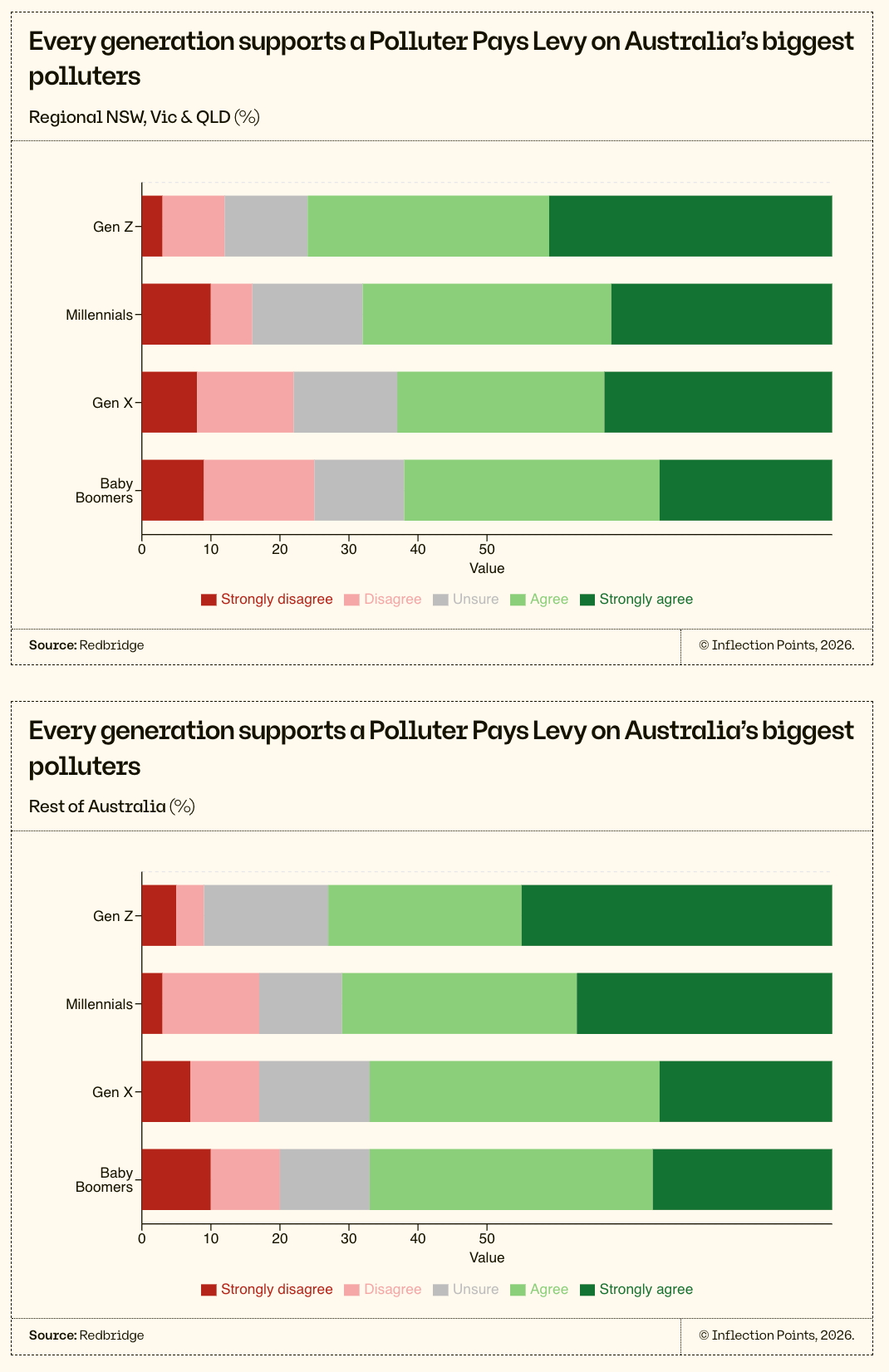
Support was not confined to Labor and Greens voters. A majority of Coalition voters also supported the proposal, with 54 per cent of Coalition voters in regional NSW, Victoria and QLD agreeing. Even Baby Boomers recorded clear net support. Importantly, these questions were asked without providing any context on the compensation that would be paid to households and small businesses. A package that bundled generous compensation with a carbon price can reasonably be expected to motivate even stronger support.
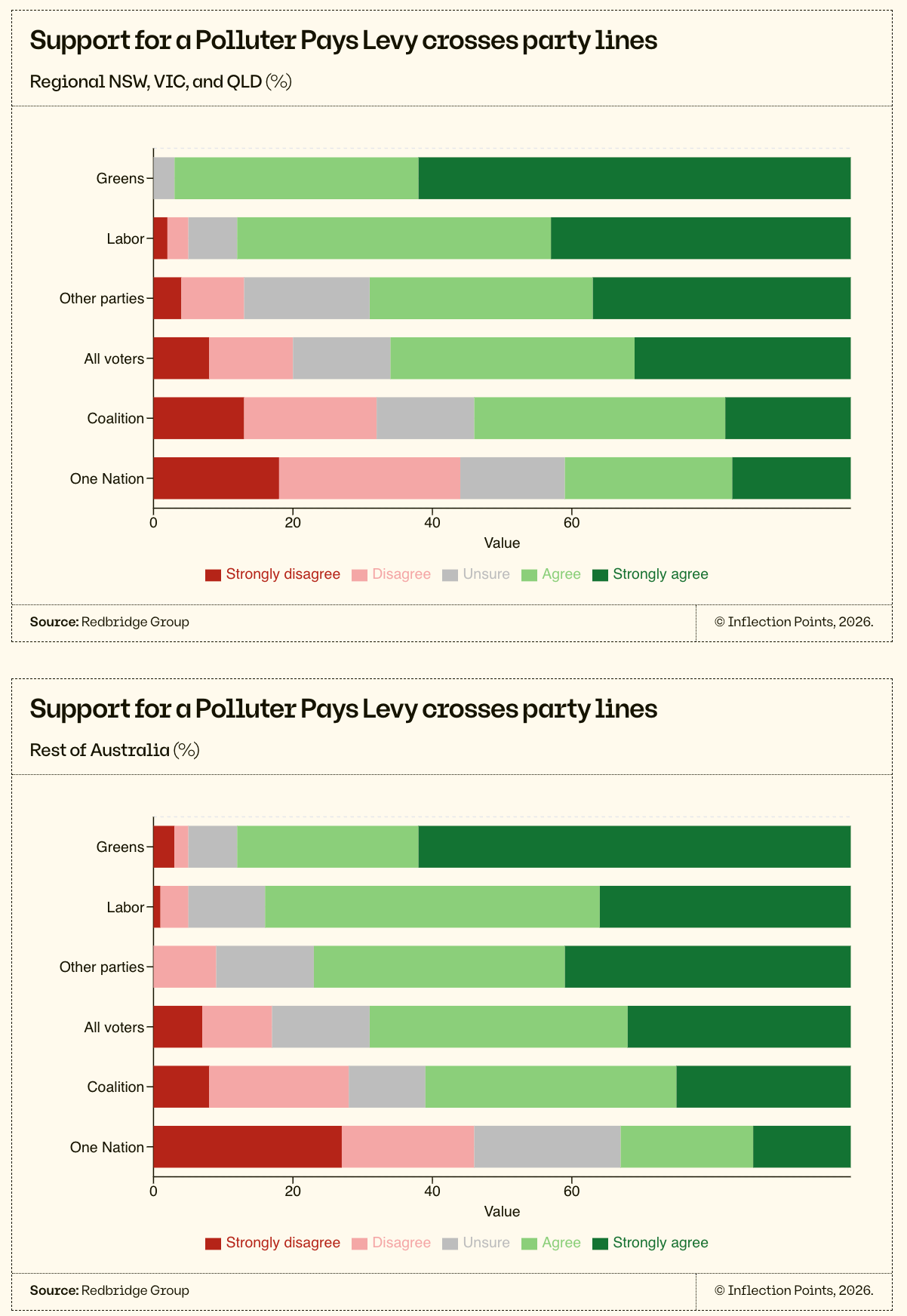
The conclusion is not that carbon pricing has become easy politics. It has not. But the political conditions that undermined the last carbon price should not be treated as fixed. A carbon price that lands first on the firms most responsible for carbon emissions, paired with transparent compensation and visible public benefit, can escape the shadow of the past.
Stepping up to the challenge of change
The current oil shock is a timely warning. Australia’s exposure to fossil fuels is not confined to emissions – it reaches into household budgets, business costs, public finances and energy security. A country rich in renewable energy resources should not be so vulnerable to global fossil fuel prices. Nor should it rely on a policy patchwork that hides costs, raises no revenue, and leaves households unsure who is paying the bill.
Australia does not have to choose between cutting emissions, strong public finance, and fair protection for households. A better policy framework can do all three. The Safeguard Mechanism review is a chance to ask whether Australia keeps taking the long way around, or moves toward a simpler, fairer system that lowers the cost of the transition and strengthens the country that emerges from it.
Ingrid is the Economic Research Director at The Superpower Institute.
Reuben is the Research Lead for Economic Pathways at The Superpower Institute.